
Marian devotion
Panagia Axion Estín
Marian vocation of Karyés (Athos) (Mount Athos)
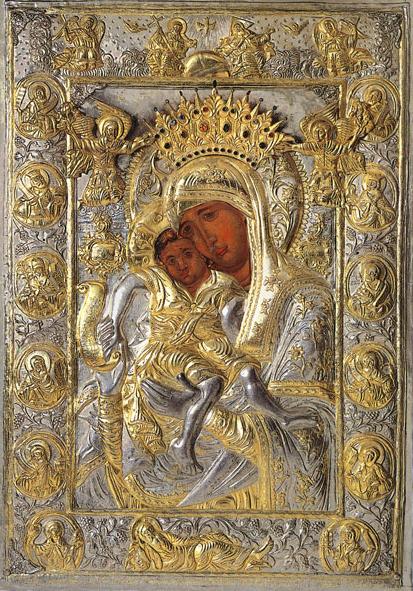
According to the athonite tradition, towards the year 982 an old monk lived in a cell near Karyés, monastic capital of Mount Athos, next to a young monk. One Saturday night, while the old man was absent, a mysterious monk visited the cell and joined the young man in the song of the trade in honor of the Mother of God before an icon of the Theotokos. When he arrived at the hymn "More venerable than the cherubim..." the unknown added a new initial words: "It is truly worthy to bless you, O Theotokos..." thus composing the full text of today's famous "Axion Estín" hymn. When the young man expressed his desire to keep those words in writing, the stranger drew them, according to the legend, miraculously on a stone slabwho softened "like wax" under the tip of his finger. Then it revealed to be an angel sent by God and disappeared. The icon before which it had been sung became venerated as Panagia Axion Estín, "Our Lady" is Digno. "
Main data
Origin and history
According to the athonite tradition, towards the year 982 an old monk lived in a cell near Karyés, monastic capital of Mount Athos, next to a young monk. One Saturday night, while the old man was absent, a mysterious monk visited the cell and joined the young man in the song of the trade in honor of the Mother of God before an icon of the Theotokos. When he arrived at the hymn "More venerable than the cherubim..." the unknown added a new initial words: "It is truly worthy to bless you, O Theotokos..." thus composing the full text of today's famous "Axion Estín" hymn. When the young man expressed his desire to keep those words in writing, the stranger drew them, according to the legend, miraculously on a stone slabwho softened "like wax" under the tip of his finger. Then it revealed to be an angel sent by God and disappeared. The icon before which it had been sung became venerated as Panagia Axion Estín, "Our Lady" is Digno. "
As for the documented historythe sources agree that the Axion Estín icon is located since ancient in the church of Protatonthe main temple of Karyés and liturgical seat of the protos (primate) of the monastic community of Mount Athos. The anthem "Axion Estín" appears firmly rooted in the Byzantine liturgy as part of the Ordinary of the Divine Liturgy and the Office, and is one of the most beloved Marian texts of Eastern Christianity. The exact allocation of the date 982 and the details of the angel episode belong to the Pious tradition, transmitted in the athonite accounts, while the existence of the icon and anthem in the Church's cult are strongly attested by liturgical practice and subsequent historical testimonies.
The image and the sanctuary
El icono Panagia Axion Estín es un Orthodox icon of the Theotokos (Mother of God), of a traditional Byzantine type. It is venerated in the church of Protaton de Karyés, considered the oldest and most main temple on Mount Athos. The icon shows the Virgin Mary with the Child Jesus, following the sober and theologically loaded style of the athonite iconography; the sources describe its miraculous and deeply venerated character, although they do not always detail in detail all the iconographic elements (gestures, exact disposition of the Child, etc.), which correspond to the usual language of the Marian icons.
El Protaton is the central church of the administrative capital of Mount Athos and no consta having a title of minor basilica or national sanctuary, since Mount Athos enjoys a unique canonical and civil status as Autonomous monastic republic within Greece. The temple also houses important frescoes and other icons, and performs liturgical functions for the whole of the Athonite community, especially in the great solemnities. Within this context, the Axion Estín icon occupies a place of honor and is considered one of the most significant spiritual treasures of Athos.
Sponsorship and coronation
In the Orthodox tradition, the Panagia Axion Estín is venerated as one of the main protectors of Mount Athos and, in a broad sense, as Mother and protector of the Christian people who pray with the anthem "It is truly worthy." The anthem Axion Estín has spread throughout the Orthodox world and, increasingly, also in Catholic environments interested in Eastern spirituality; however, no consta a Specific canonical patronage on a diocese, city or nation in the usual Latin legal terms (for example, "principal patron of..." endorsed by the decree of the Holy See).
On a canonical coronation, no pontifical decree or formal Latin-mode coronation ceremony appears in the sources for this icon. In the Orthodox field, icons are often represented with crowns or rich ornaments as an expression of veneration, but this does not necessarily amount to a canonical coronation according to the discipline of the Latin Catholic Church. Therefore, with accessible data, does not contain a documented canonical coronation.
Party and devotion
The Athonite tradition celebrates a specific commemoration of the miracle of Axion Estín el 11 June (Gregorian calendar), or on the corresponding date according to the liturgical calendar followed by each Eastern Church. On that day the event of the angelic song of the anthem is remembered and the icon is given special veneration in the Protaton and in various monasteries of Mount Athos.
Mount Athos, like Monastic Republic with restricted access, receives a constant flow of male pilgrims - mostly Orthodox, but also Catholic and other confessions - who come looking for retreat, confession and participation in the liturgy. Among the most visited places are Karyés and his Protaton church, where pilgrims have the opportunity to venerate the Axion Estín icon when monastic discipline allows. Devotion is expressed above all by:
– El canto del anthem Axion Estín en la liturgia y en la oración personal. – La veneración del icono con incensación, besos e iluminación con lámparas de aceite. – La difusión de copies of the icon in parishes and homes, especially in the Orthodox world.
Detailed annual flow figures specifically linked to this icon are not available in the general sources, but their Central spiritual importance in athonite piety and its wide spread throughout all orthodoxy.
Link to the Rosary
The sources consulted do not mention a direct historical or liturgical relationship between the invocation Panagia Axion Estín and the prayer of Rosary As such. The Rosary is a form of prayer typically developed in the Latin sphere, while the anthem "Axion Estín" belongs to the heritage of the Byzantine liturgy and is primarily associated with the celebration of the Divine Liturgy and the Office.
However, from a theological and spiritual perspective, both realities converge into the same ecclesial attitude: bless Mary for his divine motherhood and his intimate participation in the mystery of Christ. The hymn "It is truly worthy to bless you, O Theotokos..." expresses in the eastern key what the Rosary does in the western key: a repeated, contemplative and entrusted praise to the Mother of God, which leads to a deeper union with the Lord. Thus, for a faithful Catholic who prays the Rosary, devotion to Our Lady "Axion Estín" can enrich the meditation of mysteries, recalling Mary's common confession as Theotokos and linking the Marian love of East and West in the same praise to Christ.
A flower for the Virgin
Offer a simple prayer to this Marian devotion. Pray a Hail Mary for Greece and for world peace.
Pray Hail MaryIs the advocation of the Virgin Mary of your people missing?
Si no encuentras la advocación mariana de tu ciudad o pueblo, cuéntanosla: la investigaremos para ubicarla y darla a conocer en este mapa del amor de la Madre por el mundo.
Propose an apvocation →