Marian worship
Santa Catalina Labouré
Vente de la rue du Bac · la Medal Miraculous (Paris, 1830)
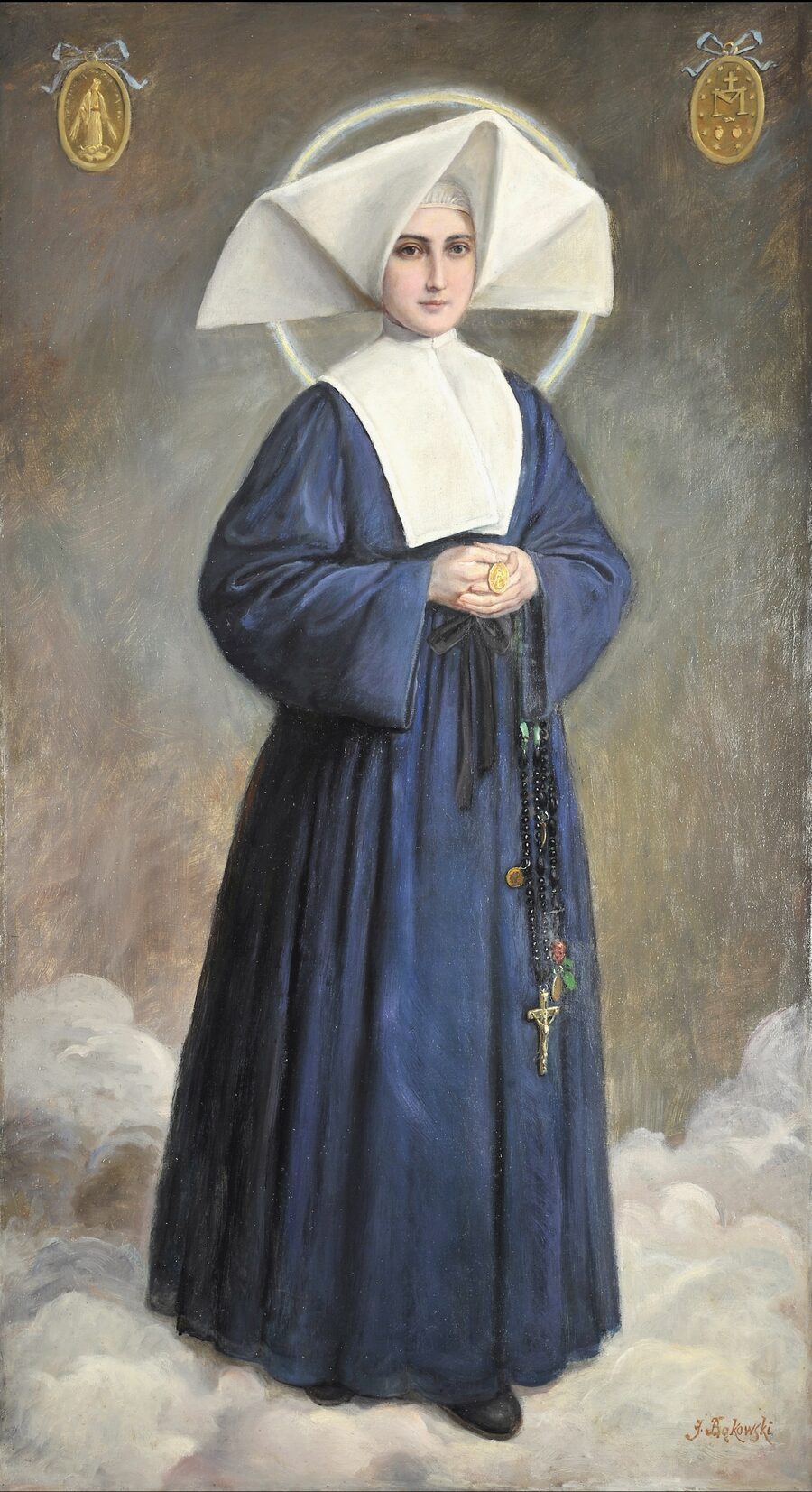
A humble Daughter of Charity to whom the Virgin appeared in Paris in 1830, sitting by her side to speak to her "as a mother speaks to her daughter," and asked her to coined the Miraculous Medal.
Who was that?
Catalina Labouré (Catherine Labouré) was born on 2 May 1806 in Fain-lès-Moutiers, a peasant village in Burgundy, in a large family; she was orphaned as a child. On 22 January 1830 he entered the Daughters of Charity of San Vicente de Paul, and on 21 April he was sent to the novitiate of Paris, at rue du Bac, 140. His life was externally very ordinary - domestic work, service to the elderly and sick, community life - marked by humility, silence and obedience that his contemporaries emphasized. He kept the secret of the apparitions almost all his life; only in the end he trusted him. He died on December 31, 1876 in Paris; he was beatified by Pius XI in 1933 and canonized by Pius XII in 1947.
The Apparitions of 1830
A few days after reaching the novitiate, Catalina lived the solemn transfer of the relics of Saint Vincent of Paul to Paris (25 April 1830), which prepared the spiritual climate of that year, considered the beginning of the "era of Mary." The Vincentian tradition includes three great meetings with the Virgin between July and December 1830, in the chapel of the rue du Bac. On the night of 18-19 July, awakened by a glowing child, Catherine went down to the chapel and found the Virgin, who sat on the chair of the spiritual director and spoke with her long.
The words of the Virgin
The story that Catherine entrusted to her spiritual director shows that the Virgin spoke to her with maternal tenderness of her mission and of the times of trial for France and the Church, promising her protection to those who came to her. Catherine herself said of that encounter that the Virgin spoke to her "as a mother speaks to her daughter." In the second apparition, on November 27, 1830, during the prayer of the novices, she saw the Virgin standing on a balloon, crushing the head of the serpent, with the hands extended from those who sprout rays of light. Around the image a inscription appeared in letters of gold: "O Mary, without sin conceived, pray for us that we turn to you." Then the Virgin asked him, "Make a medal coined according to this model; the people who carry it with confidence will receive great graces." The picture turned and showed the reverse: the letter M crowned by a cross and, below, the hearts of Jesus and Mary.
Anecdotes and afterlife
Catalina transmitted the assignment to her confessor, Father Aladel, who at first doubted; only two years later, in 1832 - in the middle of the cholera epidemic in Paris - the first medals were coined, whose rapid dissemination and the favors attributed to it were used to the popular name "Miraculous Medal." Faithful to her desire for concealment, Catherine never wanted to be known as the seer: she spent forty-six years humbly serving in the Inghien-Reuilly hospice, caring for the elderly and the doorway, with almost no one suspected her secret. Only a few months before he died he revealed it to his superior. When his body was exhumed in 1933, he was incorruted; today he rests in the chapel of the rue du Bac.
Fruit
Of those apparitions was born one of the most widespread Marian devotions in the world: the Miraculous Medal, spread by hundreds of millions. The chapel of the rue du Bac is now one of the great places of pilgrimage in Paris. The 1830 message - the subsidiary trust in Mary, Immaculate and Median of Graces - also prepared the way of the dogma of the Immaculate Conception, proclaimed in 1854.
Is the advocation of the Virgin Mary of your people missing?
Si no encuentras la advocación mariana de tu ciudad o pueblo, cuéntanosla: la investigaremos para ubicarla y darla a conocer en este mapa del amor de la Madre por el mundo.
Propose an apvocation →