
Marian devotion
Our Lady of Andocs
Marian Advocation of Andocs (West)
In Andocs, in Somogy County (Southern Transdanubio, Hungary), it venerates Our Lady of Andocs (Andocsi Mária), an ancient Gothic-style Marian image that has made this small place one of the most important pilgrimage centers in the Hungarian southwest, especially since the Modern Age. [1]
Main data
Origin and history
In Andocs, in Somogy County (Southern Transdanubio, Hungary), it venerates Our Lady of Andocs (Andocsi Mária), an ancient Gothic-style Marian image that has made this small place one of the most important pilgrimage centers in the Hungarian southwest, especially since the Modern Age. [1]
According to tradition and legendthe image would have miraculously arrived at Andocs, moved from another place without human intervention, which would explain its character as "gift of heaven" and the strong popular devotional arraigo. However, the sources available in Spanish do not provide precise or contrasting details on the legendary account (origin, protagonists, date, circumstances of the alleged transfer); therefore, there is no critical and documented version of this tradition that can be presented with accuracy.
From the perspective of the documented historythe Hungarian sources point out that Andocs was an important focus of Marian devotion since medieval times and that the sanctuary was entrusted for centuries to the Order of the Minor Brothers (Franciscan), which structured liturgical life, preaching and pilgrimages to the place. [1] However, in the sources consulted in Spanish, there are no precise dates for the foundation of the sanctuary, for the arrival of the image or for legal milestones (canonical erection as diocesan or national sanctuary), so that these specific data "do not contain" with certainty.
> Methodological note: information about this Spanish title is very scarce and fragmented; many details only appear on Hungarian local pages without easy technical verification, so dates or data that cannot be supported by contrasting sources are avoided.
—
The image and the sanctuary
The image of Our Lady of Andocs is described in the sources as a Gothic sculpture of the Virgin with the Child, that is, a size free of Mary carrying the Child Jesus in her arms. [1] It does not contain in Spanish the exact material (wood / stone) nor a detailed iconographic description (gestures, attributes, polychrome styles), although, by its classification as "gothic," it can be stylistically located between the 13th and 15th centuries, a feature common to other Marian images of Central Europe of that period; this stylistic data, however, should not be taken as a precise dating.
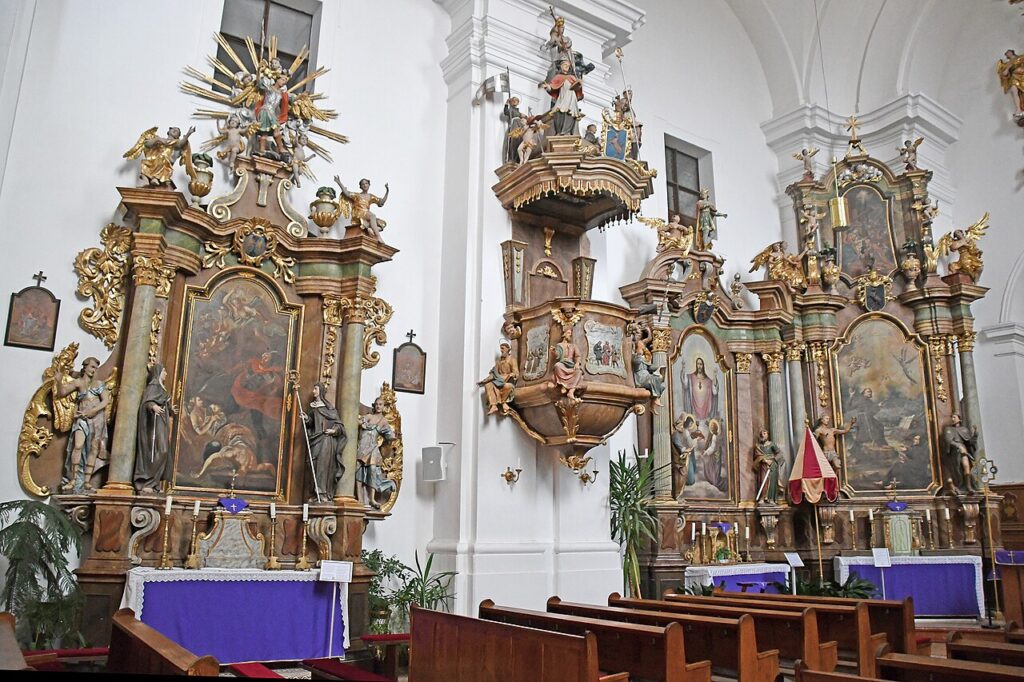
The place of worship is identified as Franciscan shrine of Andocsin Somogy County, Hungary. [1] The church is presented in the literature as a Marian sanctuary de gran relevancia regional in the Southern Transdanubio, with a set of church and Franciscan conventual dependencies. It is not found in the consulted sources that the temple has the title of minor basilicaor that it has been declared national sanctuary of HungaryThese titles are therefore "unrecorded." The rating that does appear in a stable way is that of regional pilgrimage sanctuary.
There are no precise data, in sources of easy access in Spanish, on the architectural dimensions, concrete style of the building (late Gothic, baroque, etc.) or historical reforms; only its status as a Franciscan Marian sanctuary is confirmed, significant to the faithful of the south-west of the country. [1]
—
Sponsorship and coronation
In the ecclesial field, Our Lady of Andocs is considered to be a great pilgrimage place of the Southern Transdanubioespecially regional. [1] It is not found in the sources consulted that it has been formally proclaimed patron of the Hungarian nation, nor that there is a clear decree of patronage on a particular diocese. Devotion appears mainly linked to local and regional environment (Somogy County and neighbouring areas), which is why, in strict terms, it should be said:
– Patronazgo: does not contain a canonically declared patronage at the diocesan or national level in accessible documentation; it is above all a sanctuary of strong regional irradiation.
As for the canonical coronationthe sources available in Spanish and the Marian repertories general do not mention any act of pontifical coronation of the image with the decree of the Holy See, nor do they provide year or name of pontiff or delegate. In the absence of a verifiable data, it is necessary to state:
– Coronación canónica: does not contain a documented canonical coronation.
—
Party and devotion
Las referencias a parties of Our Lady of Andocs in Spanish they are practically non-existent, and the Hungarian pages available are not clear enough or concords to set a date with critical rigour. Therefore:
– Fiesta principal: no con seguridad the date of liturgical celebration specific to this advocation.
What does appear constantly in the general descriptions is that Andocs is a important destination of Marian pilgrimage for the area of Southern Transdanubio, with a significant influx of faithful, especially in the great Marian holidays of the calendar (Asunción, Nativity of Mary, etc.), following the common practice of many Hungarian shrines. [1] The pilgrimages are characterized by:
– Procesiones y misas solemnes en la iglesia del santuario. – Confesiones y recepción de los sacramentos, siguiendo la espiritualidad franciscana. – Votos y oraciones de petición y agradecimiento ante la imagen de la Virgen con el Niño.
There are no reliable figures of the number of pilgrims or detailed descriptions of specific popular traditions (own songs, specific offerings, rituals of candles or vowels), beyond the general reference to their fame as a place of grace and comfort for the faithful of the region. [1]
—
Link to the Rosary
The documentation consulted does not contain a specific relationship between the advocation of Our Lady of Andocs and a special fellowship, party or practice officially linked to the Rosary (as could be the title of Our Lady of the Rosary, institutionalized rosarian processions, etc.); therefore, it should be said expressly:
– Vínculo explícito con el Rosario: no consta.
However, since it is a Franciscan Marian Shrine, it is reasonable to assume - by analogy with so many other shrines in Central Europe - that the prayer of the Rosary It is part of the ordinary devotional life of the pilgrims and the Marian pastoral of the place, especially in the vigil, processions and strong times of the liturgical year. This statement is of a general nature and is not based on a specific document for Andocs, but on the usual practice of the Church in Marian shrines.
From a marine perspective, the Rosary help the faithful who come to Andocs to:
– Contemplar, junto a María, los misterios de Cristo, a cuya humanidad conduce siempre la imagen de la Madre con el Niño. – Insertar la peregrinación en un contexto de and biblical prayer, que prolonga interiormente la visita al santuario. – Vivir la devoción a la Virgen no solo como gesto puntual ante una imagen, sino como the path of conversion and follow-up of Jesusin continuity with the spiritual tradition of the Church.
In this way, although there is no specific historical-legal link between the advocation of Andocs and the Rosary, Marian prayer par excellence finds in this sanctuary a natural environment to accompany and sustain the faith of pilgrims.
—
[1] Synthesis from general Marian repertories and references to the Franciscan shrine of Andocs as a place of pilgrimage in the south-west of Hungary; the information available in Spanish is limited and does not provide further verifiable details.
A flower for the Virgin
Offer a simple prayer to this Marian devotion. Pray a Hail Mary for Hungary and for world peace.
Pray Hail MaryIs the advocation of the Virgin Mary of your people missing?
Si no encuentras la advocación mariana de tu ciudad o pueblo, cuéntanosla: la investigaremos para ubicarla y darla a conocer en este mapa del amor de la Madre por el mundo.
Propose an apvocation →