
Marian devotion
Our Lady of Bergen
Marian vocation of Bergen (Norway)
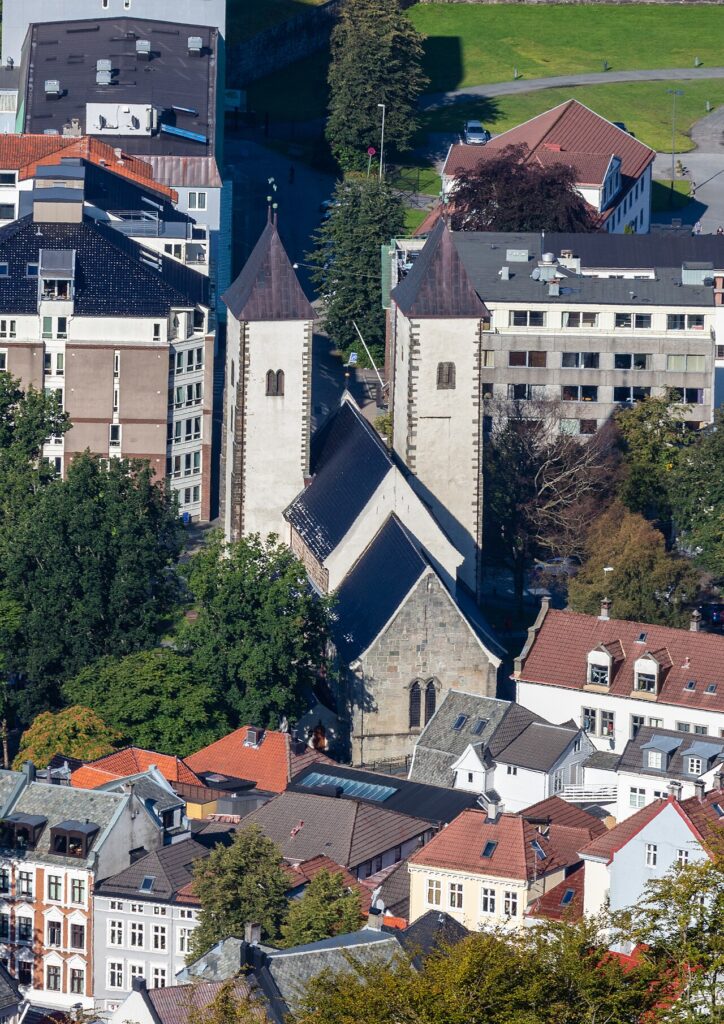
La church of Santa Maria de Bergen (Mariakirken) is a Roman temple of the 12th century, considered the oldest preserved building in Bergen. Architectural studies place its construction between approximately 1130 y 1170, and it is known to be the only medieval temple in the city that has come to this day without being left in ruins. In the Middle Ages it was part of the religious landscape of the Catholic city, when Norway still belonged to Western Christianity before the Protestant Reform.
Main data
Origin and history
La church of Santa Maria de Bergen (Mariakirken) is a Roman temple of the 12th century, considered the oldest preserved building in Bergen. Architectural studies place its construction between approximately 1130 y 1170, and it is known to be the only medieval temple in the city that has come to this day without being left in ruins. In the Middle Ages it was part of the religious landscape of the Catholic city, when Norway still belonged to Western Christianity before the Protestant Reform.
From the point of view documented history, it is known that the church was dedicated to Santa Maria, which reflects the centrality of Marian devotion in medieval Norway. From 1408 it became known as the “Alembian Church”, by becoming the church of the merchants of the Hanseatic League established in the district of the Bryggen pier; this role as a church of the Hanseatic community remained until 1766. After the Lutheran Reformation in Norway (16th century), the church passed to Lutheran veneration, however, preserving its ancient Marian advocation in the name and historical memory.
As regards tradition or legendthe available sources do not collect specific accounts of apparitions, miracles or prodigious foundations linked to "Our Lady of Bergen" in this temple. It does not contain a legendary tradition of its own comparable to other great European Marian shrines; Mariakirken's importance seems to be more rooted in its condition of ancient center of worship for Mary in the city and its historical continuity through the centuries. When certain authors speak of the "great Marian devotion" around this church, they do so mainly from their dedication to the Virgin and its relevance in the religious life of the medieval Bergen, rather than of concrete miraculous traditions.
The image and the sanctuary
La advocación de Our Lady of Bergen (Mariakirken) is linked to the very building of the Church of Santa Maria de Bergen, not to a single miraculous image documented. The current sources on the temple are concentrated in its arquitectura and in its artistic heritage, but do not accurately describe a specific Marian image (for example, specific Romanesque size or main cult image). The available documentation does not clearly contain the type, material or detailed iconography of a main image of the Virgin who is today venerated as the center of a special devotion.
The temple, officially called Let's go or "Church of Santa Maria," is a Roman basilica of stone, relatively simple plant, built in Romanesque style with anglonormandas influences. It has two western towers, thick stone walls and decorative elements characteristic of the Nordic Romanesque. It is considered one of the best preserved examples of medieval religious architecture in Norway. An official parish guide in Spanish highlights that it is "one of Bergen's oldest active buildings" and highlights its "rich collection of unique art."
Today the church is not a minor basilica or national or diocesan Marian sanctuary recognized in the Catholic field; is part of the Church of Norway (Lutheran) as one of the historic churches of the city, integrated into the Bergen domkirke menighet (parish of Bergen Cathedral). It is located next to the Bryggen district, in Dreggsallmenningenin the historical heart of the city. For the current visitor, it remains a place of prayer, contemplation and memory of the ancient Marian devotion in Norway, even if its ordinary cult is Lutheran.
Sponsorship and coronation
In the documentation consulted no official contemporary recognition of the Virgin venerated in Mariakirken as the canonical patron of the city or of a diocese in the current Catholic legal sense. Historically, the dedication of the church to Santa Maria indicates that the medieval Christian community of Bergen welcomed the Virgin as a special protector of this temple and its urban environment, but there is no formal decree of patronage in modern terms.
As regards canonical coronation of "Our Lady of Bergen" or of a concrete image of the Virgin in Mariakirken, does not contain a documented canonical coronation in the sources consulted (neither in the usual lists of Marian coronations, nor in the documentation of the church itself or of the contemporary Catholic diocese).
Party and devotion
The historical sources do not today litigation fiesta propia of "Our Lady of Bergen" as a specific advocation. In the medieval period, the church, when dedicated to Santa María, would have participated in the great Marian parties of the medieval Roman calendar (Annunciation, Asunción, Nativity of Mary, etc.), but there is no unique date in public documentation that works today as a local main feast in Catholic key. In the current Lutheran calendar, the church keeps the memory of the Virgin through her name, but does not present itself as a Marian sanctuary in the Catholic sense.
At present, Mariakirken is visited especially as historical monument and living temple; tour guides and brochures indicate their opening hours, their artistic value and their location next to the old Hanseatic pier. Not recorded organized Marian pilgrimages on a large scale to this temple in the Catholic field, and no statistics of specific religious influx. The devotion that is maintained is mainly that of the faithful and visitors who, by entering a church dedicated to St. Mary, raise their prayer to the Mother of the Lord in a largely Lutheran context.
We can therefore talk about a Marian devotion more discreet and silent, linked to the name of the temple and the historical memory of the Virgin in the city, rather than a sanctuary with great romaneries or massive popular traditions.
Link to the Rosary
No specific references have been found that link to Our Lady of Bergen (Mariakirken) con el prayer of the Rosary in a particular way (for example, historical Rosary cofradies in this temple, promises, specific indulgences or consecration linked to this devotion). Nor are public groups or celebrations of the Rosary currently documented in this church, as it belongs to the Lutheran Church of Norway.
However, for the Catholic faithful who contemplate this ancient temple dedicated to Mary, the Rosary offers a natural way of to join the medieval Marian tradition spiritually from Norway. Where the Virgin has been honored over the centuries, the Rosary allows:
– meditar los mysteries of Christ's life junto a María, cuya memoria custodia el propio nombre de la iglesia; – interceder por la unity of Christians, pidiendo que, bajo el amparo de Santa María, crezca la comunión entre católicos y luteranos; – mantener viva, en clave personal y doméstica, una continued Marian devotionin a country where the old public expressions of the veneration of the Virgin were transformed after the Reformation.
In this way, although there is no rosarian tradition of its own in Mariakirken, the Rosary is presented as a spiritual bridge that links today's Marian piety with the memory of the Our Lady of Bergen, honored for centuries in this church of St. Mary.
A flower for the Virgin
It offers a simple prayer to this advocation. Pray a Hail Mary for Norway and for world peace.
Pray Hail MarySanta Maria on the medieval itinerary of Bergen
The church of Santa Maria, Let's go, also appears in the contemporary proposal for a tour of the medieval Bergen. The tourist information of the city presents a visit that begins in Santa Maria and relates the temple to other places of faith, assistance and historical memory. This confirms the use of the building as a point of a patrimonial and religious itinerary; it does not demonstrate the existence of a concrete apparition or miraculous image.
The tour helps to place the church within a port city whose medieval history was marked by merchants, pilgrims, hospitals and temples. The dedication to Santa Maria is a historical fact of the identity of the building. The source consulted does not attribute to Mariakirken a particular Marian apparition or supernatural healing, so the fact sheet maintains that absence as "not recorded."
Current custody and Marian memory
Mariakiken pertenece hoy a la Church of Norwayof Lutheran tradition. The memory of medieval dedication to Santa Maria and the use of the temple on a tour of the historical Bergen do not amount to a contemporary Catholic sanctuary or a Catholic approval of a supernatural phenomenon. They are two planes to be kept separate: the documented history of the building and the personal faith of those who pray before God by visiting a place dedicated to the Virgin.
The itinerary also allows us to understand that a church can keep its name, architecture and Marian memory while changing the confession that administers it. The continuity of the name is not sufficient to claim that there is an autonomous advocation with a feast, canonical coronation or Catholic cult organized in the present. The sources used do not contain any of those ends for "Our Lady of Bergen."
Prayer
Holy Mary, Mother of Jesus, intercedes before God for Bergen, for those who guard their historical churches and for all Christians who seek unity. Teach us to receive with respect the memory of the holy places and to distinguish what is documented from what is not recorded. Amen.
Source of this enlargement
Is the advocation of the Virgin Mary of your people missing?
Si no encuentras la advocación mariana de tu ciudad o pueblo, cuéntanosla: la investigaremos para ubicarla y darla a conocer en este mapa del amor de la Madre por el mundo.
Propose an apvocation →