
Marian devotion
Our Lady of Braslaț, Queen of the Lakes
Marian Advocation of Braslağ (Vitebsk)
There are no available online sources (diocese, sanctuary, Catholic press or Marian studies) of historical data on the advocation Our Lady of Braslahor, Queen of the Lakes (Braslahskaya Karaleva Azyor) in Belarus. The available sources only mention in a very short way the church of Braslağ and the presence of a Marian image, without detailing the history of the advocation or its devotional evolution.
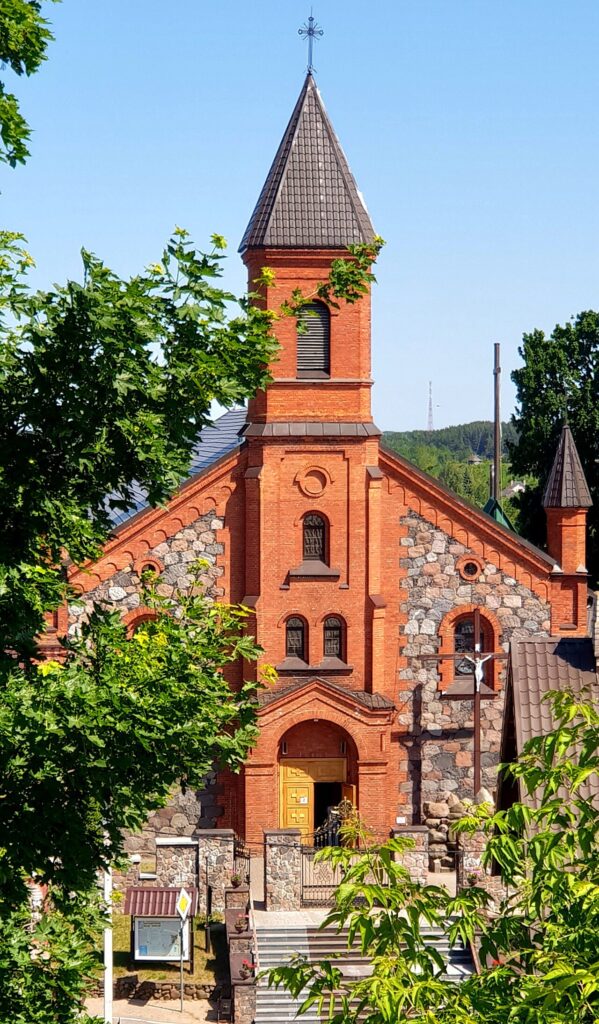
Main data
Origin and history
There are no available online sources (diocese, sanctuary, Catholic press or Marian studies) of historical data on the advocation Our Lady of Braslahor, Queen of the Lakes (Braslahskaya Karaleva Azyor) in Belarus. The available sources only mention in a very short way the church of Braslağ and the presence of a Marian image, without detailing the history of the advocation or its devotional evolution.
By analogy, some Marian repertories place this devotion in the context of the strong Marian piety of the Belarusian Catholicism, where various icons and sanctuaries (for example Budsla, declared national sanctuary) have been centres of pilgrimage since the 16th-17th centuries. However, in the specific case of Braslahor no online documentation on the date of origin of the cult, possible apparitions, transfers of the icon or historical milestones (wars, fires, restorations) specifically linked to the title "Queen of the Lakes."
En consecuencia, cannot be strictly distinguished between tradition / legend and documented historybecause local traditions about this advocation are not included in available sources. Any concrete account of miraculous origins, apparitions, prodigious findings, or precise historical facts should be considered, for now, "no."
The image and the sanctuary
The sources consulted indicate that devotion is linked to the Church of the Nativity of the Most Holy Virgin Mary in Braslağ, described as a Catholic temple of style neorromanic, built in the late 19th century. It is mentioned as a monument of Romanesque architecture (in the broad, neo-Romanesque sense), raised in stone, with characteristics specific to the great parish temples of the region. It is not known that it has been elevated to minor basilica formally declared National sanctuarynor has there been any official reference to its erection as a diocesan sanctuary, which should therefore be indicated: there is no specific canon recognition as a sanctuary in accessible documentation.
On the image, the sources only refer in a generic way to the presence of a venerated Marian icon in the temple. No need to:
– tipo iconográfico (Hodigitria, Eleusa, etc.), – técnica o material (óleo sobre tabla, icono sobre lienzo, escultura), – fecha de realización, – autor o escuela artística.
The title "Queen of the Lakes" it clearly refers to the region of Braslağ, known for its numerous lakes, but no specific iconographic features are detailed in the sources (e.g., representation of lakes, crown, star mantle, etc.). Therefore, any detailed description of the iconography should be considered conjectural; with the verifiable data it can only be said that this is a Marian icon venerated in the church of the Nativity of the Most Holy Virgin Mary of Braslaț.
Sponsorship and coronation
The advocation is presented in Marian repertories as land pattern of the Belarusian lakes, that is, spiritually linked to the lacustre region of Braslağ and its surroundings. However, not included in official sources consulted (documents of the local Church, decrees of the Episcopal Conference or of the Vatican) an explicit canonical proclamation of diocesan or national patronage, for example, equal to the recognition of Our Lady of Budsla as patron of the archdiocese of Minsk-Mohilev and national patron of Belarus. So, you can talk about a mainly local or regional, referred to the "land of lakes," but without clearly documented canon title.
As for the canonical coronation of the icon of Our Lady of Braslaț, Queen of the Lakes:
– No se han hallado referencias a un decreto de la Santa Sede. – No se menciona una ceremonia de coronación presidida por legado pontificio o autoridad delegada. – Ningún repertorio mariano o fuente diocesana accesible recoge la fecha ni el papa que habría concedido tal coronación.
Accordingly, following the indications given, it should be stated: does not contain a documented canonical coronation.
Party and devotion
The available liturgical and pastoral sources do not offer a own party date clearly fixed for Our Lady of Braslaț, Queen of the Lakes. No mention has been found of a specific celebration in the Belarusian national calendar or the corresponding diocese calendar. In the absence of contrasting data, it should simply be indicated: does not record the date of the main party.
There are no figures of the influx of pilgrims or detailed descriptions of the organized pilgrimages a Braslağ explicitly linked to the title of Queen of the Lakes, unlike the case of Budslağ, where there are documented annual multititling and its inscription on the UNESCO list of intangible heritage. It is reasonable to assume that the church of the Nativity of the Blessed Virgin Mary of Braslağ receives faithful from the region and visitors attracted by the landscape of the lakes, but there are no verifiable data on large romanies or specific popular traditions (lacustrous processions, blessing of lakes, etc.) formally associated with this advocation.
Therefore, specific practices (novena, processions, promises, own songs) should also be indicated: no detailed information is available from available sources.
Link to the Rosary
No link has been found in the sources consulted expressed and documented between the advocation of Our Lady of Braslaț, Queen of the Lakes, and a particular practice of prayer of the Rosary (for example, the Rosary's cofradies erected in the sanctuary, specifically rosarian pilgrimages or indulgences linked to the Rosary in this place). It is therefore necessary to state: does not contain a specific documented relationship with the Rosary.
However, in the context of the Belarusian Catholicism of Latin rite, the Rosary occupies a central place in Marian piety, as a simple and deep prayer that accompanies the lives of communities, especially in times of trial. In an advocation that emphasizes Mary as "Queen of the Lakes", the Rosary can be seen as a way of:
– to meditate on the mysteries of Christ's life junto a María, pidiendo que, como los lagos de Braslaŭ, el corazón del creyente se vuelva un “espejo” sereno que refleje la luz de Dios; – peace and protection of the region of the lakes, its inhabitants and visitors, joining the prayer of the faithful to the intercession of the Virgin under this local title.
Thus, even if it does not contain a rosarian tradition of its own or uniquely encoded, the Rosario integrates in a natural way in devotion to Our Lady of Braslağ, Queen of the Lakes, as in every authentic Marian spirituality of the Latin Church.
A flower for the Virgin
It offers a simple prayer to this advocation. Pray a Hail Mary for Belarus and for world peace.
Pray Hail MaryIs the advocation of the Virgin Mary of your people missing?
Si no encuentras la advocación mariana de tu ciudad o pueblo, cuéntanosla: la investigaremos para ubicarla y darla a conocer en este mapa del amor de la Madre por el mundo.
Propose an apvocation →