
Marian devotion
Our Lady of Cacica
Marian title of Cacica (Bucovina)
Documented history. The Marian devotion of Cacica is linked to the arrival of Polish miners in the region of Bucovina, where the exploitation of salt in the town of Cacica took place. These miners, Catholics of Latin rite, carried with them a copy of the Miraculous icon of the Mother of God, the "Black Madonna" of Częstochowafor his veneration in the new community. The icon that is venerated in Cacica is considered painted in the early 17th century, following the model of the famous Polish icon.
Main data
Origin and history
Documented history. The Marian devotion of Cacica is linked to the arrival of Polish miners in the region of Bucovina, where the exploitation of salt in the town of Cacica took place. These miners, Catholics of Latin rite, carried with them a copy of the Miraculous icon of the Mother of God, the "Black Madonna" of Częstochowafor his veneration in the new community. The icon that is venerated in Cacica is considered painted in the early 17th century, following the model of the famous Polish icon.
With the passage of time, Cacica was consolidated as a centre of Catholic life in a predominantly Orthodox region, and the Marian temple became a reference sanctuary for Polish-speaking Catholics, but also for Romanian, Hungarian and other communities present in Bucovina. The Marian church was later rebuilt and expanded, acquiring neo-Gothic architectural features, according to a Polish-inspired project.
Tradition and local memory. Popular piety has preserved the memory of miners who, in the midst of harsh living conditions, entrusted their work and their families to the protection of the Mother of God through this icon brought from their homeland. Many spiritual favors and thanks granted to pilgrims and the sick are attributed to the intercession of the Virgin of Cacica, although these stories belong to the field of devotional tradition and are not always critically documented.
The image and the sanctuary
The image. The advocation of Our Lady of Cacica focuses on a Marian icon que es copy of the icon of the Mother of God of Częstochowa, known as the Black Madonna. This is a imagen de type iconográfico orientalwith Mary represented half-body, holding the Child Jesus, with dark features on the face that evoke the original of Częstochowa. The icon is painted on a table (it is the same as this type of image; the local tradition considers it a painted icon at the beginning of the 17th century, although no further technical details are offered).
As in the original Polish, the Virgin is presented as Mother and Queenwith a serious and majestic attitude, inviting confidence and intercession. The iconography at the same time highlights the maternal closeness of Mary and her dignity goes with Christ.
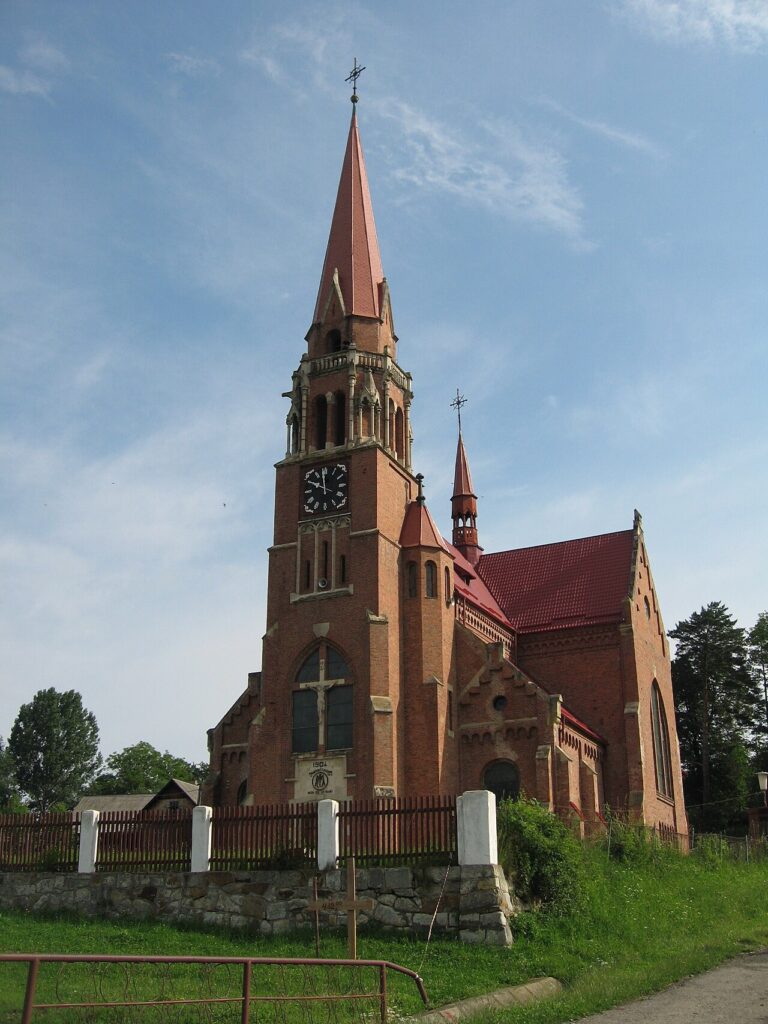
The sanctuary. The icon is venerated in the church of the Assumption of the Virgin Mary of Cacicain the Bucovina region of Romania. This church, also known as Basilica of the Virgin Mary of Cacica, was built on neoGothic style, following a from Poland. The temple stands out for its sober architecture, with an elevated tower and a spacious ship, adapted to the reception of great pilgrimages.
The church of Cacica has received the title of basilica (minor basilica), which indicates its particular importance for the liturgical and devotional life of the local Church. It is recognized as National Marian Sanctuary of Latin Rite Catholics in Romaniaand is a reference point for the Catholic identity in Bucovina.
Sponsorship and coronation
Patronage. Our Lady of Cacica is venerated as patron of the Marian shrine of Cacica and spiritual point of reference for the Latin rite Catholics in Romaniaespecially in the Bucovina region. Given its status as a Latin national sanctuary, devotion exceeds the local level and welcomes the faithful of various dioceses of the country. They do not contain, in the sources consulted, formal statements that define it as an official patron of all Romania, but their importance as National sanctuary for Latin Catholics.
Canon coronation. No explicit mention, with date and decree, of a canonical coronation of the icon of Our Lady of Cacica by the command of the Holy See or a specific Pontiff. There is no documented canonical coronation.
Party and devotion
The main Marian celebration in Cacica is linked to the Solemnity of the Assumption of the Virgin Mary, August 15. Around this date, the sanctuary becomes a place of great national pilgrimagewith faithful who come on foot, in parish groups and associations, to participate in solemn masses, confessions, processions and prayer vigil.
The devotion to Our Lady of Cacica is characterized by:
– La inflow of pilgrims of different ethnic groups and languages (Romanian, Polish, Hungarian, Ukrainian, among others), which express the unity in faith en un contexto cultural plural. – Una fuerte tradición de annual pilgrimage en torno al 15 de agosto, que consolidan el santuario como uno de los principales centros marianos del país. – La centralidad de la Eucharist, confession and community prayerwith special protagonism of Marian song and silent veneration before the icon.
The sources consulted do not provide precise figures for assistance, but they agree to present Cacica as one of Romania's great Marian pilgrimage destinations for Latin rite Catholics.
Link to the Rosary
There is no evidence in the available documentation that there is a specific historical relationship or own title which uniquely links Our Lady of Cacica to the Rosary (for example, a historical fellowship of the Rosary or a title as the "Rosary" attached to this advocation).
However, as in most Marian Catholic shrines of Latin rite, the rezo of the Holy Rosary is a regular part of the devotional life of the sanctuary, especially in the vigil, processions and strong times like the pilgrimage of August 15. The Rosary allows the faithful to contemplate, together with Mary, the mysteries of Christ, and in a place like Cacica helps to unite pilgrims of different languages in the same Marian prayer.
From a mariological perspective, the Cacica icon - a copy of the "Black Madonna" of Częstochowa - invites the contemplation of Mary as Mother of God and Mother of the Churchas the Rosary remembers in its litany and mysteries. Thus, even if there is no specific legal or historical link with the Rosary, the devotion to Our Lady of Cacica is naturally fed and deepened by her prayerwho accompanies the pilgrimage, the request for graces and the thanksgiving of the faithful.
A flower for the Virgin
It offers a simple prayer to this advocation. Pray a Hail Mary for Romania and for world peace.
Pray Hail MaryIs the advocation of the Virgin Mary of your people missing?
Si no encuentras la advocación mariana de tu ciudad o pueblo, cuéntanosla: la investigaremos para ubicarla y darla a conocer en este mapa del amor de la Madre por el mundo.
Propose an apvocation →