Marian devotion
Our Lady of Candelaria of Chiantla, "Virgen de Plata," patron of Chiantla
Marian vocation of Chiantla (Huehuetenango)
La devoción a Our Lady of Candelaria of Chiantla, popularly known as the “Virgen de Plata”, se remonta al 16th century, in the context of the Dominican evangelization of the Altiplano of Huehuetenango, Guatemala. The church of Chiantla was founded as Monastery of the Order of Preachers (Dominicans) about 1530 y 1564, and from the early days it became an important Marian regional center.
Main data
Origin and history
La devoción a Our Lady of Candelaria of Chiantla, popularly known as the “Virgen de Plata”, se remonta al 16th century, in the context of the Dominican evangelization of the Altiplano of Huehuetenango, Guatemala. The church of Chiantla was founded as Monastery of the Order of Preachers (Dominicans) about 1530 y 1564, and from the early days it became an important Marian regional center.
# # Tradition and legend According to the popular tradition, the image would have been found by some shepherds Among Maguey's matas, this finding is interpreted as a sign of heaven and origin of its miraculous and very close to the people. It also links its silver coating to the wealth of the Torlon minesfrom where the offerings of precious metal offered by the faithful would have come. These elements belong to the field of local piety and no constant as documented hechos in official sources.
# # Documented history The historical testimonies of the second half of the 16th century mention the place as "Sanctuary of Our Lady of Yantla" o "Sanctuary of Our Lady of Chiantla", which confirms the early importance of Marian devotion in this site. Studies on the Virgin of the Rosary of the convent of Santo Domingo in Santiago de los Knights of Guatemala indicate that the image of the Virgin of Chiantla would have been sculpted from a mold of the image of Our Lady of the Rosary, made in Spain by Sevillian plateurs, which inserts it into the Spanish artistic context of the 16th century and in the Dominican environment.
It is not clearly documented that the initial advocation was Candelaria; various local investigations maintain that at first the image lacked precise advocation and that the identification Candelaria would have been consolidated along the siglo XVII or included XVIII. What it does know is that, over time, the Virgin of Silver became recognized as patrona de Chiantla and focus of regional pilgrimage.
The image and the sanctuary
La image is a Marian representation of a procedural type, of origin 16th century, recubierta por un Silver mantle that gives you its characteristic appearance, motive of the popular title of “Virgen de Plata”. The metal coating is worked in great detail and decorated with seven diamonds, devotional to seven days of the week, sign of Mary's constant presence and protection. The concrete iconography (position of the hands, Child Jesus, Cirius of Candelaria, etc.) is described in the sources rather generally, highlighting its character as a Marian image of strong Dominican imprint and close to the models of the Virgin of the Rosary.
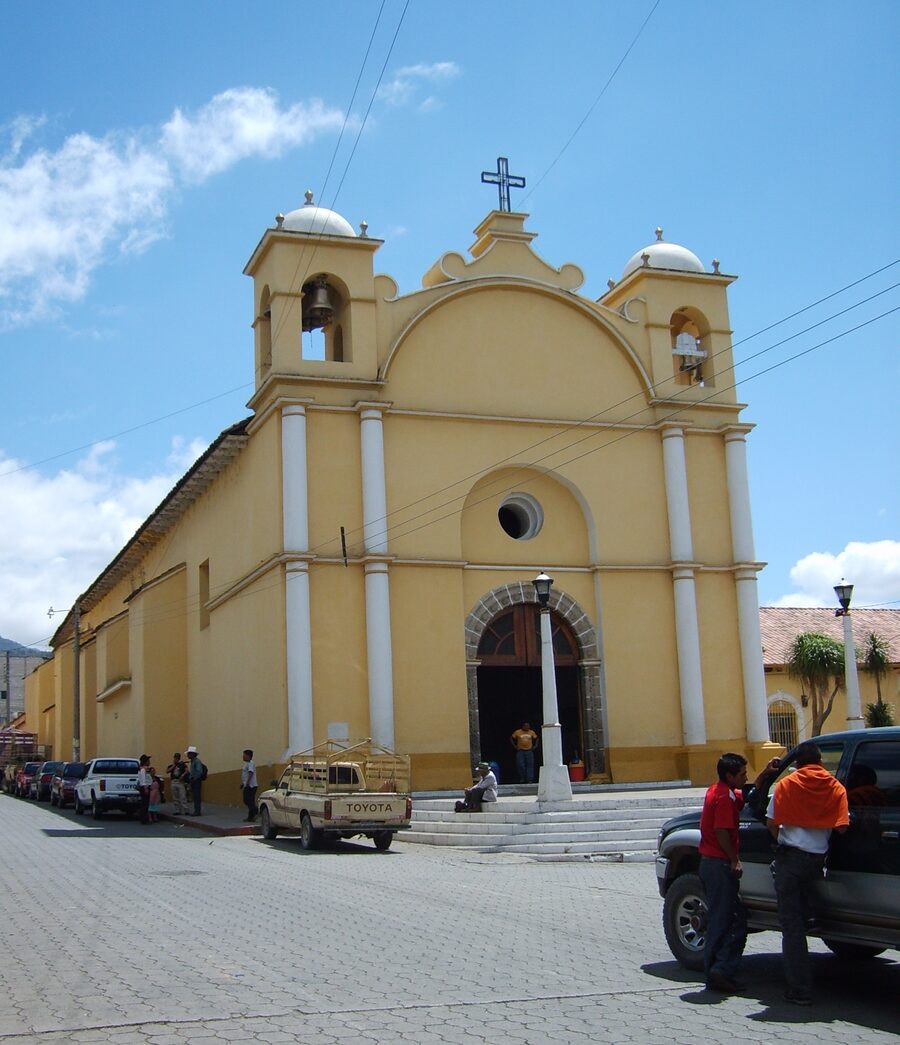
The place of worship is the Parish Our Lady of Candelaria, also known as shrine of the Virgin of Candelaria of Chiantlalocated next to the Central Park of the villa of Chiantla, department of Huehuetenango. The temple was originally a Dominican convent and preserves the physiognomy of colonial church, with altarpieces and imagery of the time. It now works as Marian parish and sanctuary of pilgrimage, attended by the diocesan clergy.
The sources consulted (parish page in networks, tourist portals and local chronicles) present it as "Santuario"but does not contain an official title of minor basilica or national sanctuaryBut it is a sanctuary of character. diocesano/local.
Sponsorship and coronation
La Virgin of Candelaria of Chiantla is taken as patron of the city and municipality of Chiantla, and his devotion extends to other locations in the department of Huehuetenango. The title of the Candelaria is cited, in the Guatemalan context, as the patron of several cities and municipalities, including Chiantla, which confirms its roots as a local protector.
In accessible sources (parish, local chronicles, devotional portals and generalists) does not contain a documented canonical coronation neither by Pontifical Decree nor by Episcopal delegation with express recognition of the Holy See. There is no mention of a year of coronation or the name of a pontiff or delegate who made it, and it should therefore be expressly stated, on the basis of the criteria requested: does not contain a documented canonical coronation.
Party and devotion
La main party of Our Lady of Candelaria of Chiantla is celebrated the 2 Februaryin harmony with the liturgical feast of the Presentation of the Lord and the Purification of the Virgin Mary. During these days an intense liturgical and popular activity is carried out: Eucharist, novies, processions and acts of Marian piety, which bring together the faithful of Chiantla, Huehuetenango and other regions of the country.
The sanctuary is a pilgrimage center very esteemed. The faithful come all year round, but especially around February 2, to present your promises, thank you for favors and ask for the intercession of the Virgin of Silver. A characteristic practice is that many devotees they enter the temple on their knees to the altaras a sign of penance and gratitude for the benefits received. The historical link with the mining economy (particularly the Torlon mines) has encouraged workers and families associated with this activity to come to entrust their life and work to the Virgin.
The local chronicles stress that the identity of the people of Chiantla "dressed in silver" from devotion to this image, so that its figure has become an authentic identity and cultural symbolas well as religious. The popular participation is also manifested in solemn processions on the streets, as shown by various audiovisual records of the procession of the Virgin of Candelaria to the sanctuary.
Link to the Rosary
Various research related to the Dominican environment indicates that the image of the Virgin of Chiantla is related to the iconography of Our Lady of the Rosary, patron of the Order of Preachers. According to a study on the Virgin of the Rosary of the convent of Santo Domingo in the ancient capital (Santiago de los Knights), the Virgen de Plata de Chiantla habría sido esculida a partir de un mold de la Virgen del Rosario, made in Spain by Sevillian plateurs. This suggests that, in its origin, the image could be more associated with the devotion of the Rosary that to a specific advocation, and that the title of Candelaria was subsequently consolidated.
A local source reflects the belief that the image "originally had been created with the advocation of the Rosary for the Dominican friars of the people" and that later he would have been given the advocation of Candelaria. Although it is a devotional hypothesis and not a fully proven data, does reflect the deep Dominican and rosarian imprint of this image. The Dominican spirituality, strongly focused on the preaching of the Rosary, has historically accompanied the life of the sanctuary and the way of praying of the people.
A specific legal or liturgical link between this advocation and co-fradies of the Rosary of national scope is not documented; however, at the spiritual level, the Rosary appears as the natural way to accompany the devotion to the Virgin of Candelaria of Chiantla: by meditating on the mysteries of Christ's life with Marythe faithful contemplate the Virgin of Silver as Mother and guide in the way of faith, offering in every avemaria the history and the
A flower for the Virgin
Offer a simple prayer to this Marian devotion. Pray a Hail Mary for Guatemala and for all of America.
Pray Hail MaryIs the advocation of the Virgin Mary of your people missing?
Si no encuentras la advocación mariana de tu ciudad o pueblo, cuéntanosla: la investigaremos para ubicarla y darla a conocer en este mapa del amor de la Madre por el mundo.
Propose an apvocation →