
Marian devotion
Our Lady of China of Donglu
Marian vocation of Donglu (China)
According to the traditionIn 1900, the Catholic village of Donglu, in Hebei province, was besieged by anti-Christian troops during the Boxers rebellion, who intended to destroy the community and the local church. In this context, the faithful report that the Virgin Mary appeared in white in heaven, with the Child Jesus, accompanied by a luminous rider who was usually identified with Michael Archangel; the soldiers, terrified by the vision, would have fled, and the people were saved from the massacre. These stories are transmitted as devotional legend and the oral tradition of the community, without formal recognition of the apparitions by the Holy See.
Main data
Origin and history
According to the traditionIn 1900, the Catholic village of Donglu, in Hebei province, was besieged by anti-Christian troops during the Boxers rebellion, who intended to destroy the community and the local church. In this context, the faithful report that the Virgin Mary appeared in white in heaven, with the Child Jesus, accompanied by a luminous rider who was usually identified with Michael Archangel; the soldiers, terrified by the vision, would have fled, and the people were saved from the massacre. These stories are transmitted as devotional legend and the oral tradition of the community, without formal recognition of the apparitions by the Holy See.
As for the documented history, it is known that Donglu (Donglü) became an important Marian pilgrimage centre for Chinese Catholics, and that the advocation was consolidated in the early 20th century. In 1924, at the First Plenary Council of Chinese Bishops, chaired by the Apostolic Delegate Celso Costantini, the Chinese bishops especially promoted Marian devotion linked to Donglu as part of the spiritual soul of the country. Later, the Pope Pío XI recognized the importance of the place by raising the shrine of Donglu to the category of official sanctuary of pilgrimage in 1932. In 1941, the Pope Pius XII He consecrated all of China to the Immaculate Heart of Mary and granted the Church in China a Marian feast under the title of Holy Mother, Empress of China, closely linked to Donglu's devotion.
Throughout the twentieth century, devotion has been marked by successive religious persecutions and restrictions on freedom of worship, so that Our Lady of Donglu has also become a symbol of the Church persecuted in China.
The image and the sanctuary
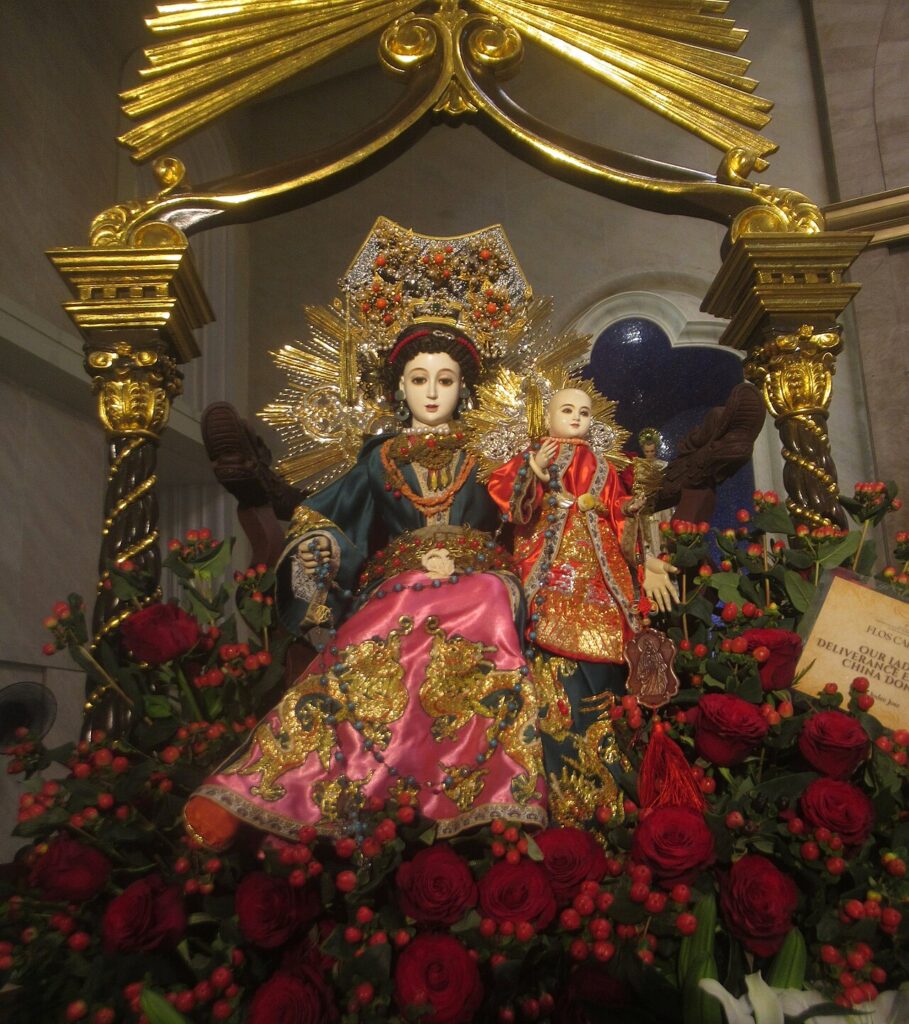
The advocation is usually represented in a image of the Virgin with the Child Jesus in her arms, that is, a type of iconography Madonna con Niño. In the popularly known form as Emperatriz de ChinaOur Lady appears with features adapted to the Chinese context, covered with an attire that evokes the imperial dignity, stressing her title "Holy Mother, Empress of China." The specific material of the original image (wood, canvas or other support) is not certain in the sources consulted; in many cases it is venerated in the form of picture or portrait Marian, carried in procession by the faithful.
The main place of worship is the church of Donglu, en la diócesis de Bading, Hebei province, which acts as Marian sanctuary linked to this devotion. The sources point out that Pope Pius XI declared Donglu "an official place of pilgrimage" in 1932, recognizing its importance for the Catholics of the country. It does not know that the temple of Donglu has been elevated to the range of minor basilica not declared National sanctuary by the Holy See; the documentation available presents it rather as a diocesan sanctuary and very significant pilgrimage center within China.
Sponsorship and coronation
Our Lady of Donglu / Our Lady of China is considered, in Chinese Catholic tradition, patron of Chinese Catholics. The devotion has also spread to Chinese communities in the diaspora, and some sources point to a particular relationship of patronage with the chinos-filipinosespecially where his worship has spread under the title of Our Lady of China. It does not contain, in the documents consulted, an explicit decree that the national patron of China is proclaimed in the legal and liturgical sense, but is de facto venerated as a spiritual patron of the Chinese Catholic people.
On the canonical coronationthe available sources do not mention any formal act of canonical coronation approved by the Holy See for the image of Donglu. Therefore, according to the accessible data, does not contain a documented canonical coronation.
Party and devotion
The liturgical feast linked to this advocation, under the name of Our Lady of China / Holy Mother, Empress of Chinais held according to various sources around the Mayo’s second Sunday. It is indicated that, in 1973, following the Second Vatican Council, the Chinese Episcopal Conference, with the approval of the Holy See, established the celebration at the vigil of the day before "Mother's Day"which in many places coincides with the second Sunday of May. This link underlines Mary's maternal character towards the Church in China.
Before the most severe restrictions, Donglu was one of the country's main Marian pilgrimage centres, with great concentrations of faithful, especially during the time of the feast. Devotion is expressed in processions with the Retraction of the Virgenin the community prayer, in personal promises and in the invocation of Mary as a protector of the persecuted Church. Although State controls have tried to limit these manifestations, popular piety remains alive, and Our Lady of Donglu remains a sign of comfort and hope for local Catholics.
Link to the Rosary
The sources consulted on Our Lady of Donglu focus on the history of apparition, persecution and the patronage dimension, but does not contain a specific and documented relationship of this advocation with the prayer of the Rosary (for example, particular promises about the Rosary or concrete indications in the alleged apparitions).
However, in the devotional practice of Chinese Catholics, the Rosary It is a central place in Marian life: it is prayed in family, in base groups and in pilgrimages, also in Donglu. The memory of Mary's protection in times of persecution naturally harmonizes with the mysteries of the Rosary, which contemplate the life of Christ with his Mother in the midst of joy, pain and glory. Thus, even if there is no unique historical link between the title of Our Lady of China and the Rosary, this Marian prayer is presented as a privileged means of spiritual accompaniment to the Church in China, interceding for fidelity in the trial and for peace in that country.
A flower for the Virgin
It offers a simple prayer to this advocation. Pray a Hail Mary for China and for the peace of the world.
Pray Hail MaryIs the advocation of the Virgin Mary of your people missing?
Si no encuentras la advocación mariana de tu ciudad o pueblo, cuéntanosla: la investigaremos para ubicarla y darla a conocer en este mapa del amor de la Madre por el mundo.
Propose an apvocation →