
Marian devotion
Our Lady of Gietrzwałd
Marian Advocation of Gietrzwałd (Varmia and Masuria)
La devoción a Nuestra Señora de Gietrzwald (Mother of God Gietrzwald) it goes back, according to local tradition, to the second half of the 14th century, first linked to an image of the Piety and from the 16th century to an image of the Virgin with the Child venerated in the parish church of the people of Gietrzwałd (then diocese of Warmia, today Varmia and Masuria, Poland). This continuity of Marian devotion is a fact transmitted by the history of the sanctuary, although the details of medieval origins are known mainly by local tradition.
Main data
Origin and history
La devoción a Nuestra Señora de Gietrzwald (Mother of God Gietrzwald) it goes back, according to local tradition, to the second half of the 14th century, first linked to an image of the Piety and from the 16th century to an image of the Virgin with the Child venerated in the parish church of the people of Gietrzwałd (then diocese of Warmia, today Varmia and Masuria, Poland). This continuity of Marian devotion is a fact transmitted by the history of the sanctuary, although the details of medieval origins are known mainly by local tradition.
As regards documented historythe sanctuary became famous for the Marian apparitions that occurred between the 27 June and 16 September 1877in the context of Prussian occupation and germanization policies. The seers were two peasant girls: Justyna Szafryńska13 years; and Barbara Samulowska12 years old. The first apparition took place on June 27, 1877, when Justyna, hearing the Angelus bells and praying, saw a light and a figure dressed in white on a maple near the church. Shortly after Barbara joined, and the apparitions were repeated many times (tradition speaks of 160-166 apparitions in that period).
A historically relevant feature is that the Virgin spoke in Polish, which was perceived as a strong sign of consolation and affirmation of the Catholic and Polish identity in an area under the Kulturkampf and under pressure to leave the Polish language. The message insisted on the conversion, frequent confession, prayer and, in a very particular way, the daily prayer of the Rosary. After diocesan investigations, the obispo de Warmia, Józef Drzazga, recognized the credibility of the apparitions and their conformity with Christian faith and morality, publishing a decree in 1977in the centenary of the events. Gietrzwałd is considered the only Marian apparition officially approved in Poland.
The image and the sanctuary
The main image venerated in the sanctuary is a Our Lady with the Child icon located on the main altar of the parish church. Represents Mary dressed in sea blue robe, holding the Child Jesus in her left arm, which carries a long red robe. From the 18th century the image was enriched with crowns and exvotes: 1717 was adorned with silver crowns, testimony of the intense devotion and graces attributed to the intercession of the Virgin of Gietrzwałd. Numerous votive offerings along with the image show the continuity of the veneration and the trust of the faithful.
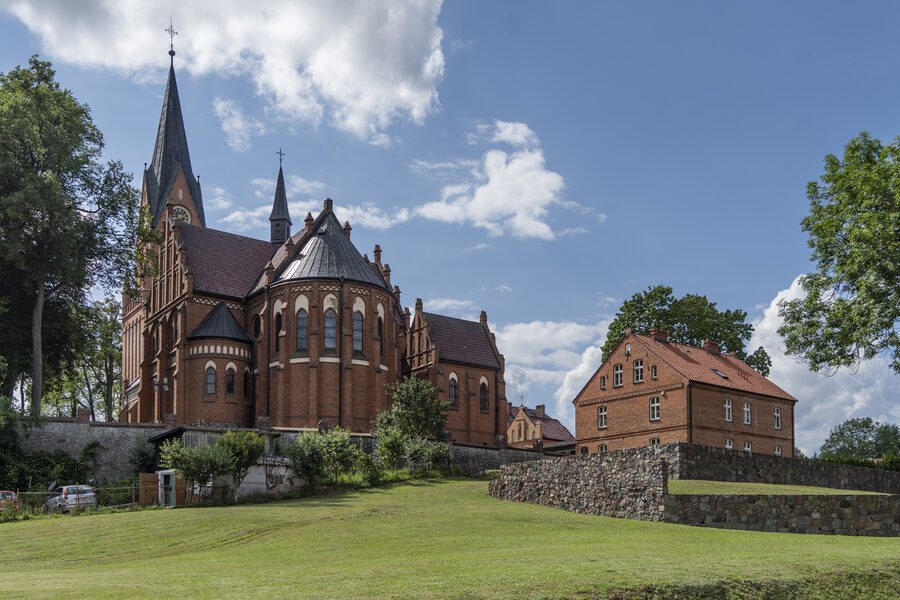
The place of worship is the Sanctuary of Our Lady of Gietrzwałdin the town of Gietrzwałd, in the region of Warmia (Varmia and Masuria, north-eastern Poland). The parish church - of medieval origin and later extended - is today a Marian sanctuary of great national importance and a main destination of pilgrimages in Poland. In 1970the temple was elevated to the dignity of minor basilica, recognition of its spiritual relevance to the Church in Poland. In the surroundings of the sanctuary are the source linked to the outdoor apparitions and prayer spaces that host many pilgrims, especially on the dates of the Marian holidays.
Sponsorship and coronation
Our Lady of Gietrzwałd is a important national sanctuary in Poland and a Marian reference for the Warmia y Masuria. Several sources mention it as one of the main places of Marian pilgrimage in the country, although there is no formal title of national patron in the same sense as the Virgin of Częstochowa. At the local level, it is closely linked to the Church of Warmia and the pastoral life of the archdiocese (ancient diocese) of Warmia; however, no consta In the sources consulted an official decree that proclaims it the principal patron of the diocese with a specific title.
La coronation of the image has a history of its own. The image was already crowned with silver crowns in 1717as an expression of popular piety and recognition of the sanctuary. In addition, the sources quote that the image was solemnly coronada en 1967in the context of the renewal of the Marian devotion prior to the centenary of the apparitions; however, a specific decree of canonical coronation with a certain mention of the pontiff or of the pontifical legacy that makes it does not appear clearly in the accessible sources. Since the user's order requires not to state data without full security, this should indicate: does not contain a documented canonical coronation with precise details of the Pontiff or delegate in the sources consulted.
Party and devotion
The main dates of celebration linked to Our Lady of Gietrzwałd are:
– 27 June, aniversario de la primera aparición (1877), conmemorado en el santuario como día de gracia y comienzo del ciclo aparicionista. – September 8, party of the Nativity of the Virgin Mary, widely celebrated, and associated in Gietrzwałd to the Virgin of the sanctuary.
The shrine of Gietrzwałd is considered one of the main Marian pilgrimage centers in Poland, attracting many faithful from all over the country and from abroad, especially in the summer, in the ninth and around to 27 June, and in the Marian celebrations of September. The pilgrimages often include participation in the Eucharist, the prayer of the Rosary, the Marian procession and the visit to the source linked to the apparitions, together with the presentation of exvotes and personal petitions.
Between the Devotional features the trust in the intercession of the Virgin for conversion, the strength in faith in times of trial and spiritual and physical healing. The celebration of the centenary of the apparitions (1977) and the official approval by the Bishop of Warmia again promoted the influx of pilgrims and consolidated Gietrzwałd as a place of prayer for the Church in Poland and for fidelity to the Gospel.
Link to the Rosary
El Rosary It is central to the message of Our Lady of Gietrzwałd. In the apparitions of 1877, the Virgin explicitly asked: "I want you to pray the Rosary daily", linking the Rosary's prayer to personal conversion, perseverance in faith and relief of the suffering of the Polish people. This exhortation to the daily prayer of the Rosary is one of the most characteristic elements of this advocation and brings it closer to other great Marian shrines such as Lourdes and Fatima.
Therefore, devotion to Our Lady of Gietrzwałd is expressed in a privileged way in the Rosary meditated in the sanctuaryin family and parishes that have it as spiritual reference. The Rosary is understood here as path of fidelity to Christ and spiritual resistance in the face of historical trials (cultural persecution, loss of faith, family crisis), following the invitation of the Virgin to persevering and trusting prayer. Thus, every devotee of Our Lady of Gietrzwałd finds in the Rosary a school of contemplation of the mysteries of Christ's life next to Mary, in favour of
A flower for the Virgin
Offer a simple prayer to this Marian devotion. Pray a Hail Mary for Poland and for world peace.
Pray Hail MaryDocumentary update: history and ecclesial state
The documentation consulted for this extension confirms that Gietrzwałd must be submitted at two different levels. On the one hand there is the institutional history of the sanctuary and the coronation of the image; on the other, the ecclesial judgment on the apparitions of 1877. The sanctuary dedicated to the Nativity of the Virgin Mary and the sources of the Polish Marian tradition describe the apparitions to Justyna Szafryńska and Barbara Samulowska, as well as the research that culminated in the decree of the Bishop of Varmia Józef Drzazga of 1977. This decree declared them credible and not contrary to faith and morality. It is therefore a historical episcopal approval prior to the rules of the Dicastery for the Doctrine of the Faith of 2024; there is no new no obstat del Dicasterio.
The coronation belongs to the documented history of the cult: it was authorized in 1963 and held on September 10, 1967, with the participation of cardinals Stefan Wyszyński and Karol Wojtyła. The subsequent replacement of the crowns, following the robbery, was held on 2 February 1969. The number of attendees who transmit the chronicles is approximate and should not become an exact number. Similarly, the existence of the cult before 1877 alone does not prove every detail of the stories transmitted about the place.
The fact sheet retains as a cartographic point the shrine of Gietrzwałd, not an invented coordinate for each place of prayer. OpenStreetMap identifies the basilica building (way 254499596), with the coordinates in the metadata of this tab. For prayer, the Rosary can offer to ask Mary for her intercession before Christ for Poland, for peace and for those who seek God, without turning the account of the apparition into a statement different from what the episcopal decree establishes.
Verified sources for this extension: historia del Santuario Maria de Gietrzwałd, history of the sanctuary y OpenStreetMap cartographic record.
Is the advocation of the Virgin Mary of your people missing?
Si no encuentras la advocación mariana de tu ciudad o pueblo, cuéntanosla: la investigaremos para ubicarla y darla a conocer en este mapa del amor de la Madre por el mundo.
Propose an apvocation →