
Marian devotion
Our Lady of Guide
Marian Advocation of Ermita (Manila) (Luzón)
According to the traditionthe image of Our Lady of Guide would have arrived in the Philippines with the expedition of Fernando de Magallanes (1521), along with the image of the Holy Child of Cebu. It also states that, at some point, the image would have been sent by Natives of Cebu as a gift to a raja of the Manila area, before the definitive Spanish conquest. These news are devotional and legendary, and are not based on contemporary documentation; therefore they must be considered a pious tradition.
Main data
Origin and history
According to the traditionthe image of Our Lady of Guide would have arrived in the Philippines with the expedition of Fernando de Magallanes (1521), along with the image of the Holy Child of Cebu. It also states that, at some point, the image would have been sent by Natives of Cebu as a gift to a raja of the Manila area, before the definitive Spanish conquest. These news are devotional and legendary, and are not based on contemporary documentation; therefore they must be considered a pious tradition.
As for the documented history, the sources agree that the image was found on 19 May 1571 in the coastal area corresponding to the present site of the church of Ermita, shortly after the take of Manila by Miguel López de Legazpi on behalf of King Philip II. Since the 16th century it is venerated by the local community and is widely held as the oldest Marian image of the Philippines. Initially, the image was deposited in the Catedral de Manilawhere she received veneration for a long period, until she was transferred to her extramurous hermitage.
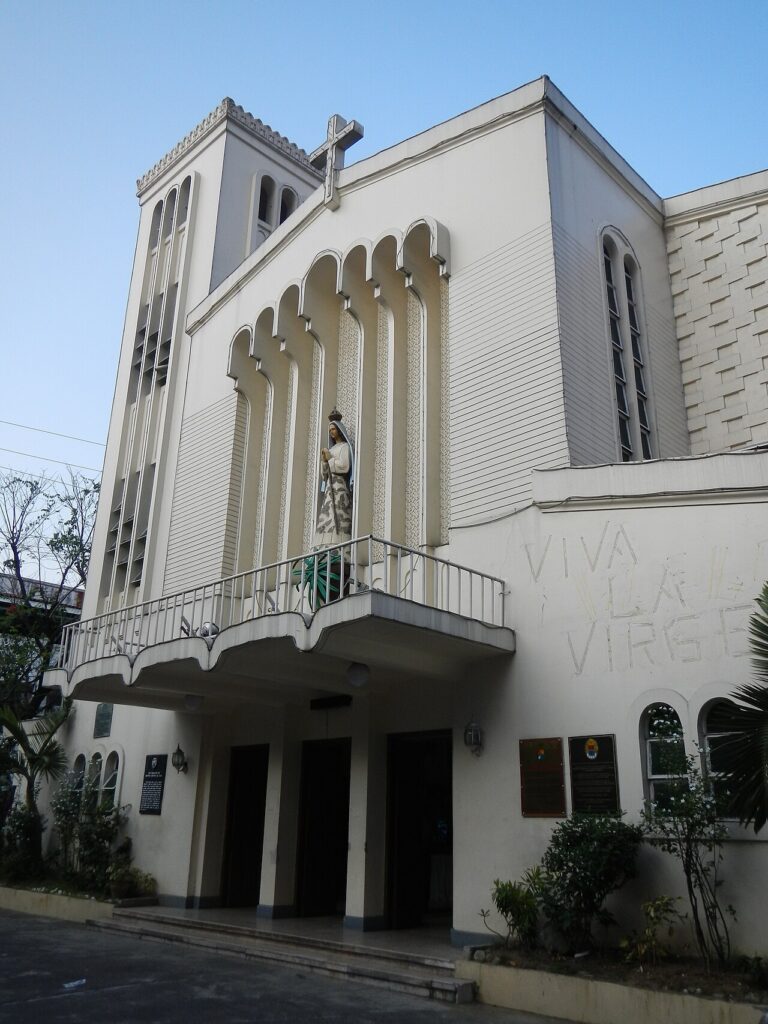
The temple of the Hermitage dedicated to Our Lady of Guide is already documented in the 17th century; in 1666 was celebrated with great solemnity the the feast of the translation from the image from the cathedral to the restored hermitage, an event of which memory is preserved in a dramatic festive loa studied by historical research. Over the centuries, the sanctuary suffered various damage from earthquakes and, in the 20th century, from the bombing of World War II; it was later rebuilt and the current church dates from the post-war, specifically from 1947.
The image and the sanctuary
The image of Our Lady of Guide is a wood size of small size, simple and archaic style, described by scholars as a 16th century statue. It is considered by local devotion and researchers as "the oldest Marian image in the Philippines." It is venerated as a representation of the Blessed Virgin Maryunder the title "Guide," that is, as a protective and guiding Mother of the faithful, particularly of the navigators and travellers. The concrete iconography (posture, attributes, possible Child Jesus) is not precisely detailed in the sources consulted; therefore, no consta with sufficient rigour a detailed iconographic description.
The temple where the image is kept is popularly known as Church of Ermita, and his official name is Archdiocese Sanctuary of Our Lady of Guide (Archdiocese of Our Lady of Guide). The first church in this place was erected in 1606, initially built with light materials (bamboo, nipa and mulawin wood), and later rebuilt in stone. Throughout its history it has been damaged several times by earthquakes and, again, severely affected by 1945 during World War II, which forced a comprehensive reconstruction whose culmination was the present temple of 1947.
The temple of Ermita is recognized as one of the main Marian shrines of the Philippines and has been declared Archidiocesan Sanctuary by the Archbishop of Manila, Cardinal Gaudencio B. Rosales. He does not know that he has the title of a minor basilica or a national sanctuary; his official rank, according to the sources consulted, is that of an archdiocesan sanctuary within the Archdiocese of Manila.
Sponsorship and coronation
Our Lady of Guide is venerated in Manila as patron of the navigators and travellers, patronage expressed in popular devotion and local testimonies. Several sources of piety also mention her as a patron or protector of the Ermita and the city of Manila, although the title of the main patron of the city is traditionally linked to the Immaculate Conception; in the case of Our Lady of Guide, her patronage appears more defined in relation to those who travel by sea and land. It is therefore possible to indicate its patronage of sailors and travellers; the precise legal scope of its patronage over the city is not detailed in the revised sources.
As for a canonical coronationthe sources consulted (historical, academic and ecclesial dissemination) do not explicitly mention a formal canonical coronation of the image, nor do they indicate year or pontifical or delegated authority. In the absence of verifiable data, it should be stated: does not contain a documented canonical coronation.
Party and devotion
Local tradition sets the 19 May 1571 as the date of the image finding, and around this memory is celebrated the main feast of Our Lady of Guide. In contemporary pastoral practice, this date is considered a day of special commemoration of the advocation in the archdiocesan sanctuary, with solemn Eucharistic celebrations and devotional acts of its own. No precise statistical data of influx are available, but Ermita is recognized as one of the most popular Marian shrines in Manila, especially around the May party and throughout the year.
The devotion to Our Lady of Guide is characterized by the filial trust in the protection of Our Lady for the travellers, sailors and those who take roadsboth physical and spiritual. Historically, their protection was invoked by those who left or arrived in Manila by sea, and the name of the advocation has been reflected in the baptism of ships and in various manifestations of popular piety linked to the maritime world. Today it continues to be a place of prayer for Manila people and pilgrims who come to ask for light, guidance and protection at the crossroads of life.
Link to the Rosary
The sources consulted do not indicate a specific or historical relationship of Our Lady of Guide with a Rosary fellowship, with a rosarian feast of its own or with explicit titles linked to the Rosary prayer. It should therefore be indicated that no consta a particular documented link between this advocation and the Rosary, beyond general Marian practice in the sanctuary.
However, in the context of Catholic spirituality, the Rosary It occupies a central place as Marian prayer that contemplates the mysteries of Christ's life from the hand of Mary. In a sanctuary like Ermita, where the Virgin is invoked precisely as "Guide," the prayer of the Rosary acquires a special resonance: by disgracing her mysteries, the faithful ask Mary to guinea On the way to the Gospel, strengthen your faith in the midst of trials and accompany your daily "trips" - family, professional, spiritual - to Christ. In this way, even if there is no specific historical link, the Rosary presents itself as a privileged means of living devotion to Our Lady of Guide, allowing the Mother to lead, step by step, the life of the believer towards God.
A flower for the Virgin
Offer a simple prayer to this Marian devotion. Pray a Hail Mary for the Philippines and for world peace.
Pray Hail MaryIs the advocation of the Virgin Mary of your people missing?
Si no encuentras la advocación mariana de tu ciudad o pueblo, cuéntanosla: la investigaremos para ubicarla y darla a conocer en este mapa del amor de la Madre por el mundo.
Propose an apvocation →