
Marian devotion
Our Lady of Iveron of Moscow
Moscow Patron
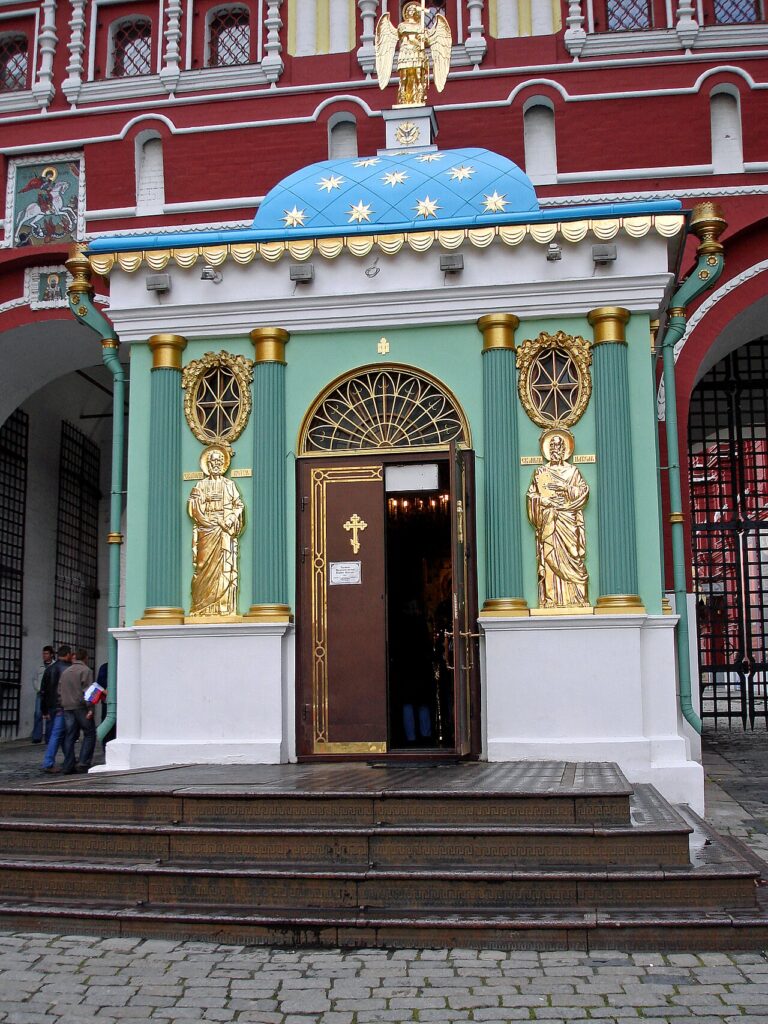
El icono de Our Lady of Iveron of Moscow (Iverskaya) is a copy of the famous Portaitissa of the monastery of Iviron, on Mount Athos (Greece), one of the most venerated Marian icons in the Orthodox world. The original is preserved in the Georgian monastery of Iviron and is believed to have been there since 999. The Moscow icon was historically venerated in a chapel located next to one of the access doors to the Kremlin, in the immediate surroundings of the current Red Square.
Main data
Origin and history
El icono de Our Lady of Iveron of Moscow (Iverskaya) is a copy of the famous Portaitissa of the monastery of Iviron, on Mount Athos (Greece), one of the most venerated Marian icons in the Orthodox world. The original is preserved in the Georgian monastery of Iviron and is believed to have been there since 999. The Moscow icon was historically venerated in a chapel located next to one of the access doors to the Kremlin, in the immediate surroundings of the current Red Square.
According to the Orthodox traditionthe original icon of Iveron would have arrived miraculously by the sea and, later, would have manifested itself as a protector of the monastic community and of the faithful; hence the title of Portaitissa"The one who keeps the door." In continuity with this tradition, the revered copy in Moscow was popularly understood as city protection icon And of those who went in and out through the old gate of the Resurrection.
As for the specific documented history of the Moscow icon, the sources consulted of a general nature about the Virgin of Iver do not safely specify the exact date of arrival of the copy to Moscow or the details of its commission, author or circumstances of entronization. Nor is there a complete chronology of the vicissitudes of the icon in Soviet times (destruction of the original chapel, disappearance and subsequent restoration of the cult) offered in these sources, so on these specific points not documented enough in accessible sources.
The image and the sanctuary
The advocation is venerated in the form of Orthodox icon of the Byzantine type, following the tradition of Theotokos de Iverón: Mary is represented as the Mother of God, with the Child Jesus in his arms, according to the style of the Eastern icons. The original of Iveron is considered taumaturgicalIn other words, many miracles have been attributed to him through the intercession of the Mother of God before those who pray before him. The Moscow icon participates in this same iconography and spirituality, as a devotional copy of the Portaitissa; however, the sources consulted do not specify with certainty the material concrete (type of table, exact pictorial technique, measurements or elements added as metal revokes) of the moscovite specimen, therefore no consta this level of detail is documented.
The icon is venerated in the chapel of the Gate of Resurrection, next to Moscow Red Square (Russia). This chapel is located in the access between Red Square and Manezhnaya Square, and houses the icon of the Mother of God of Iveron, very frequented by the faithful and visitors as one of the most popular Marian places in the Russian capital. The general sources on the Virgin of Iver do not indicate that this chapel has the title of minor basilica, national sanctuary or equivalent canonical category; no constatherefore an official recognition of this type, beyond its devotional importance within the Russian Orthodox tradition.
Sponsorship and coronation
In Russian spirituality, various Marian advocates have been considered as protectors of cities or of the nation; for example, the Virgin of Vladímir is called "Mother of Russia." For the Virgin Iverskaya, a source of Marian dissemination in Spanish mentions that the "Virgen Iberia" (Iverskaya) is a patron of Moscow. However, this statement is not explicitly confirmed by official diocesan, patriarchal or academic sources accessible in the searches carried out; therefore, from a strictly documented point of view, does not contain an official decree of canonical patronage of Moscow under this title, although its great popularity is recognized as a protective icon of the city.
As for a canonical coronation according to the praxis of the Catholic Church (decree of the Holy See, coronation by a Pontiff or his delegate), it is an icon belonging to the tradition orthodox, and the sources consulted do not collect any act of Catholic canonical coronation for this image. Therefore, with regard to the discipline of the Catholic Church, does not contain a documented canonical coronation for Our Lady of Iveron of Moscow.
Party and devotion
La liturgical feast of the icon of the Virgin of Iveron, in the Eastern tradition, is celebrated the 26 February according to the Julian calendar (equivalent to a later date in the Gregorian calendar), and in the eastern Catholic sphere (for example, in the Melchian Church) the 22 May as a festive of this icon. It is also indicated as the date of celebration in the Latin Catholic Church the last Sunday of May. These dates refer to the of the Virgin of Iver in general; the sources consulted do not require a particular feast only of the Moscow copy, so, for devotional purposes, it is assumed that it shares the dates of the general holiday of the Virgin of Iver.
La chapel of the Gate of Resurrection with the Iveron icon is a place of great popular influx: the faithful come to light candles, make brief prayers or ask for protection before entering or leaving the Red Square. Various chronicles and testimonies (not always official) describe the tradition of the people of Moscow to entrust themselves to the Mother of God Iverskaya in times of personal and social difficulty, keeping Mary's consciousness as guardiana y protect of the city, similar to the role of the original icon on Mount Athos. However, sources with easy access do not provide precise figures of organized pilgrimages and statistical data on assistance, so at this point no documented cuantitative data.
Link to the Rosary
El icono de Our Lady of Iveron of Moscow is fully part of the Orthodox traditionwhere the main form of Marian devotion is not the prayer of the Rosary as practiced in the Latin Catholic Church, but the veneration of the icons, the prayer of Jesus, the akathists and other liturgical and hymnological formulas of the Byzantine rite. The sources consulted on the Virgin of Iver and on Russian Marian devotions do not point to a specific historical or liturgical link between this icon and the prayer of the Rosary; therefore, does not contain a particular documented relationship with the Rosary.
From a broader Marian perspective, the Rosary allows the Catholic faithful to contemplate the mysteries of Christ's life with Mary, Mother of God, whom the Eastern tradition calls Theotokos. Although the Iveron icon and its muscovite copy are inscribed in an Orthodox context, Catholic Christians who venerate this advocation can integrate their devotion into the prayer of the Rosary, contemplating Mary as Gate of Heaven y protect of the people of God, as they evoke both the litany of the Rosary and the spirituality linked to the Portaitisa. The Rosary, in this sense, becomes a spiritual bridge that allows us to approach, from the Catholic faith, the Marian wealth of the Churches of Eastern tradition.
A flower for the Virgin
Offer a simple prayer to this Marian devotion. Pray a Hail Mary for Russia and for world peace.
Pray Hail MaryIs the advocation of the Virgin Mary of your people missing?
Si no encuentras la advocación mariana de tu ciudad o pueblo, cuéntanosla: la investigaremos para ubicarla y darla a conocer en este mapa del amor de la Madre por el mundo.
Propose an apvocation →