
Marian devotion
Our Lady in Khartoum
Marian vocation in Khartoum, Sudan
In Sudan, and in particular in the Jartum, devotion to the Virgin Mary has historically been linked to the action of missionaries and religious congregations, especially from the work of san Daniel Comboni and the combonian congregations, which promoted catechesis and Marian devotion in the midst of a reality marked by slavery and conflict. The figure of Mary was presented as Mother of mercy and comfort for the liberated slaves and for the emerging Christian communities.
Main data
Origin and history
In Sudan, and in particular in the Jartum, devotion to the Virgin Mary has historically been linked to the action of missionaries and religious congregations, especially from the work of san Daniel Comboni and the combonian congregations, which promoted catechesis and Marian devotion in the midst of a reality marked by slavery and conflict. The figure of Mary was presented as Mother of mercy and comfort for the liberated slaves and for the emerging Christian communities.
The life of Josefina Bakita (ca. 1869-1947), a Sudanese slave girl released in Italy, baptized and consecrated as a Canosian religious, has become a spiritual reference for many Sudanese Catholics. Although Bakhita lived her Marian path especially in Italian territory, her memory has been assumed by the Church in Sudan as a symbol of hope, freedom and maternal protection of God through Mary, especially for those suffering from slavery, war or displacement. The Marian devotion of the Sudanese, therefore, is nourished by the experience of Bakhita as Mary's daughter, rather than by a specific local advocation under the title "Our Lady in Khartoum."
It does not contain, in the accessible documentation (diocese, specific sanctuary or Marian bibliography), that there is a specific foundational account, a Marian apparition or a particular legendary tradition referred to a "Our Lady in Khartoum" with a title of her own, associated with a given date or miraculous event. When it comes to the Virgin in the Sudanese Catholic pastoral, it is often done with general titles (Our Lady, Mother of God, Our Lady of the Rosary, etc.), without a unique title of national or diocesan scope linked to Khartoum being documented.
The image and the sanctuary
The existence of a imagen marian concrete officially known and disseminated under the title "Our Lady in Khartoum" nor a detailed description of her iconography (type, material, own features). The Marian images present in the churches of Khartoum (for example, in the cathedral and parishes attended by missionaries) are often general representations of the Virgin: Mary with the Child, the Immaculate, Our Lady of the Rosary or other universal iconographs, many of them of European or missionary origin. It does not, therefore, contain a typical iconography or a "own" image model of this advocation.
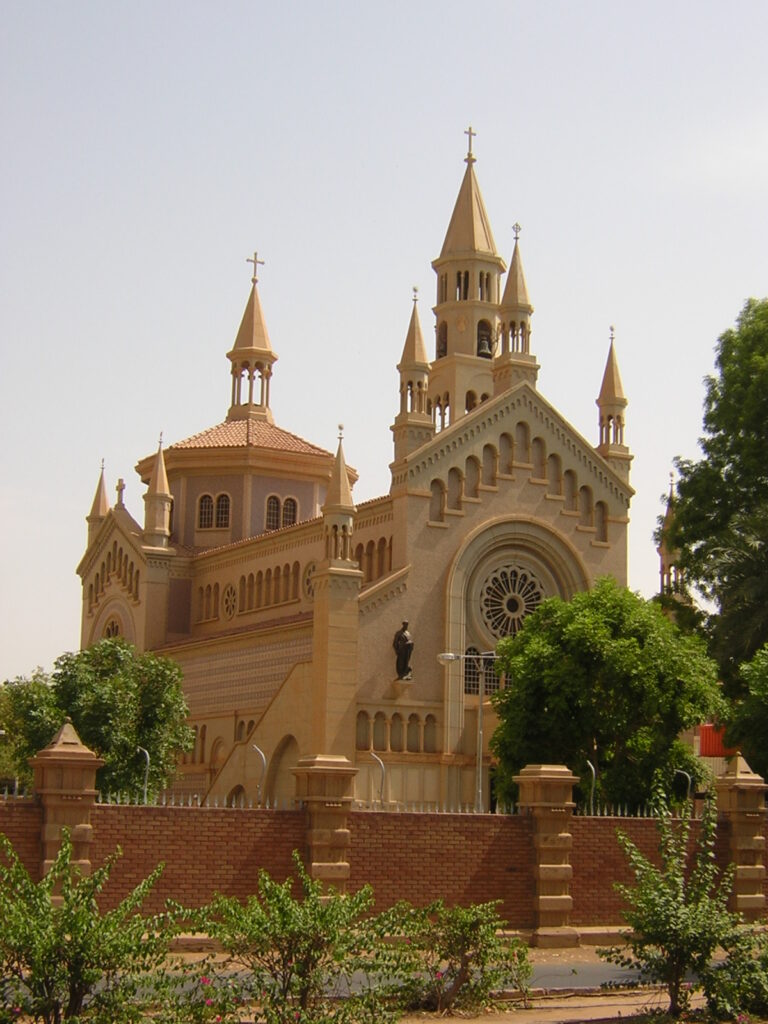
Nor does it include, in official documents or in repertory of Marian sanctuaries, the existence of a Canonically recognized Marian sanctuary with the name "Our Lady in Khartoum" (for example, as a national sanctuary, diocesan or Marian minor basilica). There are important temples in the capital where the Virgin is venerated (for example, the Catholic Cathedral of Latin Rite and other parish churches), but these are not formally registered as a Marian sanctuary with a specific title. In pastoral practice, the Virgin is honored in the main temples of Khartoum within the ordinary liturgical and devotional life of the diocese, without a unique Marian sanctuary under this name.
Sponsorship and coronation
It does not know that "Our Lady in Khartoum" is official employer of the city of Khartoum, of a specific diocese or of the Sudanese nation with that specific title. The Church in Sudan, in its public documents, often highlights the figure of the Virgin in general, as well as the memory of Saint Josefina Bakhita, but without declaring a particular Marian patronage linked to that advocation.
With regard to a possible canonical coronationthere is no documented canonical coronation of an image entitled "Our Lady in Khartoum" or a pontifical decree recognizing her as such, and it should therefore be expressly stated: does not contain a documented canonical coronation.
Party and devotion
No consta una litigation fiesta propia of "Our Lady in Khartoum" inscribed in the particular calendar of Sudan or in the universal calendar, different from the usual Marian festivals of the Latin Church (Immaculate Conception, Maternity of Mary, Asunción, Our Lady of the Rosary, etc.). In the Sudanese Catholic communities, these Marian parties are celebrated with solemnity, often linked to moments of prayer for peace, for migrants and for victims of violence, inspired by the example of Saint Bakhita as a witness of reconciliation and forgiveness.
The Marian pilgrimages in Sudan are generally carried out towards the main churches and missionary centers where a particularly venerated image of the Virgin is preserved by the local community, but there is no great national pilgrimage specifically associated with the title "Our Lady in Khartoum." The forms of devotion include the community prayer of the Rosary, novies, modest processions and acts of consecration to the Virgin, with a strong dimension of supplication for freedom, justice, coexistence between ethnic groups and religions and the protection of the most vulnerable, in resonance with the historical experience of the country and with the memory of Bakhita.
No reliable data from numerical flow of the faithful linked to a feast of this advocation, since such a feast does not appear as its own title in the calendars of consultation.
Link to the Rosary
No record of a relationship specific and documented between a formal advocation "Our Lady in Khartoum" and the prayer of the Rosary (for example, particular promises, apparitions linked to the Rosary or decrees that relate it exclusively to this prayer). In the Sudanese Catholic pastoral, the Rosary prays as in most of the Latin Church, especially in times of difficulty, persecution or war, and is spontaneously associated with the intercession of the Virgin.
From a general Marian perspective, the Rosary It is a privileged way for Sudanese Catholics to join the Mother of God on the journey of faith, especially in contexts of suffering similar to those of Saint Josefina Bakhita. To meditate on the joyful, luminous, painful and glorious mysteries allows us to reread our own history marked by slavery, conflicts and dispersion, in the light of the life of Christ contemplated with the eyes of Mary. The Rosary, in this sense, accompanies Marian devotion in Sudan as a school of patience, forgiveness and hope, even if there is no local Marian advocation formally defined under the name "Our Lady in Khartoum."
A flower for the Virgin
It offers a simple prayer to this advocation. Pray a Hail Mary for Sudan and for world peace.
Pray Hail MaryIs the advocation of the Virgin Mary of your people missing?
Si no encuentras la advocación mariana de tu ciudad o pueblo, cuéntanosla: la investigaremos para ubicarla y darla a conocer en este mapa del amor de la Madre por el mundo.
Propose an apvocation →