
Marian devotion
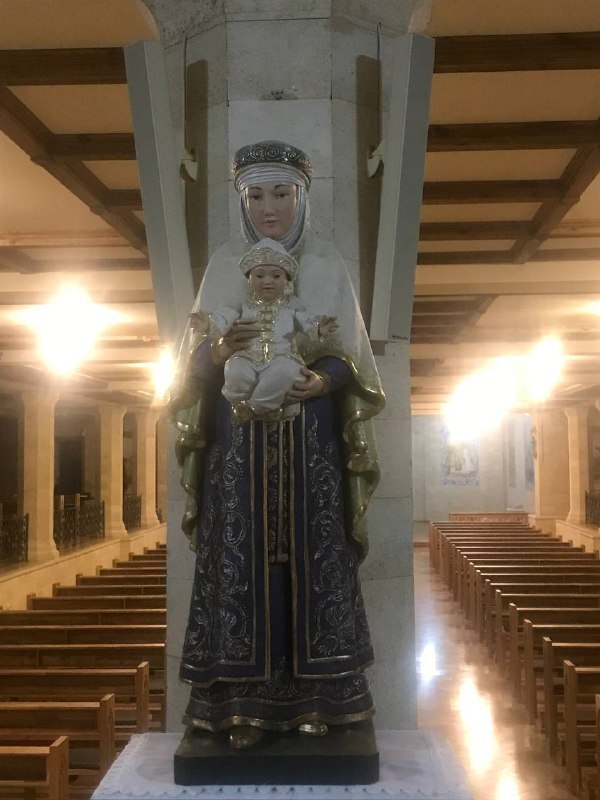
Our Lady of Fatima of Karaganda
Patron of Karaganda or the Kazakh nation
The Cathedral of Our Lady of Fatima - also called Cathedral of the Blessed Virgin Mary of Fatima, Mother of all Peoples- is located in Karagandá, in the region historically marked by the complex of Soviet work camps known as Karlag, one of the largest in the Gulag system. Many Catholics were deported there, largely Volga Germans, Poles, Ukrainians and other villages from Eastern Europe, who kept Marian faith and devotion in conditions of persecution. This memory of the persecuted Church is in the spiritual origin of the sanctuary.
Main data
Origin and history
The Cathedral of Our Lady of Fatima - also called Cathedral of the Blessed Virgin Mary of Fatima, Mother of all Peoples- is located in Karagandá, in the region historically marked by the complex of Soviet work camps known as Karlag, one of the largest in the Gulag system. Many Catholics were deported there, largely Volga Germans, Poles, Ukrainians and other villages from Eastern Europe, who kept Marian faith and devotion in conditions of persecution. This memory of the persecuted Church is in the spiritual origin of the sanctuary.
La documented history of the cathedral begins with the project of the Bishop of Karagandah (then Mons. Jan Lenga and later Msgr. Athanasius Schneider) of building a great church that made visible the presence of the Catholic Church in the ancient "land of the Gulag." The construction was carried out thanks to donations from faithful from all over the world and lasted several years; the cathedral was solemnly inaugurated and opened to veneration in September 2012, being described as the largest Catholic church in Kazakhstan and, according to various chronicles, also the largest cathedral in Central Asia.
As regards tradition and spiritual memory, various testimonies remember that the Catholics deported in Karlag were gathered secretly to pray, often without a priest, holding their hope with devotion to the Virgin, especially through the Rosary. It is considered, at the devotional level, that the cathedral is a kind of "grateful response" to the protection of Mary in that time of suffering, although these elements belong more to the believer memory that to precise legal or chronological data.
The image and the sanctuary
The title is that of Our Lady of Fatima, linked to the 1917 apparitions in Fatima (Portugal), but incarnate here in a Kazakh context marked by martyrdom and deportation. The available sources above all highlight the nature of the catedral and memorial, more than the detailed description of a single main image. There is no precise and secure description of the image type (material, author, exact date, iconographic style); therefore, no consta in detail a different iconography from the usual representation of the Virgin of Fatima (Mary standing, with rosary in her hands and white attire).
The temple is officially named after Cathedral of the Blessed Virgin Mary of Fatima, Mother of all Peoples, y es la Cathedral of the Diocese of the Most Holy Trinity in Almaty based in Karagandah according to the ecclesiastical reorganization of the country; in practice it functions as one of the main centers of Latin rite Catholicism in Kazakhstan. It's built on neoGothic style, revestida con stone from the Caucasusand rises in a significant place because of its proximity to former Soviet work camps, as a sign of reconciliation and memory. The chronicles describe it as the the largest Catholic church in Kazakhstan and one of the largest in Central Asia.
It is not known that the cathedral has the title of minor basilica is officially designated as National sanctuary; its canonical range is that of diocesan catedral of the Latin rite.
Sponsorship and coronation
La advocación de Our Lady of Fatima of Karaganda is closely linked to the Catholic community of the region and, in particular, to the memory of the deportees and martyrs of the Kazakh Gulag. It actually works as a reference centre for Catholics in Kazakhstan, especially Latin rite, though no consta a formal decree declaring her the principal patron of the city of Karagandá or of the Kazakh nation.
As for a canonical coronation of the image of Our Lady of Fatima in this cathedral, does not contain a documented canonical coronation in the sources consulted (Vatican, Catholic press, diocesan chronicles available). There are solemn celebrations, especially in the framework of the centenary of Fatima, but there is no mention of a canonical coronation rite recognized by the Holy See for this concrete image.
Party and devotion
The main feast of this advocation is celebrated 13 May, in line with the liturgical memory of Our Lady of Fatima in the Latin Church and with the anniversary of the first apparition in Portugal. In 2017, the centenary of the apparitionsPope Francis sent a Special Envoy (Cardinal Paul Josef Cordes) to the Cathedral of Our Lady of Fatima of Karagandá to preside over the celebrations of May 13, which underlines the importance of this temple in the Mapamundi of Fatimite devotion.
The sources describe a living devotion among the Catholics of Kazakhstan, many of them descendants of deportees or ethnic minorities of Catholic tradition. The cathedral welcomes Solemn masses, processions and prayer meetingsespecially around 13 May and other significant Marian dates. There are no precise statistical data of annual inflow, but the reports highlight the presence of faithful from various regions of the country and from neighbouring countries, as well as of communities of German, Polish and Ukrainian origin that keep the memory of the persecution.
La popular tradition It spontaneously unites devotion to Our Lady of Fatima with the memory of the suffering suffered in Karlag: the cathedral is seen as a "sign of resurrection" in a place marked by death and injustice. The prayer for the deceased of the fields, the commemorative masses and the invocation of Mary as "Mother of all Peoples" are recurring features of the spirituality of the place.
Link to the Rosary
La devoción a Our Lady of Fatima is essentially linked to prayer of the RosaryAccording to the message transmitted in 1917 to the pastors in Portugal, where Our Lady insistently asks the prayer of the Rosary for the peace and conversion of sinners. The cathedral of Karagandá, in taking up this vocation, takes part in the same spirit: the celebrations of May 13 and other Marian parties usually include the Community Rosaryespecially in the context of the centenary of Fatima and local pilgrimages. Although it does not contain its own detailed regulations on specific times or forms, the prayer of the Rosary is an ordinary part of Marian piety linked to this church.
In addition, the memory of the Catholics deported in Karlag further highlights the role of the Rosary: numerous testimonies from the Soviet era in Kazakhstan point out that, in the absence of temples and priests, the Rosario was the domestic and clandestine prayer that held the faith of entire familiesincluding the Volga and Polish German communities. Even when it is not possible to document each particular case, the experience of the Church in the countries under the Soviet regime shows that the Rosary was one of the most widespread forms of secular prayer.
In this context, the Our Lady of Fatima of Karaganda y with gra
A flower for the Virgin
Offer a simple prayer to this Marian devotion. Pray a Hail Mary for Kazakhstan and for world peace.
Pray Hail MaryIs the advocation of the Virgin Mary of your people missing?
Si no encuentras la advocación mariana de tu ciudad o pueblo, cuéntanosla: la investigaremos para ubicarla y darla a conocer en este mapa del amor de la Madre por el mundo.
Propose an apvocation →