
Marian devotion
Marth Mariam de Kuravilangd
Advocación marijuana de Kuravilangad (Kottayam) (Kerala)
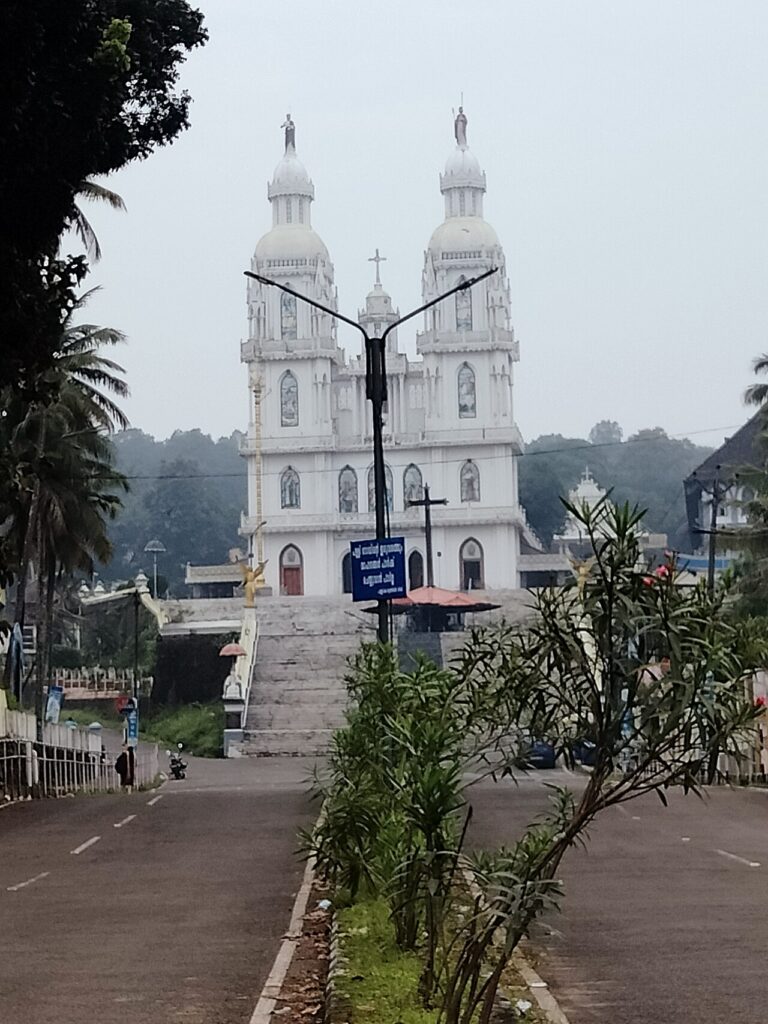
According to the tradition the church of Marth Mariam (Santa Maria) of Kuravilangad has its origin in a apparition of the Virgin Mary to a group of children by a wellasking them to build a church there in their honor. This tradition places the event towards the siglo IVand is commonly considered as the first story of Marian apparition in India within the Christian memory of Kerala, linked to the ancient communities of the "Christians of St. Thomas." This story is part of the popular piety of the region, transmitted from generation to generation, but is not based on contemporary documentation to the facts.
Main data
Origin and history
According to the tradition the church of Marth Mariam (Santa Maria) of Kuravilangad has its origin in a apparition of the Virgin Mary to a group of children by a wellasking them to build a church there in their honor. This tradition places the event towards the siglo IVand is commonly considered as the first story of Marian apparition in India within the Christian memory of Kerala, linked to the ancient communities of the "Christians of St. Thomas." This story is part of the popular piety of the region, transmitted from generation to generation, but is not based on contemporary documentation to the facts.
As for the documented historythe sources of the Syrian-Malabar Church and studies on the sanctuaries of Kerala consider Kuravilangad as one of the oldest Marian parishes in the Christianity of St. Thomaswith origin prior to the arrival of the Portuguese, although the clearer written references are located in the Middle Ages and modern times. It does not accurately contain a certain date of documented foundation, or contemporary acts of the alleged apparition of the fourth century; historical reconstructions are based primarily on later ecclesiastical chronicles, the continuity of the local Christian community and the importance of the sanctuary within the network of Syrian-Malabar churches.
During the later centuries, the church of Kuravilangad was consolidated as important Marian regional center, associated with the Syrian-Malabar rite and the tradition of the Christians of St. Thomas. Over time, the temple was ampliado y renovado, according to the typical architecture of Kerala and with contributions from colonial times, until reaching the current building, which remains a reference point for the Marian devotion of the area.
—
The image and the sanctuary
In the sanctuary of Kuravilangad venerates the Virgin under the title of Marth Mariam (Santa Maria), according to the Syrian-Malabar liturgical tradition. There is no very detailed technical description of the main image (exact type of size, date, author, material); the representation responds to the scheme of a image of the Virgin Mary with the Child Jesus or other Marian iconography of the Syrian-Malabar environment. Since the parish sources do not clearly specify material or image dating, no con seguridad if it is a wooden size, a stone image or other support.
The temple is usually known as Iglesia de Marth Mariam de Kuravilangad (en inglés, “Marth Mariam Forane Church, Kuravilangad”). Pertenece a la Syrian Catholic Church - Malabar and is located in the district of Kottayam, estado de Kerala, India. It is not established in the documentation consulted that the temple has been elevated to the title of minor basilica or declared National sanctuaryabove all, it is recognized as important Marian sanctuary regional within the epoch of Palai. Nor has there been any explicit reference to formal recognition as "diocesan sanctuary" with specific decree; in any case, its character as a place of Marian pilgrimage is clear in pastoral practice.
Architectural, the temple corresponds to the style of many ancient churches of Kerala: traditional structure adapted to the Syrian-Malabar liturgy, with successive remodeling. The church rises in a large parish complex, with spaces for celebrations, pastoral and well that tradition links to the apparition of children, an element that forms an important part of the devotional memory of the place.
—
Sponsorship and coronation
La advocación de Marth Mariam de Kuravilangd exercises a strong patronazgo local on the Christian community of Kuravilangad and its surroundings, being a main Marian reference for the faithful of the Syrian-Malabar epoch of Palai. There is no specific decree proclaiming the patron of a city, municipality or the whole diocese with a formal canon title, but in practice its sanctuary works as Marian reference center for many peoples of the region.
On a canonical coronation of the image, in the sources consulted (ecclesial documentation available online, historical synthesis and news of the Catholic press) does not contain a documented canonical coronation granted by the Holy See or made on its behalf by a pontifical delegate with specific decree. As a result, neither the year nor the Pontiff involved can be indicated with certainty.
—
Party and devotion
Kuravilangad tradition celebrates in a special way dos fechas marianas linked to the sanctuary:
– 15 January: fiesta local importante en honor de Marth Mariam, con celebraciones litúrgicas propias del rito siro-malabar y fuerte participación popular. – August 15: solemnidad de la Assumption of the Blessed Virgin Marywhich in India also coincides with the Independence Day, which gives the day a double civil and religious significance. In the sanctuary, August 15 is one of the great dates of Marian pilgrimage.
During these holidays, the Kuravilangad shrine receives numerous pilgrims from the region of Kerala and other parts of India, belonging not only to the Syrian-Malabar rite, but also to other rites and faithful of various backgrounds. There is no official influx figure, but local testimonies and ecclesial news highlight the character masivo of the pilgrimages on the main days.
Between the Devotional features characteristic are:
– La participación intensa en la Santa Qurbana (Eucaristía) según el rito siro-malabar, con énfasis mariano en la predicación y en los cantos. – Procesiones marianas por los alrededores del templo, especialmente en las fiestas de enero y agosto. – Visita y oración junto al well linked to the apparition tradicional, que muchos fieles consideran un lugar de gracia particular. – Prácticas de novena and other Marian prayers of Syrian-malabar spirituality.
—
Link to the Rosary
In the available documentation on the shrine of Marth Mariam de Kuravilangd no consta una specific and unique relationship with the prayer of the Rosary (for example, a historical fellowship of the Rosary or a feast of its own explicitly titled "of the Rosary" linked to this advocation). The Marian devotion of the temple focuses mainly on the veneration of St. Mary under the title of Marth Mariam and on the great Marian parties of the Syrian-Malabar calendar.
However, the Catholic spiritual life of Kerala, el Rosary It is a widespread practice in families and parish communities. In a Marian sanctuary as significant as Kuravilangad, the Rosary naturally accompanies devotion: many faithful pray the Rosary before or after the Qurban, during pilgrimages or in the ninth, contemplating in their mysteries the life of Christ in union with Mary. So, even if there is no link
A flower for the Virgin
It offers a simple prayer to this advocation. Pray a Hail Mary for India and for world peace.
Pray Hail MaryDocumented extension: Kuravilangad and Muthiyamma
The file corresponds to the same temple of Santa Maria de Kuravilangad, in Kerala, attended by the Syrian-Malabar Church. The source Catholics & Cultures It presents it as a foreign church of the Syrian-Malabar tradition and collects the continuity of devotion to Muthiyamma. Kerala Tourism also identifies it as a religious place in Kuravilangad. These sources allow us to describe the sanctuary and its present cult without turning all the dates transmitted by the community into a proven history.
Local tradition places the foundation in the year 105 and the apparition before pastors in the year 335. The public documentation verified for this batch does not provide a coetane record confirming those dates. That is why they remain the tradition of the place. What can be affirmed is the existence of an ancient ecclesial community, the presence of venerated elements such as bells and altars, and the continuity of pilgrimages to the temple and the spring associated with Muthiyamma.
The account of the pastoral children, the spring and the request to build a church belongs to the devotional memory of Kuravilangad. The transformation of stones into bread and the exact attribution of a year are part of the legendary development of the story. This distinction does not despise the faith of those who pray there: it orders each statement according to what is recorded, what is transmitted and what has not been the subject of a located supernatural pronunciation.
The source consulted notes that the place received special pastoral recognition as a major archbishopric pilgrimage center in 2018. This is a fact about the organization and ecclesial relevance of the sanctuary; it does not amount to a decree declaring the apparition supernatural. Consequently, the form retains the expression permitted veneration for public Catholic veneration and leaves it indicated that there is no approval of the supernatural of the traditional apparition.
The mapping point and the metadata that already had the tab are kept intact. The inherited coordinate identifies the town of Kuravilangad, does not aim to point to a specific altar, and this extension does not achieve the mapping normalization corresponding to Claude / M1. The Marian prayer of this place is understood as Mary's request for intercession before God, never as the worship of the Virgin.
Additional sources: Catholics & Cultures, Saint Mary’s Forane, Kuravilangad y Kerala Tourism, St. Mary's Church Kuruvigand, HTTP 200 queries archived in the lot.
Is the advocation of the Virgin Mary of your people missing?
Si no encuentras la advocación mariana de tu ciudad o pueblo, cuéntanosla: la investigaremos para ubicarla y darla a conocer en este mapa del amor de la Madre por el mundo.
Propose an apvocation →