
Marian devotion
Panagia by Kykou
Marian vocation of Kykkos (Cyprus)
According to the tradition of the Cypriot Orthodox Church, the icon of the Panagia by Kykou (Our Lady of Kykkos) was painted by Luke the Evangelist and taken to Cyprus by the Byzantine Emperor Alejo I Comneno (1081-1118). In the legendary accounts, the Virgin would have appeared in a dream to the emperor asking him to send the icon to the island, where he would be guarded on the Troodos mountains. The tradition also reports the mediation of a local hermit and an imperial governor so that the icon finally came to the place where the Kykos monastery would then rise.
Main data
Origin and history
According to the tradition of the Cypriot Orthodox Church, the icon of the Panagia by Kykou (Our Lady of Kykkos) was painted by Luke the Evangelist and taken to Cyprus by the Byzantine Emperor Alejo I Comneno (1081-1118). In the legendary accounts, the Virgin would have appeared in a dream to the emperor asking him to send the icon to the island, where he would be guarded on the Troodos mountains. The tradition also reports the mediation of a local hermit and an imperial governor so that the icon finally came to the place where the Kykos monastery would then rise.
As for the documented history, the monastery of the Royal Holy and Stavropégico of the Panagia of Kikkos dates back to the 11th century and was founded under the empire of Alejo I Comneno. However, the exact origin of the icon and its authorship cannot be verified historically and fall within the scope of pious tradition, not critical documentation. The monastery has been one of the most important monastic and pilgrimage centers in Cyprus since the Middle Ages and is considered the main monastery on the island.
Over the centuries, the monastery suffered fires and reconstructions; the current buildings are the result of various stages, especially of modern times, while the icon has been protected with precious metal coatings to preserve it. During the history of Cyprus, the Monastic Community of Kykkos has also played a significant role in cultural life and, at certain times, in the affirmation of the national Cypriot identity.
The image and the sanctuary
The image of the Panagia by Kykou is a Marian icon of the type Panagia Eleousa (Virgin of the Ternure or Source of mercy), in which the Virgin sustains the Child Jesus and supports her face in her, according to the traditional description. The icon is considered one of the three attributed by tradition to Luke, although this attribution is not historically verifiable. Since the 16th century it has been covered in gold and silver (about 1576), and also covered by a veil, so that it is never discovered before the faithful. Therefore, the direct contemplation of the face of the Virgin is reserved for the mystery and faith, and the veneration focuses on the covered icon.
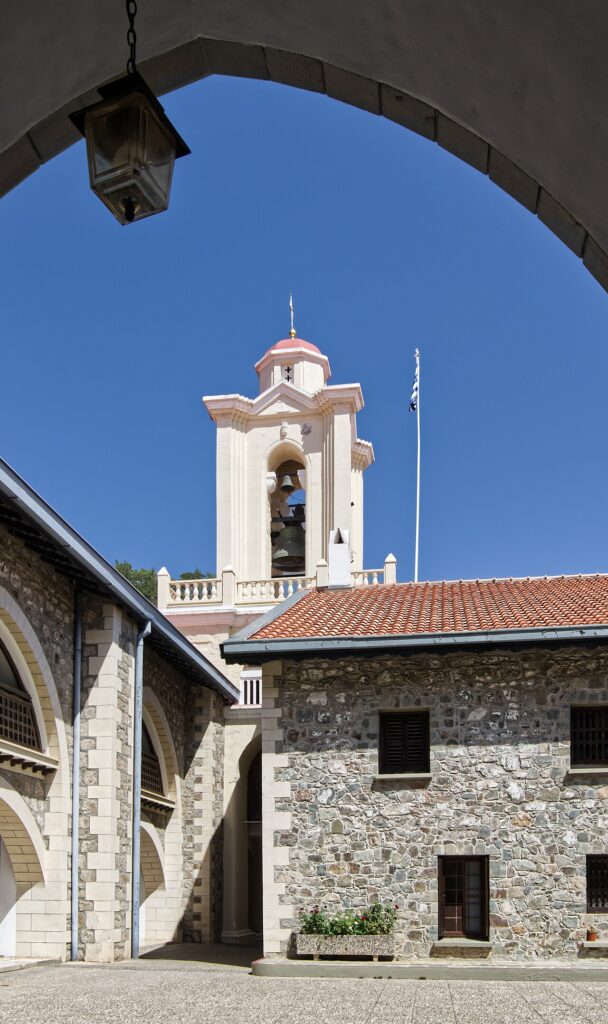
The sanctuary where it is venerated is the Monastery of the Royal Santo and Stavropégico of the Panagía of Kikkos (Ιερά Μονή της Παναγίας του Κύκκου), más conocido como monasterio de Kikkos. It is located on the Troodos Mountains, in the Kykkos region, in the current Republic of Cyprus. According to the documentation, it is the major monastery of the entire island and is canonically under the jurisdiction of the Orthodox Church of Cyprus. The monastery is dedicated to the archangel Michael, although the presence of the Kykkos Panagia icon has shaped its identity as one of the great orthodox Marian shrines of the Eastern Mediterranean.
Architectural, the monastery presents a wide set of monastic buildings, main church with rich iconostasiums, porticated patios and museums that preserve liturgical objects, manuscripts and icons of great historical and artistic value. It is not known that the temple has the title of a minor basilica or a proclamation as a national sanctuary by the Catholic Church; it is a sanctuary of the Orthodox tradition.
Sponsorship and coronation
La Panagia by Kykou is considered one of the most venerated Marian icons of Chipre and, in popular piety, has a strong character of protection over the island and its people. In a number of historical accounts, he is given interventions in favour of the Cypriot nation, especially in times of trial, which has consolidated his fame as a protector of the country. However, there is no formal and specific proclamation, in Western canonical terms, that the officially national patron name; therefore, as to patronage Legal concrete (city, diocese, nation) does not contain a title specified in the sources consulted.
On a possible canonical coronation (according to the discipline of the Catholic Church), there are no reliable data indicating a coronation ceremony by the command of a Roman Pontiff or his delegate. Since it is a venerated icon in the Orthodox Church of Cyprus, and in the absence of precise references, it should be indicated: does not contain a documented canonical coronation.
Party and devotion
In the Monastery of Kykkos are held of the great Marian festivities related to the veneration of the Kikkos Panagia: the August 15 (Sleep / Assumption of the Virgin Mary) and the September 8 (Nativity of the Virgin). At this time, a great religious festival is organized, with solemn liturgy, processions and the influx of many pilgrims from all over the island and from the Cypriot diaspora.
Devotion is expressed mainly through the pilgrimage to the monastery, the veneration of the covered icon - kissing the frame or coating of precious metal -, lighting cirios and making requests for intercession, especially for the health, family and protection of the country. Various testimonies of travellers and guides describe a constant influx of faithful and visitors, who perceive in Kykkos one of the most significant spiritual places in Cyprus.
The popular religiosity around the Panagia tou Kykkou also includes the use of it in times of national crisis or natural disasters, invoking it as Source of mercy and protection of the people.
Link to the Rosary
En la Orthodox tradition to which belongs the Panagia tou Kykkou, the prayer of Rosary does not take the same place as in Latin Catholic spirituality; Marian devotion is expressed above all by the veneration of icons, liturgical parties and the prayer of Jesus (komboskini), rather than through the Dominican Rosary. It does not contain, in the sources consulted, a specific or historical relationship documented between this icon and the practice of the Rosary as understood in the Catholic Church.
However, from a general Marian perspective, the faithful Catholic can see in the Panagia tou Kykkou an image that harmonizes with the mysteries of the life of Christ and Mary which the Rosary proposes. The type icon Eleousa It highlights the closeness and tenderness between Mother and Son, which invites us to meditate on the joyful mysteries and incarnation of the Word. The veneration of the icon, even in the silence and veil that covers it, can be integrated into the prayer of the Rosary as a help to enter into the contemplation of the Virgin, humble servant and Mother of mercy, whose intercession is implored in both the East and the West.
A flower for the Virgin
It offers a simple prayer to this advocation. Pray a Hail Mary for Cyprus and for the peace of the world.
Pray Hail MaryIs the advocation of the Virgin Mary of your people missing?
Si no encuentras la advocación mariana de tu ciudad o pueblo, cuéntanosla: la investigaremos para ubicarla y darla a conocer en este mapa del amor de la Madre por el mundo.
Propose an apvocation →