Marian devotion
Our Lady of the Assumption of Buda
Marian devotion of Budapest (Center)
The church of Our Lady of the Assumption of the castle of Buda (Budavári Nagyboldogasszony-templom), popularly known as church of Matías, is a medieval Catholic temple in the Buda Castle district of Budapest. The tradition of the city links this temple to the cult of the Virgin Mary under the mystery of the Assumption, which gives its official title to the building.
Main data
Origin and history
The church of Our Lady of the Assumption of the castle of Buda (Budavári Nagyboldogasszony-templom), popularly known as church of Matías, is a medieval Catholic temple in the Buda Castle district of Budapest. The tradition of the city links this temple to the cult of the Virgin Mary under the mystery of the Assumption, which gives its official title to the building.
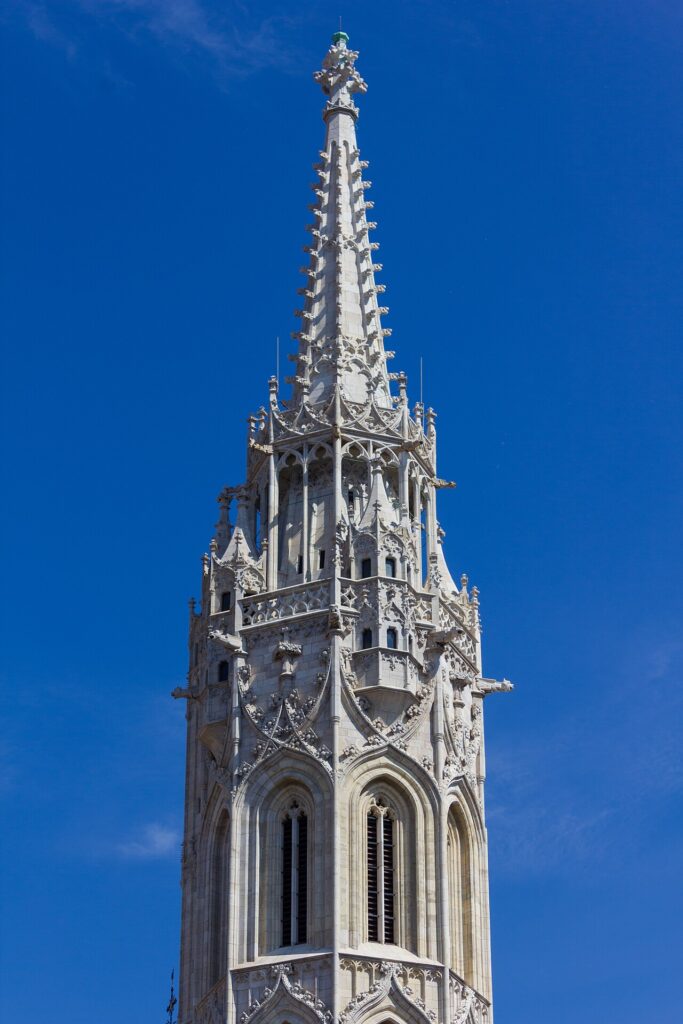
According to the documented historythe church has Gothic origin and it began to be built in the 13th century, in the time of King Béla IV, and was later extended by the monarchs that happened to him. In the 15th century, King Matias Corvino ordered the building of the famous south tower, about 70 metres, which became one of the most characteristic features of the temple and gave rise to the popular name "Church of Matias." After the Turkish occupation, the temple suffered various uses and damage and was deeply restored in the 19th century (reconstruction started in 1874 and completed in 1896 under the direction of architect Frigyes Schulek).
As for the tradition or legend linked to the Virgin, various tourist and outreach sources mention the Marian character of the temple and its link to the history of the reconquest of Buddha against the Turks, but there is no detailed description, with primary sources, of the alleged miraculous "reappearance" of a Marian image in 1686 against the Turkish invaders. There is also no official account of the sanctuary in the sources consulted, which specifies this fact as a contrasting historical event. The history of "reappearance" must therefore be considered, at least from a critical point of view, as undocumented pious tradition in available sources.
The image and the sanctuary
The sources consulted point to the Marian title of the temple ("Church of Our Lady of the Assumption," Church of Great Happiness), but do not accurately describe a concrete image of the Virgin (type of sculpture or painting, material, dimensions or specific iconography) that can be identified as the "main image" of Our Lady of Buddha's Assumption. In the tourism and outreach resources, emphasis is placed on the architectural and historical value of the building, without detailing the central devotional piece. Therefore, on the concrete image of the Virgin no constain the sources consulted, a rigorous iconographic description (type, material, attributes).
On the other hand, information on the sanctuary / temple It's abundant. It is a Catholic church, predominantly Gothic with neo-Gothic restorations, located on the hill of the Buda Castle, next to the Bastion of the Fishers, in the castle district. It is one of the oldest and most emblematic churches in Budapest and is considered one of the historic temples of the city. The façade, the high tower attributed to King Matias and the richly decorated interior complex (including vitral and neo-Gothic wall paintings) make this temple an architectural and religious reference of the Hungarian capital.
The sources consulted do not explicitly mention it as minor basilica or as a "national sanctuary" in ecclesial documents; it is presented as a important parrochial and historical iglesia of the city, linked to the religious and ceremonial life of Hungary (royal coronations, solemn celebrations, etc.). Therefore, no consta in the revised sources having the canon title of minor basilica and no specific official recognition as a national Marian sanctuary.
Sponsorship and coronation
The official title of the temple ("Our Lady of the Assumption") indicates a special link of the church and the castle area with the Virgin Mary in the mystery of the Assumption. The church of Matías is considered one of the main Catholic temples in Budapest, but the sources consulted do not indicate a proclamación formal of the Virgin of the Assumption of Buddha as official patron of the city, of the diocese or of the Hungarian nation. In accessible documentation no consta a specific canonical patronage decree under this title.
As for a canonical coronation of the main Marian image of the church (according to the rules of the Holy See), in the revised sources (pages of dissemination, historical synthesis, tourist reviews and encyclopedic entrance on the church) does not contain a documented canonical coronation. No date, no pontiff, no pontifical delegate is mentioned for an act of solenne coronation of a concrete Marian image in this temple.
Party and devotion
The title of the temple refers directly to the solemnity of the Assumption of the Virgin Mary (August 15)which in the tradition of the Church is one of the main Marian parties of the year. However, in the documentation consulted on the church of Matias no consta explicitly the date of a specific feast of the sanctuary (for example, a local party other than August 15) and the detailed description of its liturgical celebrations and processions. It can be assumed that, as in the rest of the Latin Church, the Solemnity of the Assumption has a prominent place, but this data is not explicitly documented in the revised sources.
Various tourist and cultural resources present the church as one of the most visited places in the castle district, with a significant influx of faithful and visitors. The temple is shown as a place of worship, of sacred concerts and of guided tours, which implies a constant flow of people, both pilgrims and tourists. However, no constan concrete quantitative data of organized Marian pilgrimages or specific popular traditions (Romerías, Novias Marian own, etc.) linked exclusively to the advocation of the Assumption of Buddha, beyond the general devotion to the Virgin in a historically Marian church.
Link to the Rosary
In the sources consulted on the church of Our Lady of the Assumption of the castle of Buddha (church of Matías) no consta an explicit and specific link between this Marian advocation and the prayer of Rosary (for example, canonically erected copradies of the Rosary, great rosarian pilgrimages or a feast of the Rosary associated with the main image).
However, the mystery of the Assumption of Mary is part of the prayer of the Rosary in the glorious mysteries, and thus the Marian devotion of the temple is naturally integrated into the contemplation of the life of the Virgin proposed by the Rosary. Where the Church venerates the mystery of the Assumption, the Rosary offers a privileged way to meditate on Mary's glorification and her intercession for the Church. In this context, the advocation of Our Lady of the Assumption of Buddha can be viewed, spiritual and catechetically, as a reference to pray the Rosary, especially by contemplating the fourth glorious mystery, uniting the memory of the Christian history of Hungary with the hope of the glory promised to the whole People of God.
A flower for the Virgin
Offer a simple prayer to this Marian devotion. Pray a Hail Mary for Hungary and for world peace.
Pray Hail MaryIs the advocation of the Virgin Mary of your people missing?
Si no encuentras la advocación mariana de tu ciudad o pueblo, cuéntanosla: la investigaremos para ubicarla y darla a conocer en este mapa del amor de la Madre por el mundo.
Propose an apvocation →