
Marian devotion
Our Lady of Liberation
Marian Invocation of Antananarivo (Antananarivo)
In the general repertories of Marian advocations it is recalled that many advocations are linked to a particular place (sanctuaries, cities, regions) and highlight a particular feature of the intercession of the Virgin, such as protection, liberation or help in danger. In this general context, it is likely that the advocation of Our Lady of Liberation in Madagascar has emerged as an expression of the confidence of the Malagasy people in Mary as free and protectiveHowever, there are no sources that accurately describe their historical origin or the foundational circumstances of the sanctuary.
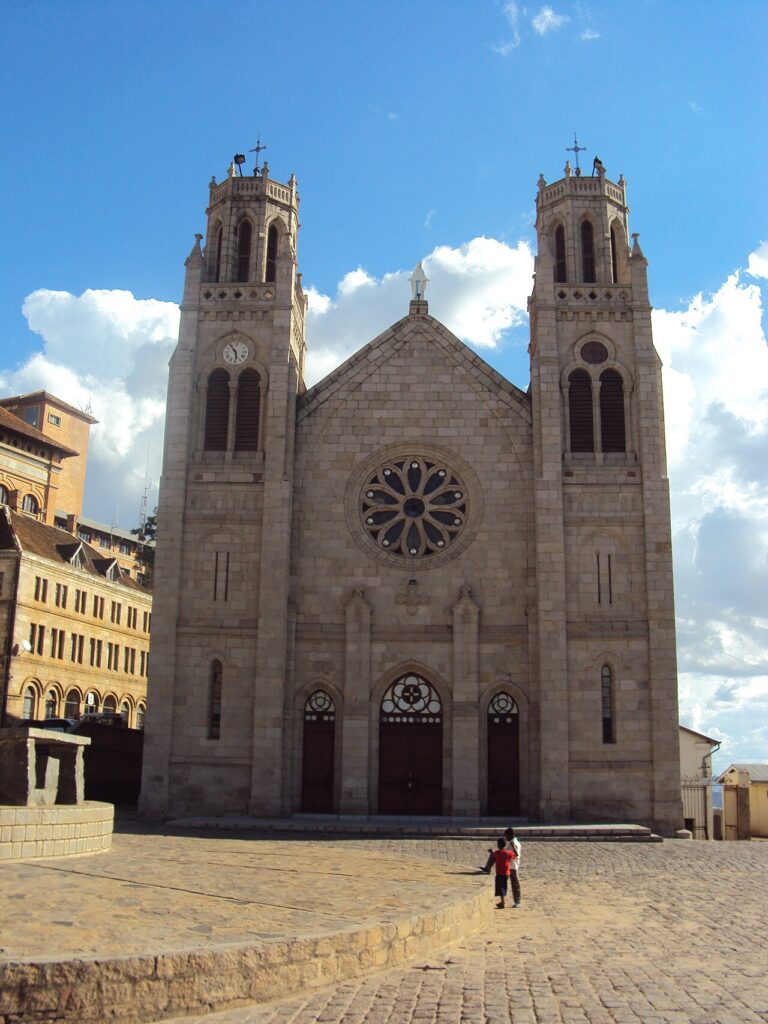
Main data
Origin and history
In the general repertories of Marian advocations it is recalled that many advocations are linked to a particular place (sanctuaries, cities, regions) and highlight a particular feature of the intercession of the Virgin, such as protection, liberation or help in danger. In this general context, it is likely that the advocation of Our Lady of Liberation in Madagascar has emerged as an expression of the confidence of the Malagasy people in Mary as free and protectiveHowever, there are no sources that accurately describe their historical origin or the foundational circumstances of the sanctuary.
No ecclesial documents, diocesan chronicles, official pages of the sanctuary or of the archdiocese have been found, or accessible online marine studies that report an apparition, a prodigious fact, a date of introduction of the cult or the moment when this sanctuary was recognized as a national Marian sanctuary. Consequently, no consta a detailed documented story of this advocation and its sanctuary in Antananarivo.
Since the available research on Marian advocacy underlines the deep insertion of each title into the concrete history of a people and its evangelization, it can be assumed - as a prudent and unproven hypothesis - that devotion to Our Lady of Liberation has developed in the context of the expansion of Latin Catholicism in the central highlands of Madagascar, but no consta Documentally.
The image and the sanctuary
The sources consulted on Marian advocacy do not provide specific data on the image of Our Lady of the Liberation of Madagascar: no consta material (wood, stone, plaster, etc.), art style, iconographic description (position of the Virgin, presence of the Child, symbols of liberation, crown, scepter, etc.).
Nor has it been found in verifiable documentation, the official name of the Marian sanctuary of this advocation in Antananarivo, not a canonical fact sheet that expressly designates it as National sanctuary or as a minor basilica. The general literature on Marian shrines mentions that many become national pilgrimage centres, but does not provide specific details for this case. Therefore:
– No consta con seguridad el official title del templo. – No consta que haya sido declarado minor basilica. – No consta, de modo documentado, el acto por el cual se habría erigido como Marian national sanctuary of Madagascar, even if it is presented in some unofficial devotional contexts.
As a result, it can only be said that this is an advocation venerated in the Latin catholic rite, located in the area of Antananarivo, without greater architectural or legal accuracy-canonical documented.
Sponsorship and coronation
In many Marian vocations, the title of the Virgin is associated with a patronazgo specific about cities, dioceses or nations, or protection from dangers or situations of oppression. In this sense, the name "Liberation" suggests an invocation of Mary as free and protectiveparticularly close to the hopes of the Malagasy people; however:
– No consta, en fuentes oficiales consultadas, una declaración formal que la proclame patrona principal de la nación, de la arquidiócesis de Antananarivo o de una ciudad concreta. – No consta una lista reconocida de patronazgos particulares (profesiones, asociaciones, etc.) vinculados específicamente a esta advocación.
With regard to a possible canonical coronation, known Marian coronations catalogues and the online Catholic press do not record a ceremony officially authorized by the Holy See, nor do they indicate year or pontiff for a coronation of Our Lady of Liberation in Madagascar. Accordingly, according to the above rules:
"there is no documented canonical coronation."
Party and devotion
The general calendar of Marian asvocations usually indicates the date of the liturgical feast of each title, when it has been approved by the Church or incorporated into a particular calendar (diocesan, national or religious family). For Our Lady of the Liberation of Madagascar, no consta in the sources consulted:
– La exact date de la fiesta principal. – La forma específica de celebración litúrgica (memor ia, fiesta, solemnidad) en el calendario local. – Datos oficiales de afluencia annual of pilgrims or related statistical figures.
It is reasonable to think that devotion is expressed by pilgrimages, novena, processions and votive masses, as is the case in most Marian shrines of the world, and that the faithful especially invoke it as in situations of danger, oppression, disease or needbut these features can only be stated in a generic way, without details specific to this sanctuary, because no constan precise documented testimonies.
Link to the Rosary
The general sources on Marian advocacy and on the Rosary emphasize that the prayer of Holy Rosary is one of the most widespread forms of Marian piety in the Church and is present in the life of almost all Marian shrines, even though it is not specifically a "of the Rosary." For Our Lady of the Liberation of Madagascar:
– No consta una documented specific relationship entre esta advocación y el Rosario (por ejemplo, una cofradía del Rosario erigida en el santuario, indulgencias propias, promesas particulares ligadas al rezo del Rosario, etc.). – No constan formularios oficiales de own mysteries or meditations linked to this advocation.
On a broader theological and spiritual plane - and here the reflection is general, not specific to the Virgin, called "of Liberation" - the Virgin is deeply aligned with the Rosary, which travels through the mysteries of Christ's life with Mary. The Rosary remembers the liberation from sin and death worked by Christ, in which Mary participates in a unique way. In this sense, although there is no documented evidence of a particular link, it is consistent that the faithful who come to Our Lady of Liberation in the highlands of Madagascar experience in the Rosary a path of:
– Contemplation de la obra liberadora de Cristo, acompañados por María. – Constant intercession, pidiendo protección y libertad frente a todo aquello que oprime al corazón y a la sociedad. – Union with the Universal Churchwho prays the Rosary in many languages and cultures, recognizing in each Marian advocation a close face of the same Mother of God.
Given the current state of accessible information, any further development of this document should be based on sources of the sanctuary, the archdiocese of Antananarivo or the Episcopal Conference of Madagascar, when publicly available.
A flower for the Virgin
It offers a simple prayer to this advocation. Pray a Hail Mary for Madagascar and for world peace.
Pray Hail MaryIs the advocation of the Virgin Mary of your people missing?
Si no encuentras la advocación mariana de tu ciudad o pueblo, cuéntanosla: la investigaremos para ubicarla y darla a conocer en este mapa del amor de la Madre por el mundo.
Propose an apvocation →