
Marian devotion
Our Lady of Potterie
Marian devotion of Bruges (West Flanders)
According to historical documentation, the Onze-Lieve-Vrouw ter Potterie / Our Lady of the pottery was born as a care institution in the 13th century, on the banks of one of the Bruges channels. In 1276 the existence of a hospital well organized, attended by lay nuns who welcomed pilgrims, travellers and bystanders and cared for the sick. Over time, from 1411, the place also became residence of the elderly for citizens of Bruges, thus integrating health and charitable assistance with religious life and Marian devotion.
Main data
Origin and history
According to historical documentation, the Onze-Lieve-Vrouw ter Potterie / Our Lady of the pottery was born as a care institution in the 13th century, on the banks of one of the Bruges channels. In 1276 the existence of a hospital well organized, attended by lay nuns who welcomed pilgrims, travellers and bystanders and cared for the sick. Over time, from 1411, the place also became residence of the elderly for citizens of Bruges, thus integrating health and charitable assistance with religious life and Marian devotion.
The name "Potterie"is related to the fact that the potters, who had their workshops there by the water, worked in that area. Over the centuries, the hospital and convent expanded, and the church was consolidated as a place of worship and local pilgrimage. Today the set works as church and museum, conserving nursing and historical cloister, as well as numerous works of art, relics and objects related to hospital life and Marian devotion.
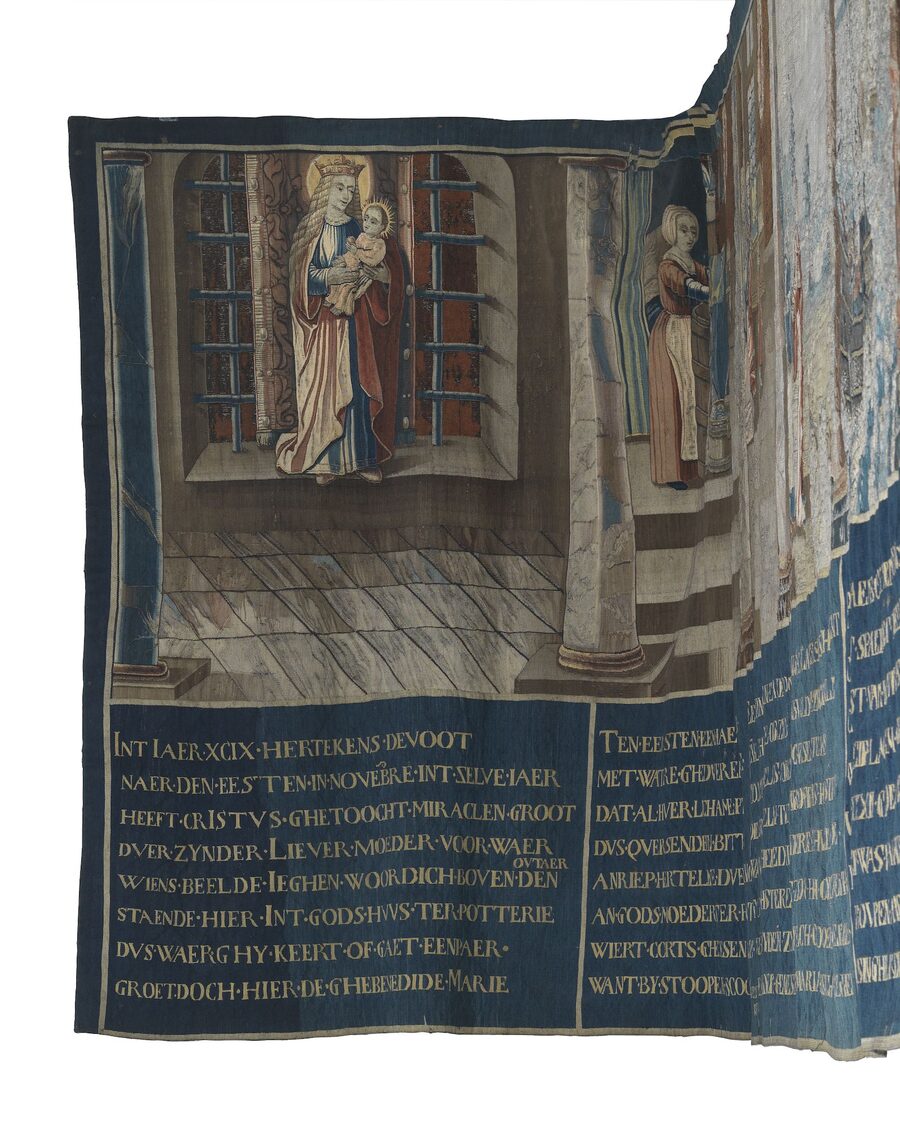
As for the Pious traditionsince the Middle Ages it has been considered that the image of the Virgin venerated in the Potterie is miracleand has intervened in favour of the sick and needy. The miracles attributed were reflected in tapestries, a illustrated miracle book and windows, which testified to the fame of grace of this advocation in the city. These accounts belong to the devotional sphere; the existence of the image and of these artistic testimonies is documented, but the miraculous interventions correspond to the faith of the people.
The image and the sanctuary
En la iglesia de la Potterie se venera una Medieval statue of the Virgin Mary, described as a limestone image of the 13th century, considered one of the oldest of Bruges. It is a small / medium size Marian, in white limestone, traditionally associated with the protection of the sick and the needy; the tourist sources highlight its character. ‘estatua milagrosa’. There is no detailed technical description of the iconography (child's position, specific attributes, etc.) in the sources consulted; it does highlight its antiquity and the fact that the assigned miracles have been collected in tapestries, miracle book and church windows.
El sanctuary is the church of Onze-Lieve-Vrouw ter Potterie / Our Lady of the pottery, integrated into the old hospital and charity house, today museum. The temple has an interior baroque rich in altarpieces, liturgical furniture and religious art, which lives with the historical hospital spaces. It is described as a Gothic church and museum within a complex founded in the 13th century. It is not known that the church has the title of minor basilica it is a local-historical sanctuary within the city of Bruges, with great patrimonial and devotional relevance.
Sponsorship and coronation
Our Lady of Potterie is particularly linked to the city of Brugesand in particular with regard to the assistance to the sick, pilgrims and the elderly, given the hospital origin of the place. The tourist and cultural sources present it as one of the oldest urban charity centres and as a place of Marian pilgrimage, but do not mention a formal appointment as an official patron of the city or of the diocese. There is therefore no Specific canonical patronage (city, diocese or nation) for this advocation in the sources consulted.
As for the canonical coronation, historical and outreach sources (official Bruges tourism information, museum-church descriptions, travel reviews) do not mention any canonical coronation of the icon or image. Given the silence of the specialized sources available, it should be concluded: does not contain a documented canonical coronation.
Party and devotion
The church of Our Lady of the Pottery has been place of pilgrimage for centuries. One of the most characteristic devotional expressions is the Bruges Promise o procession of Our Lady of the Blind, which has as its final destination this church. Its origin is linked to the Batalla de Pevelenberg (1304): According to tradition, the women of Bruges who stayed in the city promised each year to offer a candle to Our Lady of the pottery if their husbands and children returned safe and sound. The pilgrimage and the annual offering were maintained as a gesture of gratitude and supplication to the Virgin.
The sources consulted do not explicitly indicate the liturgical date of a feast of Our Lady of Potterie (exact day in the calendar). There is therefore no precise main holiday date of its own in the documents available. It is true that the church has for a long time been the point of arrival of local processions and pilgrimages, and it retains in its interior numerous testimonies of devotion: tapestries with scenes of miracles, allusive windows and an illustrated book of miracles, as well as exvotes and works of art.
There are no figures of contemporary inflow in the sources mentioned, but it is constantly presented as a relevant spiritual and heritage destination within the religious itineraries of Bruges.
Link to the Rosary
The sources consulted on Onze-Lieve-Vrouw ter Potterie focus on hospital history, miraculous image, processions and artistic heritage, but do not explicitly mention a Rosary fellowship, solemn rosaries or other specific practices linked to the Rosary prayer in this sanctuary. Therefore, does not contain an own and documented link with the Rosary beyond general Marian devotion.
In Catholic spirituality, the Rosary is a privileged way to contemplate the mysteries of Christ's life with the Virgin. In a sanctuary such as the Potterie, marked by the attention to the sick and the memory of the miracles attributed to Mary, the prayer of the Rosary is naturally integrated into spiritual life: the painful mysteries are associated with the suffering of the sick, the glorious to Christian hope, and the joyful and luminous to the filial trust in the intercession of the Mother of the Lord. Although the sources do not contain specific practices, it is consistent that the faithful who come to the image of Our Lady of the Potterie find in the Rosary a simple and profound way to join the Virgin in the supplication and in the thanksgiving.
A flower for the Virgin
Offer a simple prayer to this Marian devotion. Pray a Hail Mary for Belgium and for world peace.
Pray Hail MaryIs the advocation of the Virgin Mary of your people missing?
Si no encuentras la advocación mariana de tu ciudad o pueblo, cuéntanosla: la investigaremos para ubicarla y darla a conocer en este mapa del amor de la Madre por el mundo.
Propose an apvocation →