
Marian devotion
Our Lady of La Salette of Attleboro
Patron of Attleboro
From the perspective of the traditionthe National Sanctuary of Attleboro is spiritually rooted in the apparition of the Virgin Mary to the pastoralists Maximin Giraud y Melanie Calvat September 19, 1846, in La Salette, in the French Alps, where the Virgin manifested herself as "Reconciliation of sinners," calling for conversion, prayer and respect for Sunday. This apparition, recognized by the Church, is the devotional foundation of all the presence of La Salette in the world, including the houses of the Missionaries of La Salette and their national sanctuaries.
Main data
Origin and history
From the perspective of the traditionthe National Sanctuary of Attleboro is spiritually rooted in the apparition of the Virgin Mary to the pastoralists Maximin Giraud y Melanie Calvat September 19, 1846, in La Salette, in the French Alps, where the Virgin manifested herself as "Reconciliation of sinners," calling for conversion, prayer and respect for Sunday. This apparition, recognized by the Church, is the devotional foundation of all the presence of La Salette in the world, including the houses of the Missionaries of La Salette and their national sanctuaries.
As for the documented historythe National Sanctuary of Our Lady of La Salette of Attleboro is officially run by the Missionaries of Our Lady of La Salette, a congregation from the priests in charge of the original French sanctuary and today extended to several continents. The site of the Attleboro shrine itself presents it as National Shrine of Our Lady of La Salette, a centre of evangelization and reconciliation that hosts pilgrims throughout the year. The diocese / "Roman Catholic Community of Attleboro" expressly recognizes the presence of the sanctuary in its territory and invites the faithful to come there for prayer and various celebrations. There is no detailed chronology of the foundation in the sources consulted (the exact year of the beginning of the work in Attleboro), so the precise date of establishment of the sanctuary no consta.
The image and the sanctuary
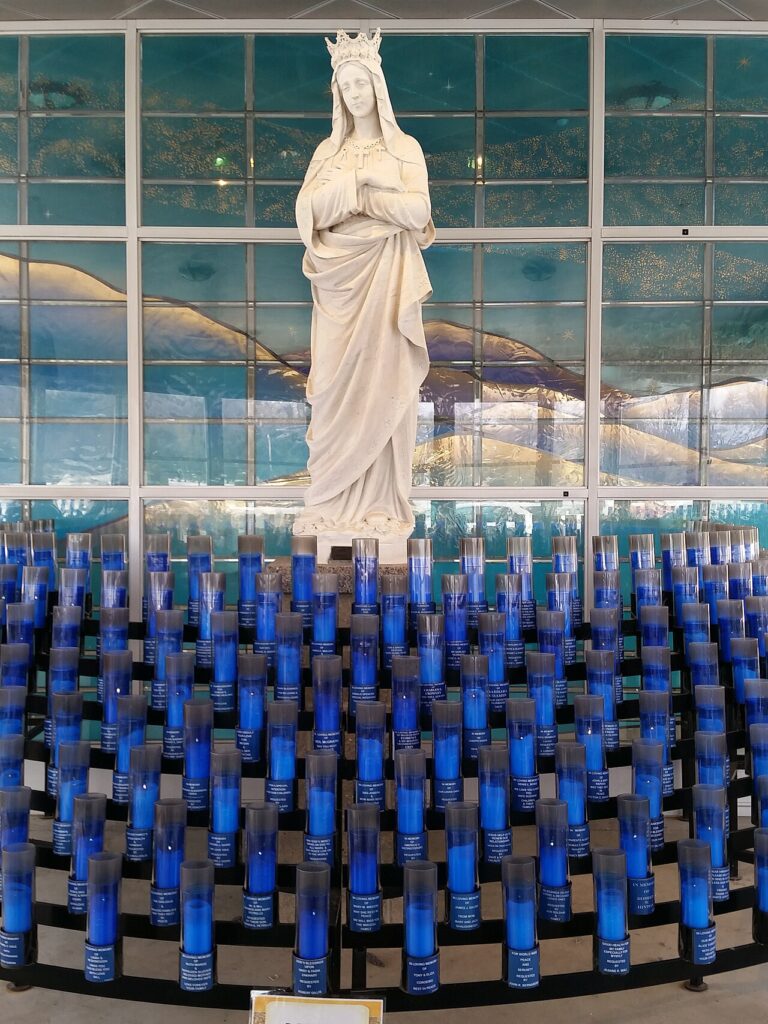
The advocation is usually represented following the iconography of La Salette: The Virgin Mary, dressed in white, with ruby shawl and golden apron, surrounded by roses on her head, waist and feet, with a large glowing crucifix on her chest, flanked by a hammer and a few tongs, and a chain on her shoulders, a sign of penance and pain. This description corresponds to the universal iconographic model of La Salette, also assumed in images, statues and catechetical representations associated with the Attleboro shrine, although the public sources of the sanctuary do not detail material or concrete authorship of a main image; therefore, no consta with documentary precision the type of material (wood, stone, resin, etc.) of the headline image venerated in Attleboro.
The temple and enclosure are officially known as National Shrine of Our Lady of La Salette (National Sanctuary of Our Lady of La Salette). The sanctuary includes a main church, devotional outer spaces, landscaped areas and areas specially designed for the reception of pilgrims, as well as infrastructure linked to the famous display of Christmas lights. According to the pastoral description of the local diocese, it is a sanctuary in the territory of the Catholic community of Attleboro that offers multiple opportunities for prayer and liturgical events. It is not known that the temple has been elevated to the title of minor basilicaor that it has a specific range (e.g. national sanctuary recognized by the Episcopal Conference) other than that which the official site itself is attributed as "National Shrine"; therefore, it can only be said with certainty that it is a Catholic sanctuary under the Latin rite, attended by the Missionaries of La Salette.
Sponsorship and coronation
The sanctuary is presented as “National Shrine” dedicated to Our Lady of La Salette, which indicates a national relevance within Marian pastoral care in the United States, especially in the context of the Missionaries of La Salette. However, there is no explicit statement of canon patronage on a diocese, city or nation by local or national ecclesiastical authority in the sources consulted; therefore, from the legal point of view, no consta a formally proclaimed patronage (for example, principal patron of Attleboro, the state of Massachusetts or a specific diocese). The meaning of "National Shrine" refers rather to its scope of pilgrimage and mission than to an appointment of a canonical patron.
In relation to the canonical coronation of the venerated image in Attleboro, the official sources of the sanctuary and of the diocese do not mention any coronation ceremony approved by the Holy See or by pontifical delegation. There are also no references in other Marian repertories or in the Catholic press consulted. Therefore, following the criterion of historical and canonical rigour, for the image of Our Lady of La Salette in Attleboro does not contain a documented canonical coronation.
Party and devotion
La main party of Our Lady of La Salette, linked to the original message of 1846, is celebrated liturgical the 19 September, a date recognized in various Marian calendars and texts as the day of Our Lady of La Salette or "Reconciliation of sinners." This date also structure the spirituality and programming of Saletine shrines in the world, including the house of Attleboro.
The Attleboro National Sanctuary is especially known for its imposing Christmas Lights Festivalwhich makes the compound a great space illuminated with Christmas and religious motifs, attracting crowds of visitors and pilgrims every year. Public testimonies describe this festival as an entrenched tradition "from childhood" for many families, who return annually to contemplate the lights and participate in spiritual activities. The sanctuary also offers, according to its usual programming, masses, moments of worship, opportunities for confession and other initiatives of evangelization and reconciliation, although the numerical details of annual inflow no constan in available sources.
The devotion to Our Lady of La Salette in Attleboro is articulated around the message of reconciliation: conversion of the heart, confession, return to the Sunday Eucharist and reparation for sins against the Name of God and the day of the Lord, in continuity with the core of the message of the apparition of 1846. The sanctuary is presented as a space where people can find forgiveness, peace and spiritual renewal in the school of Mary, Mother of Reconciliation.
Link to the Rosary
The specific sources of the National Sanctuary of Our Lady of La Salette of Attleboro do not explicitly mention a particular or exclusive link with the Rosary prayeras in other Marian sanctuaries directly focused on this practice; therefore, a special link with the Rosary as an element of the identity of the sanctuary no consta in the documents consulted.
However, as a Catholic Marian sanctuary of Latin rite, the spirituality of La Salette in Attleboro is naturally inserted in the great tradition of the Rosary in the Church. The message of La Salette, focused on conversion, reparation and faithful return to Christ, finds in the Rosary a privileged instrument of meditative prayer: by contemplating the mysteries of Jesus' life with Mary, the faithful is prepared to reconciliation, responds to the call to penance and strengthens the Dominican experience of faith. In this sense, although no exclusive practice is documented, the Rosary can be considered an ordinary and very appropriate way to accompany the devotion to Our Lady of La Salette of Attleboro, in harmony with the charism of the Missionaries of La Salette and its mission to proclaim God's mercy and peace.
A flower for the Virgin
Offer a simple prayer to this Marian devotion. Pray a Hail Mary for the United States and for world peace.
Pray Hail MaryIs the advocation of the Virgin Mary of your people missing?
Si no encuentras la advocación mariana de tu ciudad o pueblo, cuéntanosla: la investigaremos para ubicarla y darla a conocer en este mapa del amor de la Madre por el mundo.
Propose an apvocation →