
Marian devotion
Our Lady of the Snow of Merida, co-patron of the archdiocese of Merida
Marian vocation of Merida (Merida)
About Our Lady of the Snow of Merida (Colombia) accessible information is very scarce and fragmented. The general sources on the advocation of the Virgin of the Snow agree that it is a devotion of Roman origin (linked to the icon of the Salus Populi Romani and to the Basilica of Santa Maria la Mayor), later spread to Spain and to Hispanoamerica, with a feast of 5 August. This expansion explains the presence of the advocation in several places in Colombia, although local stories are almost never detailed.
Main data
Origin and history
About Our Lady of the Snow of Merida (Colombia) accessible information is very scarce and fragmented. The general sources on the advocation of the Virgin of the Snow agree that it is a devotion of Roman origin (linked to the icon of the Salus Populi Romani and to the Basilica of Santa Maria la Mayor), later spread to Spain and to Hispanoamerica, with a feast of 5 August. This expansion explains the presence of the advocation in several places in Colombia, although local stories are almost never detailed.
Specific documented history of Mérida (Colombia): no official data from the archdiocese, the parish or the temple of "Las Nieves" in Mérida (department of Mérida, Colombia) have been located in accessible sources that allow for the precise reconstruction of the historical origin of this local devotion (foundation of the parish, erection as sanctuary, dates of patronage, etc.): no verifiable online documentation. It is clear, in the context of the advocation in the Andean region (Colombia and Venezuela), that this is a devotion implanted in colonial times and associated with the Spanish presence and the imaginary of snow as a sign of Marian protection in the Andean mountains.
Tradition / legend: the advocation of Our Lady of the Snow, in general, is linked to accounts of Extraordinarily snowy as a sign of the intervention of the Virgin, taking as original reference the Roman tradition of a snowfall in the middle of the summer on the Esquilino, which would have indicated the place to build the Basilica of Santa Maria la Mayor. In the Andean context, this tradition has been reinterpreted as a special protection of Mary over the snow mountains and over those who live and travel these places; however, for Mérida (Colombia) does not contain a specific local legend (apparition, punctual miracle or own foundational account) in the sources consulted.
The image and the sanctuary
In relation to the concrete image venerated in the parish - the shrine of Las Nieves in Mérida (Colombia), the available sources do not reliably describe the type, material ni iconografía detallada:: does not show whether it is wood size, clothing image, painting or other form; no data on specific attributes (e.g., Child in arms, snow-related elements, etc.) have been found: does not contain documented iconographic information.
Nor has an official and detailed description of the temple or sanctuary: exact legal name of the parish, date of construction, architectural style, or if it has any special dignity (such as minor basilica, National sanctuary o diocesan sanctuary). As regards this invocation in Mérida (Colombia), it can therefore only be said with certainty that it is venerated in a parish-sanctuary dedicated to Our Lady of the Snowbut does not contain, in verifiable sources, an explicit declaration of special canonical rank (basilica, national sanctuary, etc.).
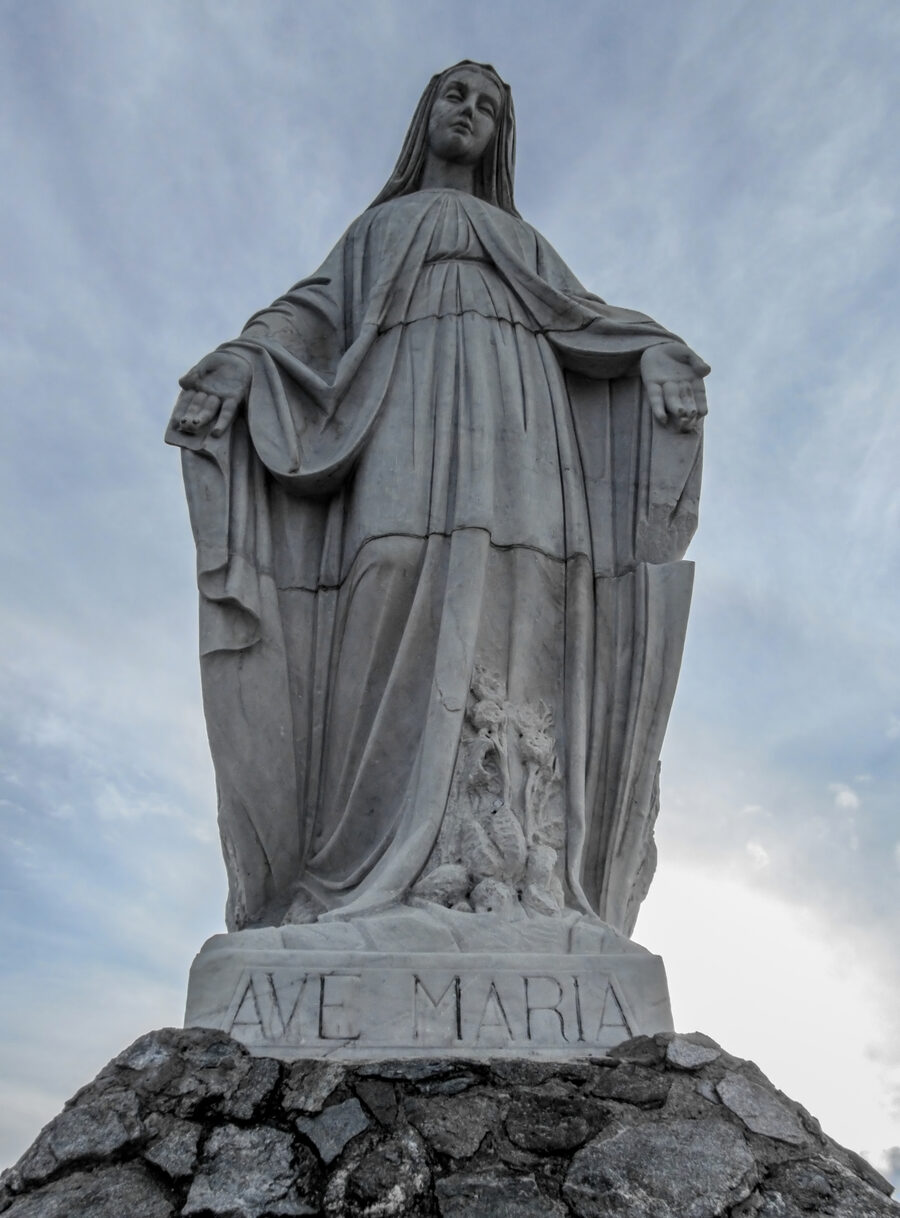
It is important not to confuse this reality with other devotional spaces, such as the monument to Our Lady of the Snow in Pico Espejo, Mérida (Venezuela), a 3.5-meter-high marble sculpture of Carrara, enthroned in 1965 and declared Good of Cultural Interest of the Venezuelan Nation. This Venezuelan image is a patron of mountaineers and andinists, but it belongs to another country and another ecclesial context.
Sponsorship and coronation
The sources consulted on the Virgin of the Snow in Colombia and Venezuela indicate multiple Local levelbut almost always without exhaustively detailing each specific city or diocese. In the specific case of Our Lady of the Snow of Merida (Colombia):
– Patronazgo diocesan/local: an official document of the Colombian Church that explicitly confirms the title of co-patron of the archdiocese of Merida (Venezuela) applied to the venerated advocation in Merida (Colombia)These are different ecclesial realities. So, as far as Mérida (Colombia) and his parish - the sanctuary of Las Nieves, the canonical recognition of a specific diocesan or municipal patronage is not documented (beyond the local devotion that is imposed on him).
– Canon coronation: no reliable reference to canonical coronation (neither pontifical nor episcopal delegation) of Our Lady of the Snow in Merida (Colombia): does not contain a documented canonical coronation.
These data should be distinguished from other well-attested patrons under the same title in other places (for example, Ciudad Bolívar in Venezuela, or various cities in Spain and Argentina), which are described in historical or ecclesial sources. These patterns, however, cannot be automatically moved or assumed for Mérida (Colombia) without their own documentary evidence.
Party and devotion
For the advocation of Our Lady of the Snows, la universally extended liturgical feast is August 5, associated with the dedication of the Basilica of St. Mary the Major in Rome. This date is also celebrated in numerous sanctuaries of the advocation in Hispanoamerica, with Solemn Masses, Processions and Romeries.
In the case of the parish-shrine of Las Nieves in Mérida (Colombia), it is reasonable to assume - by analogy with the general practice of the Church and with other sanctuaries of the Virgin of the Snow in Colombia and Venezuela - that the main party is held on August 5with solemn Eucharist and devotional acts of their own; however, there is no detailed description of the celebrations, pilgrimages and inflow figures in the accessible sources for this particular temple. Therefore, the existence of specific processions, novenas or specific popular traditions (such as promises of mountaineers, typical dances, etc.) cannot be strictly affirmed without explicit documentation.
De manera general, en los santuarios marianos andinos, la devoción se expresa a través de: – Participación en la Eucharist en la fiesta patronal. – Novenas preparatorias, rezos comunitarios y cantos marianos. – Ofrendas de flores, velas y exvotos en acción de gracias.
For Mérida (Colombia) similar expressions may be given, but in the absence of verifiable data, does not accurately know what are the devotional forms characteristic of this sanctuary.
Link to the Rosary
The sources consulted on Our Lady of the Snow in general - both historical and outreach - do not point to a specific and specific link of this advocation to the prayer of the Rosary (as is the case, for example, with advocates explicitly linked to the battle of Lepanto or to rosarian copradies). In relation to Our Lady of the Snow of Merida (Colombia), does not contain a particular link documented with the Rosary (Rosary cofradies, special indulgences, etc.).
However, in the spiritual life of the Church, every advocation of the Virgin is naturally inserted into the school of Rosary:
– El Rosario permite to contemplate the mysteries of Christ's life with the eyes of Mary, y la advocación de las Nieves subraya la cercanía de la Madre de Dios en medio de las dificultades y fríos espirituales, como luz y pureza que desciende sobre los fieles. – En contextos andinos, donde la montaña y la nieve evocan grandeza y silencio, el rezo del Rosario ante la imagen de Nuestra Señora de las Nieves puede ayudar a vivir una contemplative prayer, uniting the beauty of creation to the mystery of the Incarnation.
A flower for the Virgin
Offer a simple prayer to this Marian devotion. Pray a Hail Mary for Venezuela and for all of America.
Pray Hail MaryIs the advocation of the Virgin Mary of your people missing?
Si no encuentras la advocación mariana de tu ciudad o pueblo, cuéntanosla: la investigaremos para ubicarla y darla a conocer en este mapa del amor de la Madre por el mundo.
Propose an apvocation →