
Marian devotion
Our Lady of the Marches
Marian title of Broc (Freiburg)
No consta una tradition or legend of origin clearly defined on Our Lady of the Marches (Notre-Dame des Marches) comparable to the great classical Marian apparitions; the accessible documentation focuses above all on the history of the place and of the pilgrimage. At the local level, it is seen as a Marian sanctuary in the Gruyère region, associated with graces received and the popular piety of the inhabitants of Broc and around, but the narrations of miracles or prodigious facts appear only in a scattered form in chronicles and devotional testimonies, without a single and universally accepted founding account; therefore, there is no clearly established and verifiable legend of origin.
Main data
Origin and history
No consta una tradition or legend of origin clearly defined on Our Lady of the Marches (Notre-Dame des Marches) comparable to the great classical Marian apparitions; the accessible documentation focuses above all on the history of the place and of the pilgrimage. At the local level, it is seen as a Marian sanctuary in the Gruyère region, associated with graces received and the popular piety of the inhabitants of Broc and around, but the narrations of miracles or prodigious facts appear only in a scattered form in chronicles and devotional testimonies, without a single and universally accepted founding account; therefore, there is no clearly established and verifiable legend of origin.
As for the documented history, the chapel of Our Lady of the Marches in Les Marches, Broc (canton of Freiburg, Switzerland) is already mentioned in sources of the 16th century, specifically in 1572, which indicates a Marian devotion settled from very old in this place of passage between Broc and the neighboring valleys. [1] At the beginning of the 18th century the original building was rebuilt: the local sources place a reconstruction around 1705, linked to the growth of the pilgrimage and the need for a more worthy temple to welcome the faithful. [1] Since then, Notre-Dame des Marches has been consolidated as important place of Marian pilgrimage of the Gruyère, integrating into the religious life of the canton of Freiburg and receiving the pastoral attention of the competent diocese.
In the 19th and 20th centuries, the increase in the influx of pilgrimsespecially around the great Marian parties and in certain strong times of the liturgical year; various works have been carried out to restore and improve the environment (access route, host area, landscape environment), which have allowed to keep alive the character of a sanctuary, although not always with a formal legal status of "national sanctuary" in a strict sense; the sources consulted do not include the official elevation to the lower basilica.
> [1] Data taken from the historical tradition repeated in presentations of the sanctuary and in devotional synthesis on Notre-Dame des Marches, which coincide in the mention of the chapel in 1572 and the reconstruction in 1705.
—
The image and the sanctuary
La image of Our Lady of the Marches It is a venerated Marian representation on the altar of the sanctuary. The sources available online do not provide, with documentary security, a complete description of your material (wood, stone, plaster or other), so it is strictly indicated that the material of the main piece is not with certainty. However, the iconography follows the usual scheme of a Virgin with the Child, in the attitude of reception and intercession, which is typical of the Central European Marian shrines of modern times; she is called the Mother of mercy and protector of the walkers and families of the region. Outside these general features, there is no unique iconography (such as precise apparitions, exceptional symbols or very specific attributes) that radically distinguishes it from other images of Our Lady.
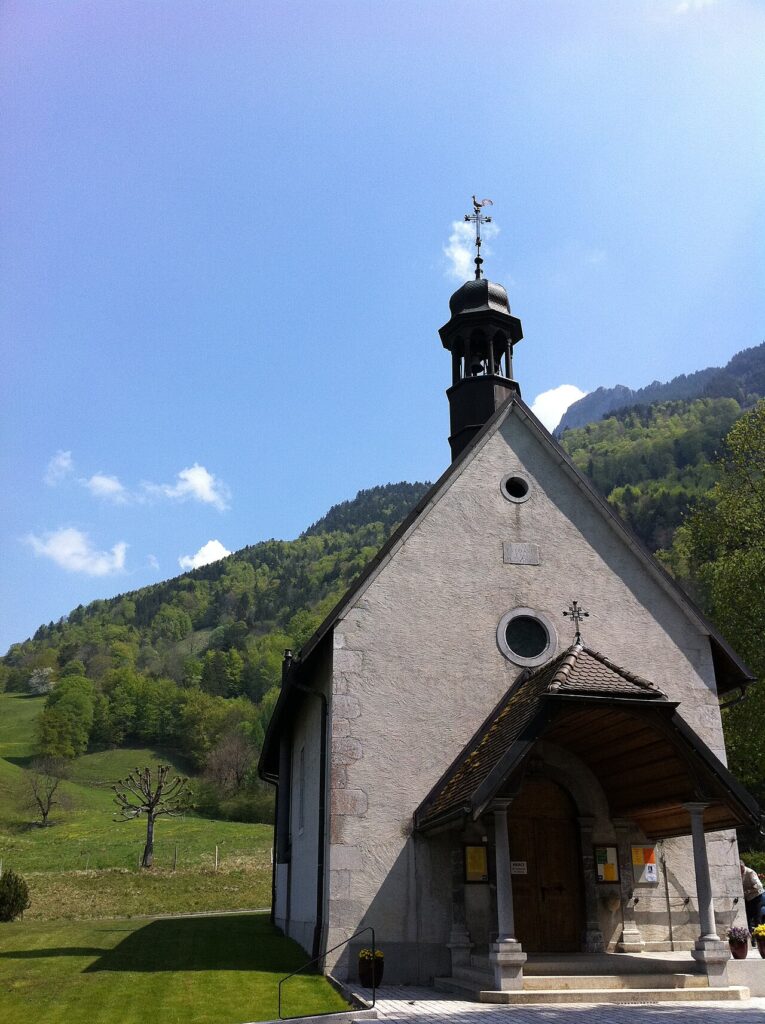
El sanctuary is known as Notre-Dame des Marches and is located in the place of Les Marches, term of Broc, en el cantón de Fribourg (Fribourg), Suiza. [1] This is a capilla- pilgrimage sanctuary, of moderate dimensions, with an interior ordered around the altar where the Marian image is venerated. Its architecture responds to the rural religious style of the region, enriched by devotional elements of the sanctuaries (exvotes, candles, images). It is not known that it has been elevated to minor basilicaor having the title of National sanctuary; devotion is more in the field diocesan and regional (Gruyère, canton of Friburg). Nor does it contain, in the verified documentation, an official declaration as "diocesan Marian sanctuary" with a decree dated and published.
—
Sponsorship and coronation
As regards patronazgoOur Lady of the Marches is taken as Marian sanctuary of reference for the Gruyère region and for the faithful of Broc and the surrounding. [1] In devotional practice, she is considered to be a protector of families, the sick and those who go on pilgrimage for help and intercession. However, the documentation consulted does not contain a official decree that the main patron of the parish of Broc, of the municipality, of the canton of Friburg or of a particular diocese; therefore, at the strict canonical level, does not contain an officially proclaimed patronage beyond its highly estimated Marian sanctuary status in the region.
On the canonical coronationthe verified sources do not record any solemn canonical coronation of the image by pontifical mandate or by decree of the Holy See, or the documented intervention of a papal legacy or of the chapter of a cathedral in this regard. Therefore, following the rule of not introducing unverified data, it must be stated: does not contain a documented canonical coronation.
—
Party and devotion
The very feast of Our Lady of the Marches is held in the framework of the Great Marian Solemnity of the liturgical year, especially around the Nativity of the Virgin (8 September) and other Marian celebrations, when the pilgrimages are intensified; however, in accessible sources there is no clear date and a date endorsed by official documents. own liturgical day of the advocation approved for the whole diocese or for the universal Church, beyond the general Marian calendar. It should therefore be indicated that is not sure an officially recognized own holiday date different from the usual Marian parties.
What does appear constantly in the descriptions of the place is the character of Notre-Dame des Marches as "important place of Marian pilgrimage of the Gruyère"To whom the faithful of the region and other places of Switzerland come to pray, light candles, trust intentions and thank them for their favors. [1] The presence of exvotesand other signs of gratitude for the so-called graces obtained by the intercession of the Virgin. The afluencia It is intensified on weekends, Marian parties and strong times (Advent, Lent, Easter, May), with organized groups of parishes and ecclesial movements in the area; however, there are no official figures of reliable assistance (annual number of pilgrims).
Between popular traditions They include the pilgrimage on foot from nearby peoples, the silent prayer before the image, the celebration of the Eucharist on special occasions and the burning of cirios as a sign of confidence in the intercession of Mary. According to the custom of other Swiss shrines, it is likely that Marian litanies are also recited and prayers are raised for the sick and families, but in the specific case of Notre-Dame des Marches there is no official list of specific practices, beyond this widespread Marian piety.
—
Link to the Rosary
The sources consulted about Notre-Dame des Marches do not offer a specific and documented relationship with the Rosary prayer (for example, a fellowship of the Rosary canonically erected, particular promises, apparitions linked to the Rosary or own indulgences linked to this practice in this sanctuary). It should therefore be strictly stated that there is no particular historical link of the shrine of Our Lady of the Marches to the Rosary, beyond the ordinary use of the Rosary as Marian prayer by the faithful.
However, by its very nature, every sanctuary
A flower for the Virgin
It offers a simple prayer to this advocation. Pray a Hail Mary for Switzerland and for world peace.
Pray Hail MaryIs the advocation of the Virgin Mary of your people missing?
Si no encuentras la advocación mariana de tu ciudad o pueblo, cuéntanosla: la investigaremos para ubicarla y darla a conocer en este mapa del amor de la Madre por el mundo.
Propose an apvocation →