
Marian devotion
Our Lady of Leśna Podlaka
Marian vocation of Leśna Podlaka (Lublin)
According to the traditionthe origin of the sanctuary of Leśna Podlaka goes back to 26 September 1683. That day, two shepherds, Miron Makaruk and Aleksander Stelmaszuk, while looking for lost cattle between the weeds, were reportedly seen hanging from a wild pear stone relief of the Virgin Mary that radiated an extraordinary light. This pious narrative describes the miraculous finding of the image and interprets it as a special intervention of the Mother of God in those rural areas.
Main data
Origin and history
According to the traditionthe origin of the sanctuary of Leśna Podlaka goes back to 26 September 1683. That day, two shepherds, Miron Makaruk and Aleksander Stelmaszuk, while looking for lost cattle between the weeds, were reportedly seen hanging from a wild pear stone relief of the Virgin Mary that radiated an extraordinary light. This pious narrative describes the miraculous finding of the image and interprets it as a special intervention of the Mother of God in those rural areas.
In the plan of the documented historythe same official page of the sanctuary indicates that from the beginning the "Obraz" (image) attracted crowds of faithful, who declared to receive many graces, especially of healingby the intercession of the Virgin of Leśna. The ecclesial recognition of this cult came soon: 1700, el obispo Franciszek Prażmowski, de la diócesis de Łuck (Luck), emitió un Decree in which he declared that the image "appeared" should be considered miracle. Throughout the 18th and 19th centuries the sanctuary was consolidated as a regional pilgrimage centre, despite historical and political vicissitudes that affected the Podlaquia area.
The image and the sanctuary
La image of Our Lady of Leśna es un stone relief that presents Mary in half body, standing, facing the faithful. In the left hand it holds a open bookon which a Winged eagle, unique iconographic element associated with tradition and local history. The style is typical of a late Baroque devotional representation, although the emphasis of the sanctuary is more on its miraculous character than on its precise artistic dating.
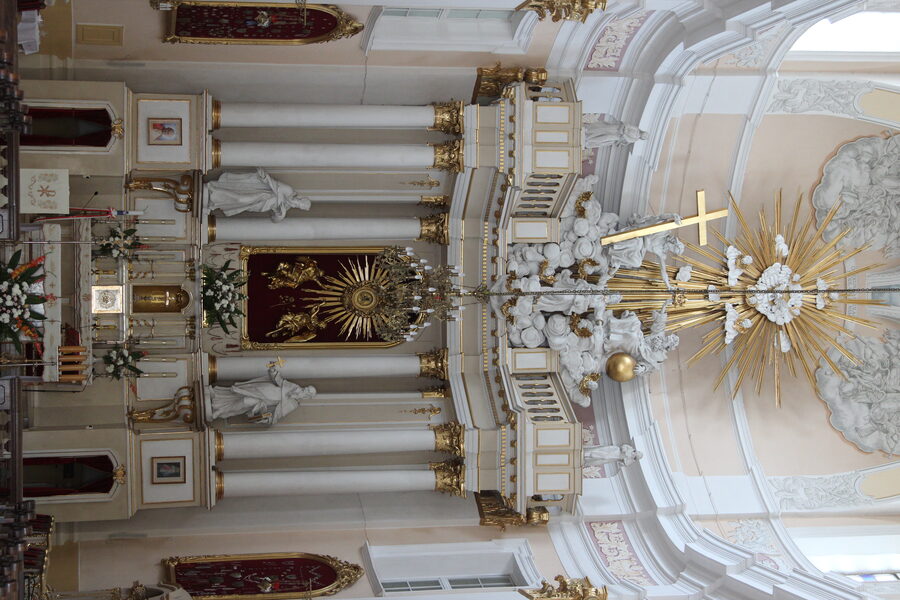
The image is venerated in the Sanctuary of the Mother of God of Leśna (Shrine of Our Lady of the Forest) en Forest Podlasie. The temple, of character diocesan, has been entrusted to the Order of St. Paul First Eremita (Paulines), known also to guard the shrine of Jasna Góra in Częstochowa. The church and the whole of the sanctuary have been extended and renewed over time, responding to the influx of pilgrims; the easily accessible documentation does not clearly indicate the title of minor basilicaand so, with the available data, only its condition of diocesan Marian shrine.
Sponsorship and coronation
Our Lady of Leśna is especially invoked as “Mother of Unity and Faith” (Mother of Unity and Faith) and “The care of Podlasie” (Protector of Podlaquia), which underline the spiritual patronage over the region of Podlaquia. The devotion extends particularly in the diocese of Siedlce and in eastern Poland, where the Virgin of Leśna is considered a regional Marian reference of great importance.
La canonical coronation of the image took place the August 18, 1963. That day, the cardenal Stefan Wyszyński, Primate of Poland, along with the Bishop of Podlaquia Ignacy Świrski, They crowned the miraculous image with papal crowns. The official source of the sanctuary explicitly speaks of "koronami papieskimi" (papal crowns), which indicates that the coronation was carried out on behalf of the Holy See; the prevailing pontiff at that time was san Juan XXIII.
Party and devotion
The fiesta principal de Our Lady of Leśna Podlaka se celebra el 2 Julythe date on which the sanctuary particularly points out the thanksgiving for Mary's presence and for the spiritual and material favors attributed to her intercession. In addition, 26 September is locally remembered as the day of the "origin" of the sanctuary, linked to the finding of the image according to tradition.
From the beginning, the shrine of Leśna has been a place of numerous pilgrimagesespecially the faithful of Podlaquia and other regions of eastern Poland. The sources of the sanctuary highlight the "many graces, especially cures"and a strong dimension of prayer for unity and firmness in faithin line with the titles of the Virgin. There are no precise figures of inflow in the sources consulted, but the continuity of veneration, the coronation of 1963 and the pastoral care of the Paulines show that devotion is still alive and growing.
Link to the Rosary
The specific sources of the accessible Leśna shrine do not mention a particular or exclusive historical link with the prayer of the Rosary (for example, apparitions with an explicit message about the Rosary, unique historical rosarian copradies or other similar characteristics). Therefore, no consta a special relationship documented beyond the general practice of Marian piety.
However, as in most Marian shrines in Poland, the Rosary It is a natural part of the prayer life of pilgrims and of the communities that come to the Virgin of Leśna. The contemplation of the mysteries of Christ together with Mary - especially the joyful and glorious mysteries, which refer to the Incarnation, the divine motherhood of Mary and its glorification - well harmonizes with the iconography of the Virgin who presents the open book, sign of God's Word received and meditated. In this way, even if there is no specific historical link, the Rosario accompanies and sustains devotion to Our Lady of Leśna Podlakahelping the faithful to live the unity and perseverance in the faith that this advocation symbolizes.
A flower for the Virgin
Offer a simple prayer to this Marian devotion. Pray a Hail Mary for Poland and for world peace.
Pray Hail MaryDocumentary expansion: the image, history and tradition
The official page of the Pauline shrine makes it possible to specify several aspects of the history of Leśna Podlaka. The account of the finding of the relief in a wild pear belongs to the tradition of the sanctuary: two shepherds, Miron Makaruk and Aleksander Stelmaszuk, had found the image on 26 September 1683. The continued existence of the cult, on the other hand, is also documented by the construction of the chapel of the place of the find in 1718, the arrival of the Paulines in 1727 and the construction of the temple between 1731 and 1758. These plans are not mixed: the account of origin is transmitted as a tradition, while buildings, custody communities and historical changes are part of the documented history.
The history of the sanctuary was deeply affected by the partitions of Poland and the religious policy of the Russian Empire. After the repression after the January uprising, the Paulines were expelled during the night of 27-28 October 1864. The official source explains that Bishop Beniamin Szymański ordered the original image to be secretly removed and a copy to be placed. The temple was later used by Orthodox veneration and Catholic pilgrimages ceased. The recovery of the building for the Catholic cult in 1915, the return of the Paulines in 1919 and the finding of the original in Łomża in 1926 are made from the modern history of the sanctuary, not elements of a legend of apparition.
The solemn return of the image to Leśna Podlaka took place on 25 September 1927 and brought together, according to the very history of the sanctuary, more than twenty-five thousand faithful. This figure is attributed here to this institutional source and is not presented as an independent measurement. Later, on August 18, 1963, Cardinal Stefan Wyszyński and Bishop Ignacy Świrski crowned the image with papal crowns. In 1984 the temple was raised to the lower basilica. A coronation and a basic elevation document the recognition of the cult and the place; they are not in themselves a decree on every grace or extraordinary account associated with the image.
The sanctuary describes graces and cures attributed by the pilgrims to the intercession of Mary. In this document, the prudent formulation is maintained: there is no individual file in the source consulted for this extension that allows a concrete healing to be presented as a medical miracle or as a canonically declared miracle. Christian veneration is addressed to God and asks the Virgin to intercede; the relief is not considered a divinity or an independent power is attributed to the matter of the stone.
Sources of this enlargement
- Sanctuary of Our Lady of Leśna Podlaka, History of the Sanctuary, HTTP 200.
- Sanctuary of Our Lady of Leśna Podlaka, institutional site, consulted as a context of the Pauline custodian.
Is the advocation of the Virgin Mary of your people missing?
Si no encuentras la advocación mariana de tu ciudad o pueblo, cuéntanosla: la investigaremos para ubicarla y darla a conocer en este mapa del amor de la Madre por el mundo.
Propose an apvocation →