
Marian devotion
Our Lady Dolorosa, Queen of Poland of Licheń
Marian title of Licheń Stary (Great Poland)
La Basilica-sanctuary of Our Lady of Licheń is dedicated to Our Lady of the Dolores, Queen of Poland (Our Lady of Painful Queen of Poland in Old Lichen), venerated in the village of Licheń Stary, in the voivodship of Great Poland, near Konin.
Main data
Origin and history
La Basilica-sanctuary of Our Lady of Licheń is dedicated to Our Lady of the Dolores, Queen of Poland (Our Lady of Painful Queen of Poland in Old Lichen), venerated in the village of Licheń Stary, in the voivodship of Great Poland, near Konin.
Tradition and legend: According to the tradition in the spirituality of the sanctuary, the Virgin Mary appeared in 1813 to the Polish soldier Tomasz Kłossowski, wounded in combat, who would have been cured and inspired to seek or place an image of the Mother of God Dolored. Later, between 1844 and 1850, the Virgin would have manifested herself to a simple shepherd, Santa Chicby urging him to promote conversion, prayer and confidence in his intercession. In these apparitions the Virgin is particularly linked to the religious and national destiny of Poland, also announcing an epidemic of cholera and promising assistance to those who came to her.
Documented history: Historically, the icon of Our Lady Dolorosa of Licheń is a painting that probable date of siglo XVIIIaccording to the tradition and studies cited by the sanctuary itself and by encyclopedic synthesis. The painting was transferred and enthroned in Licheń Stary, gradually becoming the focus of pilgrimages, especially from the second half of the 19th century, when the devotion linked to the alleged apparitions and protection against cholera was spread. The present basic complex was raised in the 20th century: the new monumental church was built between 1994 and 2004, and was dedicated as a basilica by John Paul II, who blessed it in 1999. The sanctuary has since been one of the main destinations of Marian pilgrimage in Poland.
The image and the sanctuary
El icono de Our Lady Dolorosa, Queen of Poland of Licheń es una Marian paint small dimensions, popular style, probably on table (the sanctuary does not specify in detail the support in its divulgative synthesis). It represents the Mother Dolorosa con una crown on the head, holding and narrowing against his chest a White eagle, national symbol of Poland, as - according to the sanctuary - was seen during the apparitions. The iconography thus intimately links the mystery of the Dolores of Mary to the history and identity of the Polish people.
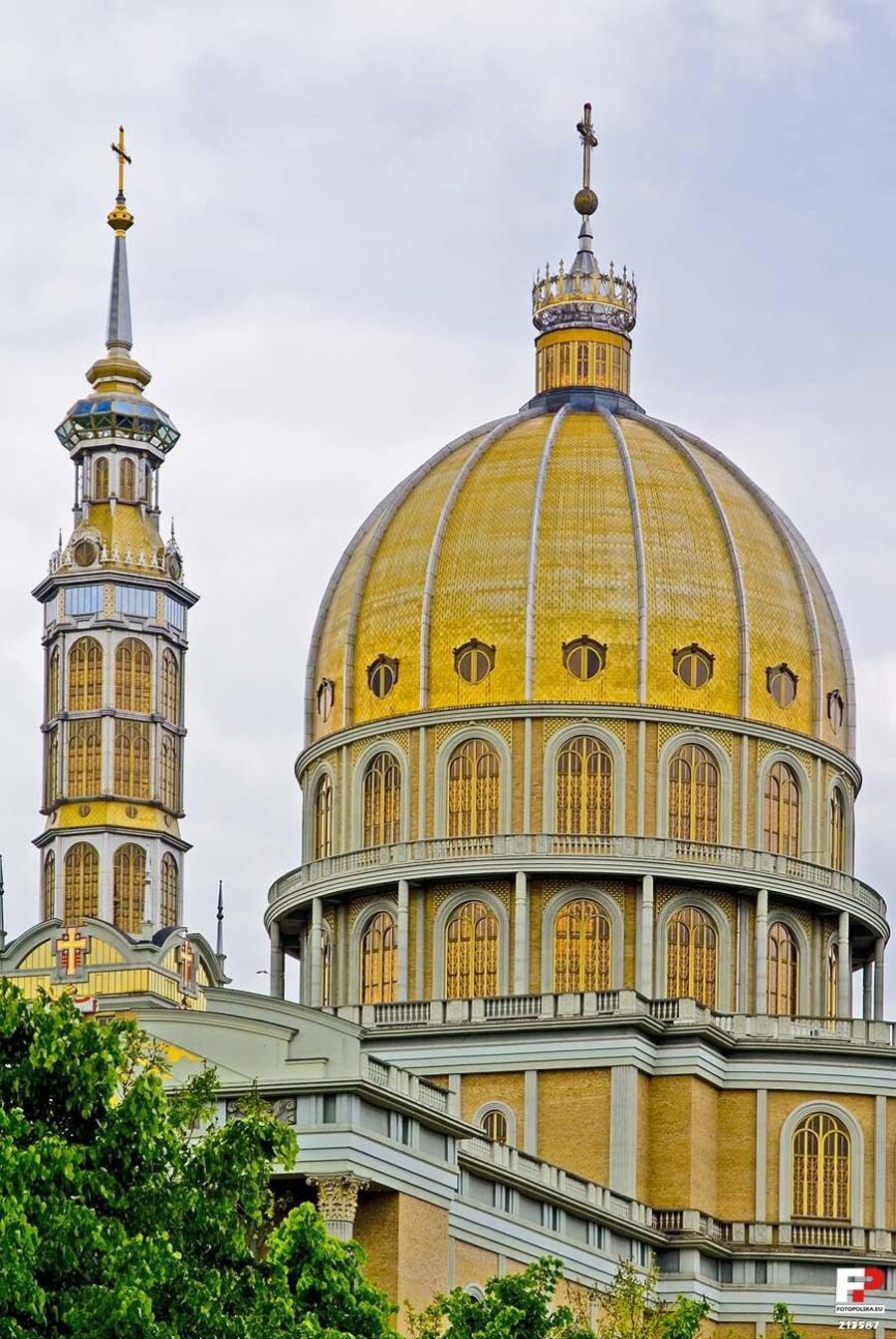
The image is kept and venerated in the main altar of the Basilica of Our Lady of Licheń. The temple bears the official name of Basilica of Our Lady Dolorosa, Queen of Poland, in Licheń Stary (Basilica of Our Lady of the Painful Queen of Poland in Old Lichen). Es una minor basilica since the blessing of John Paul II in 1999. Architectural, it's the largest temple in Polandwith a ship of about 120 m long and 77 m wide, a central dome of about 98 m high and a tower of about 141.5 m. It is part of a wide Sanctuarial complex which includes chapels, pilgrims' spaces and prayer areas, consolidated as one of the most significant Marian centers in the country.
Sponsorship and coronation
The title of the advocation is that of "Our Lady of the Dolores, Queen of Poland"and so his patronage is particularly linked to the Polish nationas the spiritual queen of the country. The sanctuary highlights this national character through the iconography of the white eagle and the great influx of faithful from all over Poland. There is no specific declaration of diocesan or municipal patronage other than this national horizon in the sources consulted; therefore, does not contain a particular canonical patronage other than its title as Queen of Poland.
As for the canonical coronation, various devotional sources quote that the image was crowned in 1967but in the institutional and encyclopedic sources of immediate access, the act or the pontifical authority or the delegate who made it is not detailed. Since the precise information (exact date, decree and name of the Pontifical Delegate) is not clearly documented in the sources consultedthe rules established must indicate: "does not contain a documented canonical coronation" in these sources.
Party and devotion
The liturgical and devotional feast most closely associated with this advocation is that of Our Lady of Sorrows, el 15 Septemberin line with the memory of the Virgin Dolorosa in the calendar of the Latin Church. [It is indicated according to the general Marian tradition; in the sources of the sanctuary there is no different date for the advocation.] In the Polish popular area, there are also several days and novies around this date and the great summer pilgrimages; some devotional initiatives outside Poland also mention celebrations around the end of September, but they do not necessarily correspond to the official calendar of the sanctuary.
The shrine of Licheń is presented by the sources as one of Poland's main pilgrimage siteswith a large annual influx of faithful, especially in the summer months. The pilgrims come to pray before the miraculous icon on the greater altar, to participate in the Eucharist, in Eucharistic worship and in the sacrament of reconciliation. The devotion underlines the contemplation of the Dolores of Marythe plea for the homeland and the intercession of the Dolored Mother in diseases and situations of suffering, in continuity with the traditions linked to the cholera epidemic and to the history of Poland.
Link to the Rosary
In the documentation available from the Shrine of Licheń and in the main historical synthesis does not contain a specific and exclusive link of this advocation with some particular form of prayer of the Rosary (for example, special promises or a specific modality of Rosario). However, as in most of the great Marian shrines, the Rosario is a regular part of devotional life: is prayed in groups of pilgrims, in Marian celebrations and in personal piety before the icon.
In this advocation, the contemplation of the Dolores de María se armoniza de modo natural con el Rosario: – En los painful mysteries, la fe contempla junto a la Madre Dolorosa la Pasión del Señor, compartiendo espiritualmente los sufrimientos de Cristo que el icono de Licheń evoca. – En los glorious mysteriesMary is recognized as Queen with his risen Son, in tune with his title of Queen of Poland.
Although there is no explicit rosarian charism, the prayer of the Rosary in Licheń can be understood as a privileged form of to join Mary's own pains y de intercede for the Church and the Polish nationin the coat of Mother Dolores, Queen of Poland.
A flower for the Virgin
Offer a simple prayer to this Marian devotion. Pray a Hail Mary for Poland and for world peace.
Pray Hail MaryDocumentary extension: Licheń, the 1852 report and the sanctuary
The history of the Shrine of Licheń retains several levels that should be read separately. The institutional page of the sanctuary places the extraordinary events of 1850 in the forest of Grąblin, about two kilometres from Licheń, in front of an image placed on a pine. The same source states that Pastor Mikołaj Sikatka declared under oath to have had several visions before the parish priest Florian Kosiński. This testimony and the existence of a report of the parish priest dated November 5, 1852 belong to the documentary history of the transmission of the story: they show that the phenomenon was communicated to the ecclesiastical authorities and that an early document on its content was kept.
The fact sheet does not therefore make every detail of the visions a proven supernatural fact. The parish report is a historical source of what was declared and of the response of the community; it does not, in itself, amount to a contemporary decree of the bishop or to a declaration of the Dicastery for the Doctrine of the Faith. The sanctuary itself presents the veneration and memory of the apparitions, while in the verified sources for this extension there is no pronunciation that declares the apparitions supernatural with a current canonical category. The coronation of an image and the existence of a living pilgrimage recognize public veneration, but do not replace that discernment.
Tradition also links the message transmitted by the pastor with a call to prayer, penance and conversion, and with the announcement of a cholera epidemic that reached the region in 1852. The fact sheet maintains that relationship in the plane of tradition and devotional memory. The cures and graces which the pilgrims attribute to the intercession of Mary must be expressed as testimonies of piety as long as it does not contain for each case a medical and ecclesial record that allows it to be called a miracle. Christian prayer asks Mary to intercede before God; she does not attribute an independent divine force to the image.
The history of the place also includes the transfer of the image from the forest to Licheń. The institutional source of the sanctuary relates the transfer to the decision to take it to a more accessible and dignified space, first to a chapel and then to the parish church. In 1967 Cardinal Stefan Wyszyński crowned the image; decades later the great basilica was built, built between 1994 and 2004 according to the history of the sanctuary. They are made of the material and pastoral evolution of the place: they allow us to understand why Licheń became a great center of pilgrimage without presenting as approved any extraordinary narration associated with its origin.
Sources of this enlargement
- Santuario de Lichen, Revelations, HTTP 200.
- Sanctuary of Licheń, historia del sanctuary, HTTP 200.
Is the advocation of the Virgin Mary of your people missing?
Si no encuentras la advocación mariana de tu ciudad o pueblo, cuéntanosla: la investigaremos para ubicarla y darla a conocer en este mapa del amor de la Madre por el mundo.
Propose an apvocation →