
Marian devotion
Our Lady Mediator of All Lipa's Graces
Marian Advocation of Lipa (Batangas) (Luzon)
La devoción de Our Lady Mediator of All Lipa's Graces is linked to alleged Marian phenomena in the Carmelite monastery of Lipa, Batangas, in 1948, attributed to the Carmelite novice Teresita Castillo. The tradition spread speaks of apparitions of the Virgin under the title of All Thanks Mediator y de una célebre “lluvia de pétalos” of roses, along with other extraordinary signs narrated in the surroundings of Carmel.
Main data
Origin and history
La devoción de Our Lady Mediator of All Lipa's Graces is linked to alleged Marian phenomena in the Carmelite monastery of Lipa, Batangas, in 1948, attributed to the Carmelite novice Teresita Castillo. The tradition spread speaks of apparitions of the Virgin under the title of All Thanks Mediator y de una célebre “lluvia de pétalos” of roses, along with other extraordinary signs narrated in the surroundings of Carmel.
However, from the perspective of the documented ecclesial history, the case is not approved as supernatural. In 1951 a Philippine episcopal investigation declared it "non-supernatural."; then there were reopenings and disputes, but the prudent position to be maintained for a devotional sheet is as follows: the alleged apparitions of Lipa are not recorded as recognized by the Holy See or the Philippine Episcopal Conferencebut remain within the scope of a local Marian devotion tolerated within the Carmel of Lipa, without official proclamation of supernatural.
The image and the sanctuary
The venerated image in relation to this advocation is often presented as a Marian image of devotional type, associated with the Mary, Mediator of All Graces; in the sources consulted it is linked to the iconography that emerged from the account of the apparitions, though does not have a single material type or a universally established official iconographic description in the results provided.
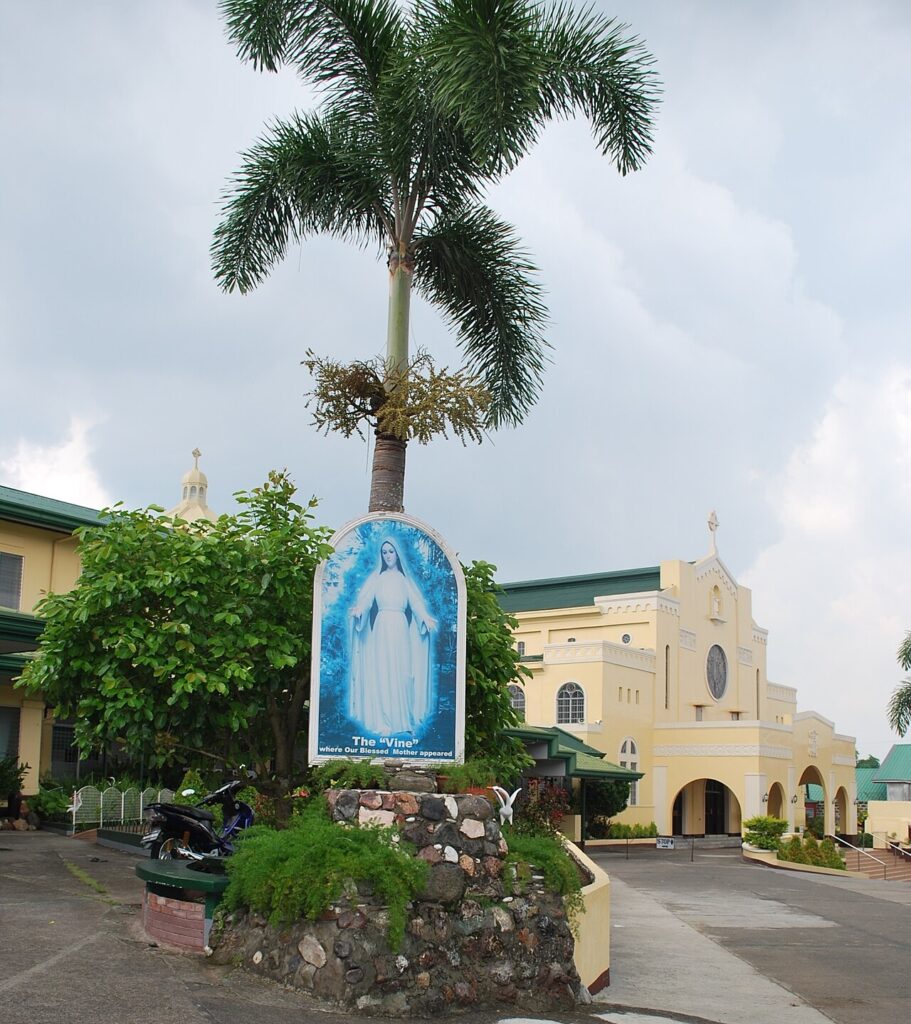
The reference place is the Carmelite monasteries of Lipa, Batangason the island of Luzon, Philippines, where the 1948 tradition was developed and where the devotional focus remains. In the sources provided it is not known that the temple has the range of minor basilicanor does there appear, in these sources, an unequivocal designation as National sanctuary. By documentary prudence, it must be described as the Carmelo/monastery carmelita de Lipa, local Marian veneration center.
Sponsorship and coronation
No consta un patronazgo universal, nacional or diocesan formally established for this advocation in the sources provided. Its own scope is the Carmelo de Lipa and popular devotion linked to the city of Lipa (Batanga).
It also does not contain a documented canonical coronation with safety in the sources provided; therefore, it must be stated: does not contain a documented canonical coronation.
Party and devotion
In some sources this advocation is associated with the 12 Septemberthe date on which the Archbishop of Lipa issued in 2015 a decree favourable to the supernatural authenticity of the facts; however, that pronunciation was subsequently disauthorized by the Holy See, so that that date can be maintained only as a local devotional reference, not as a basis for ecclesial recognition of the apparitions.
The devotion is expressed above all in the Carmelo de Lipa and in Filipino Marian circles, with pilgrimages and private prayers linked to the title of All Thanks Mediator. Among the most popular features are the memory of the petal rain and the idea of Mary as an intercessor mother and dispenser of graces; yet it should be stressed that these elements belong to the Devocional resonance and not an approved supernatural fact.
Link to the Rosary
The relationship with the Rosary exists in the spiritual and devotional plane: various popular narrations linked to Lipa highlight the invitation to the prayer, la penitencia and trust in the intercession of Mary, in a framework fully compatible with the prayer of the Rosary. However, in the sources consulted there is no exclusive institutional link with this advocation; therefore, the Rosary must be presented as the ordinary Marian form that accompanies this devotion, recalling that in the Catholic spirituality Mary always refers to Christ and that the Rosary expresses precisely that subordinate mediation in the life of the Church.
A flower for the Virgin
Offer a simple prayer to this Marian devotion. Pray a Hail Mary for the Philippines and for world peace.
Pray Hail MaryIs the advocation of the Virgin Mary of your people missing?
Si no encuentras la advocación mariana de tu ciudad o pueblo, cuéntanosla: la investigaremos para ubicarla y darla a conocer en este mapa del amor de la Madre por el mundo.
Propose an apvocation →