
Marian devotion
Our Lady of Ljeviška
Marian vocation of Prizren (Kosovo and Metohia)
♪ documented history ♪
Main data
Origin and history
♪ documented history ♪
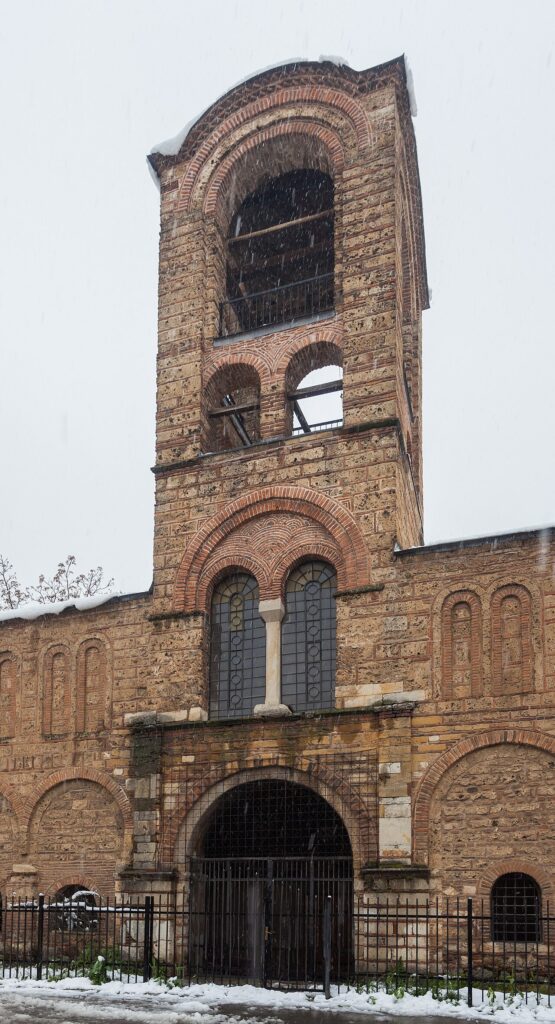
The church of Our Lady of Ljeviška (in Serbian Богородица Февишка, Bogorodica Ljeviška) stands in the old town of Prizren, in the current territory of Kosovo. It was rebuilt as a great church of the Catholic Church by the Serbian king Esteban Uroš II Milutin between 1307 y 1309, in Byzantine style, based on an earlier temple of Byzantine-Serbian times, probably of the 12th century.
The building was the catedral de Prizrenthe episcopal seat of the Serbian Orthodox Church, and is one of the main monuments of Serbian medieval culture. In the Ottoman era, like many churches in the region, it was converted into a mosque (icons were removed and frescoes were cut off) and later regained its Christian function. In 2006, UNESCO included Bogorodica Ljeviška within the site "Medieval Monasteries in Kosovo," which is on the World Heritage List in Danger due to the instability of the area and damage to recent conflicts.
# # Tradition and local memory
The available sources insist on the role of King Milutin as founder and benefactor, celebrated liturgically as "ktitor" (founder) of the temple. In Orthodox devotional practice, the patronage of the sovereign over the temple dedicated to the Mother of God reinforces the perception of Bogorodica Ljeviška as spiritual protector of the city of Prizren and its faithful, but no specific legends of concrete apparitions or miracles associated with this advocation are documented in the sources consulted; therefore, beyond the memory of the founding king and the role of the church as a historic cathedral, no consta a legendary Marian tradition of its own clearly individualized.
The image and the sanctuary
Invocation is first and foremost linked to iconographic set of frescoes of the temple rather than a single image of a concrete bundle or miraculous icon. It is a basic-floor church with five domes arranged on the cross, with a dominant central dome, typical of the paleologist architectural program. The current structure, made of stone and brick, is the result of the reconstruction of the early 14th century.
Inside are preserved famous fresh Byzantines of high artistic quality, made after the reconstruction of Milutin, many of them belonging to the Serbian paleologist school. Among them are scenes of the life of Christ, of the Virgin, of saints and of hierarchies, in a broad theological-liturgical program, as is usual in the great medieval Orthodox churches. Although the sources consulted do not describe in detail a concrete image of the Mother of God, the very title of the church ("Bogorodica," Theotokos) indicates the outstanding presence of Marian iconography in the apse and in various scenes of the mural decoration (for example, the Virgin with the Child in the apse shell, as in the Byzantine tradition), although precise details no constan in the revised sources.
The official name in Spanish is "Church of Our Lady of Ljeviš". In Serbian it is called Bogorodica Ljeviška. He was the Orthodox cathedral of Prizren in the Middle Ages. It is not clear that, in the current official use, it has the title of minor basilica nor of national or diocesan sanctuary in the Catholic canonical sense; in the Orthodox context, however, it is a temple of primary historical and liturgical relevance.
Sponsorship and coronation
In the Serbian Orthodox tradition, the church of Our Lady of Ljeviška is closely linked to the city of Prizrenof which it was a cathedral and a prominent religious symbol. In the available sources there is no modern formal declaration of patronage (civil or ecclesiastical) comparable to the canonical patronings of dioceses or cities in Latin canonical law; however, because of its history and the role of the Mother of God in liturgical life, it can be considered de facto a Marian sanctuary of reference for the Serbian Orthodox faithful of Prizren and its surroundings. No if you document a patronazgo a nivel nacional.
As for a canonical coronation of the image of Our Lady of Ljeviška according to the praxis of the Catholic Church, does not contain a documented canonical coronation in the sources consulted. Nor is a specific similar ceremony of solemn coronation of a particular icon linked to this advocation mentioned in the Orthodox sources.
Party and devotion
The information available highlights above all the liturgical celebration related to the King Milutin as the founder (ktitor) of the church. In Orthodox practice, the "foundational glory" (ktitorska slava) commemorates the holy founder of the temple; in the case of Bogorodica Ljeviška, it is celebrated Saint King Milutinbut the specific date of this celebration in the Orthodox liturgical calendar no consta with precision in the sources consulted.
On a specific main feast of Our Lady of Ljeviškathe sources do not mention a date of their own different from the great Marian solemnities of the Orthodox calendar (such as the Nativity of the Mother of God, her Sleep, the Annunciation, etc.), which are certainly celebrated in the church but without an exclusive commemoration of the advocation under this title; therefore, no consta a documented own date for a particular feast of the advocation.
The current devotion is conditioned by the situation in the region and the state of the monument. The church is protected and, according to tourist testimonies, is not always accessible to the interior for reasons of security and conservation, which limits mass pilgrimages. No influx figures and no specific processions or popular Marian traditions are described; devotion seems to focus on the espiritual valor and identity of the temple for Serbian Orthodox Christians and in the veneration of the Mother of God within the framework of the liturgy of the Serbian Orthodox Church.
Link to the Rosary
In spirituality orthodox the prayer of Rosary as is known in the Latin Catholic Church is not part of the usual tradition. The orthodox Marian piety is expressed rather by the veneration of icons, the singing of hymns (such as Akathistos) and participation in the liturgy and Marian parties, as well as in the use of the "prayer of Jesus" with the komboskini or chotki.
Therefore, no consta a specific historical or devotional relationship between the advocation of Our Lady of Ljeviška and the prayer of the Rosary in a Catholic sense. However, from a broader Marian perspective, the mystery of Christ and of the Mother of God considered in the frescoes of Bogorodica Ljeviška, it links spiritually with what the Rosary proposes to meditate: the mysteries of the life, death and resurrection of Jesus Christ.
A flower for the Virgin
It offers a simple prayer to this advocation. Pray a Hail Mary for Serbia and for world peace.
Pray Hail MaryIs the advocation of the Virgin Mary of your people missing?
Si no encuentras la advocación mariana de tu ciudad o pueblo, cuéntanosla: la investigaremos para ubicarla y darla a conocer en este mapa del amor de la Madre por el mundo.
Propose an apvocation →