
Marian devotion
Our Lady of Longeborn
Marian Advocation of Bramois (Sion) (Valais)
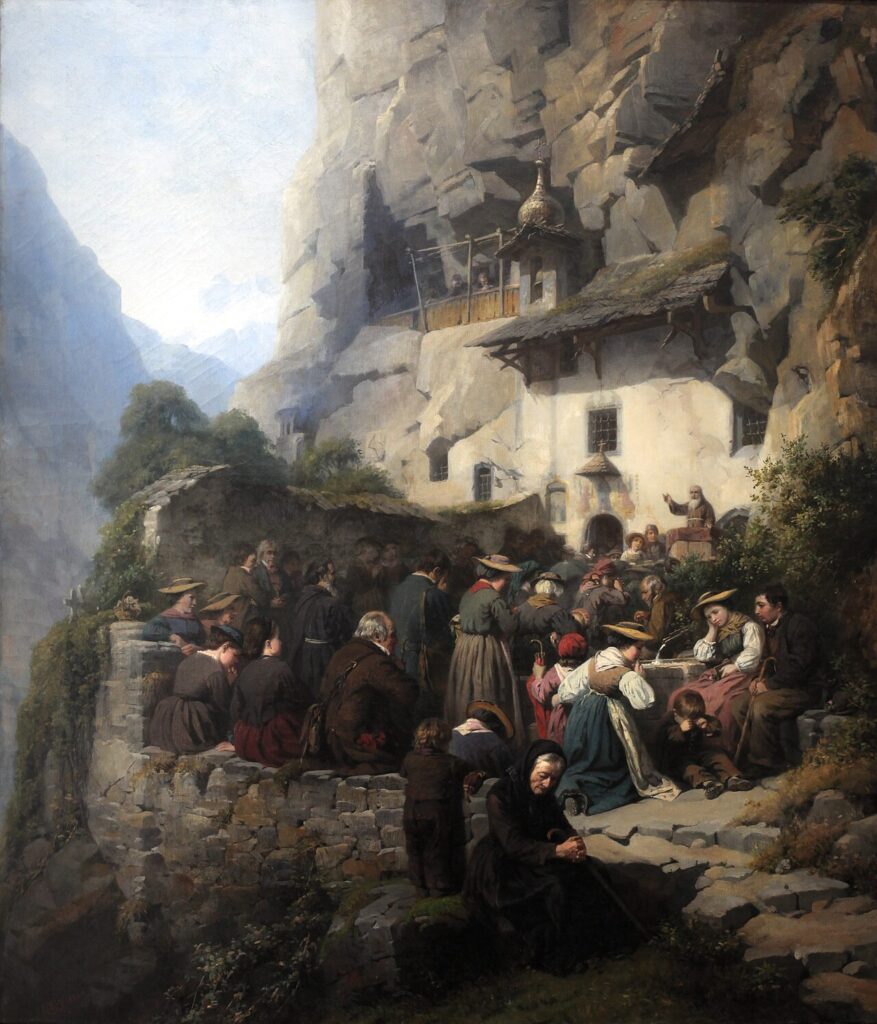
According to the tradition, Longeborgne is born as a place of solitude and penance in an almost inaccessible environment, taking advantage of a rocky cornice in the gorge of the Borgne stream, where erecites were withdrawn for prayer and penance. Marian devotion gradually developed around the image of Our Lady of Compassionwho became the patron of the eremite.
Main data
Origin and history
According to the tradition, Longeborgne is born as a place of solitude and penance in an almost inaccessible environment, taking advantage of a rocky cornice in the gorge of the Borgne stream, where erecites were withdrawn for prayer and penance. Marian devotion gradually developed around the image of Our Lady of Compassionwho became the patron of the eremite.
As for the documented historythe sources point out that the eremite already existed at least in the 17th century and that it was configured as a reference Marian sanctuary in the Valais. In 1699, el Apostolic nuncio grants to the city of Zion the right of employers on Longeborgne, with the administration of the chapels, the choice of the hermits and the care of the buildings; in that act are mentioned miracles in Longeborgne, a sign of the already consolidated importance of the place as a sanctuary of grace.
Over the centuries, the eremite knew times of greater and less erectic presence; in 1932the patron was entrusted by the bourgeois Council of Zion to the Benedictine monks (from the abbey of Maredsous, Belgium), coming to reestablish the Benedictine life in French-speaking Switzerland. At present, the sanctuary remains under the responsibility of the Benedictine abbey of Saint-Benoît of Port-Valaisand maintains a stable pastoral activity as a place of reception, confession and spiritual retreat.
The image and the sanctuary
The advocation focuses on the Virgin under the title of Note- Give me of Longeborgne / Our Lady of Compassion, patron of the eremite. The sources consulted indicate the existence of a Marian image venerated in the small chapel, but no consta detallada in the documentation available the exact type (sculpture or painting), the material or the precise iconography (e.g., Dolorosa, Piety, etc.); what is indicated is its link with the Compassion of Marythat is, with the Virgin, united with the sufferings of Christ and the sorrows of those who come in prayer. In the absence of verifiable technical data, it is not possible to describe the artistic style or the author of the image rigorously.
El sanctuary is known as Ermitage de Longeborgne (Hermitage of Longeborgne), a small complex located in the rock, on a ledge in the throat of the Borgne, above Bramois, at about 595 m altitude. It is accessed on foot from the village after a short signposted road; the place is literally "embedded" in the rocky wall, which gives it a strong character of retreat and recollection. The heart of the eremite is a small chapelwith a simple interior and much loved by the faithful, surrounded by spaces of prayer and silence. It does not know that the temple has the title of minor basilica, ni que sea National sanctuary; if you draw a sanctuary local/diocesanoin Zion and entrusted to the Benedictine.
Sponsorship and coronation
Our Lady of Longeborgne is venerated as patron of the hermitory and place of grace for the Valais centralwith special connection to the population of Bramois and the city of Sion, which has historically had the patronage of Longeborgne. The documentation highlights the importance of the sanctuary as one of the main places of Marian pilgrimage of the Valaisbut no official patronage is indicated at the level of diocese or canton in strict canonical terms.
As regards a possible canonical coronation of the image, in the sources consulted (history of the eremite, official page, local studies, repertory of hours and pastoral presentations) no documented canonical coronation given in the name of the Pope to this advocation. It should therefore be clearly stated: does not contain a documented canonical coronation of Our Lady of Longeborgne.
Party and devotion
The available sources do not specify a main holiday date own of Our Lady of Longeborgne (for example, a local Marian memory with specific day). The liturgical life of the sanctuary is articulated above all around the pilgrimage seasonwith masses, confessions and spiritual welcome, following the general calendar of the Church and the universal Marian parties, without mention of a "great patron party" of its own with a precise date.
Longeborgne is described as a high place of pilgrimage of the Valais, very much frequented in summer time and on weekends, by faithful who seek to confess, to pray in silence or to keep a promise. The eremite, "hung" on the throats, has become a symbol of recovery, peace and conversionand is associated with numerous votes and thanksgiving by favors received, although the sources do not detail inflow figures or describe in detail the material forms of these votes. The presentation of the site highlights its nature as a "mythical place" and peace in the heart of nature, a few minutes from Zion, which invites silent prayer rather than large multitudes.
Link to the Rosary
In the documentation consulted (official history of the eremite, historical notes and pastoral descriptions) does not contain a specific and documented relationship between the advocation of Our Lady of Longeborgne and the prayer of the Rosary as own or formally outstanding practice of the sanctuary. There are no mention of the Rosary's co-fradies, or explicitly rosarian processions, or particular indulgences linked to the Rosary's prayer in this place.
However, by the type of sanctuary - the eremite of silence, confession and pilgrimage - the Rosary is very naturally integrated into the Marian devotion lived in Longeborgne. The title of Our Lady of Compassion He refers directly to the painful mysteries, but he also invites us to contemplate with Mary the whole life of Christ, as is done by disgracing the joyful, luminous, painful and glorious mysteries. In an environment of rock, silence and height, the Rosary becomes a simple way to accompany the Virgin in the meditation of the Gospel, while presenting - mystery after mystery - the sufferings, hopes and thanksgiving that the pilgrims place before Our Lady of Longeborgne.
A flower for the Virgin
It offers a simple prayer to this advocation. Pray a Hail Mary for Switzerland and for world peace.
Pray Hail MaryIs the advocation of the Virgin Mary of your people missing?
Si no encuentras la advocación mariana de tu ciudad o pueblo, cuéntanosla: la investigaremos para ubicarla y darla a conocer en este mapa del amor de la Madre por el mundo.
Propose an apvocation →