
Marian devotion
Our Lady of the Starkenburg Dolores
Marian Invocation of Starkenburg (Missouri)
La Our Lady of the Starkenburg Dolores is a Marian advocation linked to the Catholic sanctuary of Starkenburg, Misuri, considered in local tradition as the oldest Marian sanctuary to the west of the Mississippi River. The community was born in the context of the German Catholic colonization of the region, and the place was early associated with the piety of immigrants, especially devotion to the Virgin Dolorosa.
Main data
Origin and history
La Our Lady of the Starkenburg Dolores is a Marian advocation linked to the Catholic sanctuary of Starkenburg, Misuri, considered in local tradition as the oldest Marian sanctuary to the west of the Mississippi River. The community was born in the context of the German Catholic colonization of the region, and the place was early associated with the piety of immigrants, especially devotion to the Virgin Dolorosa.
La documented history places the existence of the church and the sanctuary within the development of the German colony of Starkenburg in the 19th century; different sources of the sanctuary and of historical reference agree that Marian devotion was consolidated there very soon among the settlers, although they do not always offer online all the foundational details with the same precision. The local tradition presents the place as the destination of ancient romaneries and as a centre of special Marian protection for the Catholic population of the area, but some extremes of the devotional account do not always contain uniform documentation in the sources consulted.
The image and the sanctuary
The venerated image is a representation of Our Lady of Sorrows o Dolored, that is, Mary as a Mother who participates in the suffering of Christ; in this iconographic type, the heart is often highlighted through the sword and the attributes of pain and compassion, although for the concrete image of Starkenburg no consta in the sources consulted a complete technical description of the material or its authority.
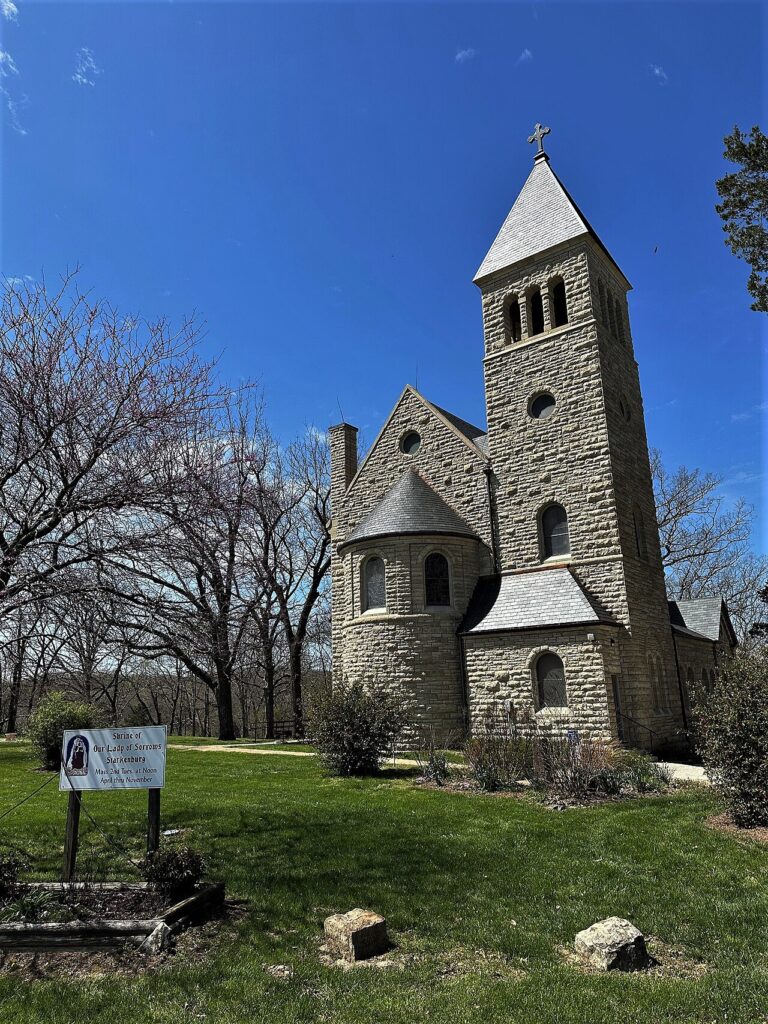
The cult focuses on the iglesia- sanctuary known as Shrine of Our Lady of Sorrows in Starkenburg, also called in local tradition White House. The sources consulted present it as a sanctuary of great regional antiquity, but no consta in which it has the title of a minor basilica, national sanctuary or diocesan sanctuary with a specific universally standardized canonical name.
Sponsorship and coronation
There is no formal patronage of city, municipality, diocese or nation in the sources consulted.
It also does not contain a documented canonical coronation of this image in the revised sources.
Party and devotion
The main party is held 15 September, liturgical date of the Blessed Virgin Mary of the Dolores. The devotion in Starkenburg has historically been characterized by the pilgrimages and Romeries of the faithful, especially of Catholic communities of German origin in the region.
The sources consulted describe the place as a sanctuary of strong popular arraigo and local religious memory, but no constan with safety uniform data on current or historical flow figures.
Link to the Rosary
There is no specific institutional relationship between this advocation of the Dolores of Starkenburg and a brotherhood, title or practice of the Rosary in the sources consulted.
Even so, the spirituality of the Rosary naturally accompanies the painful asvocations, because it invites us to contemplate with Mary the mysteries of the life, passion and glorification of Christ; therefore, in a devotion like that of Starkenburg, the Rosary fits in a very appropriate way as prayer of meditation, compassion and perseverance with the Dolored Mother.
A flower for the Virgin
Offer a simple prayer to this Marian devotion. Pray a Hail Mary for the United States and for world peace.
Pray Hail MaryIs the advocation of the Virgin Mary of your people missing?
Si no encuentras la advocación mariana de tu ciudad o pueblo, cuéntanosla: la investigaremos para ubicarla y darla a conocer en este mapa del amor de la Madre por el mundo.
Propose an apvocation →