
Marian devotion
Our Lady of Madagascar; the great Malagasy Catholic community venerates the Virgin in the Cathedral of Andohalo of Antananarivo and in Grutas of Lourdes and Marian shrines throughout the island. Latin Catholic Rite.
Marian Invocation of Antananarivo (Madagascar)
The most significant Marian invocation linked to the capital of Madagascar is related to the Cathedral of the Immaculate Conception of Andohalo, seat of the archdiocese of Antananarivo. The stable and documented use of the specific title is not recorded in official sources "Our Lady of Madagascar" as an advocation of its own with a different history; in practice, the faithful Malagasy people venerate to the Virgin above all under the title of the Immaculate Conception in this cathedral and in various Marian shrines of the island.
Main data
Origin and history
The most significant Marian invocation linked to the capital of Madagascar is related to the Cathedral of the Immaculate Conception of Andohalo, seat of the archdiocese of Antananarivo. The stable and documented use of the specific title is not recorded in official sources "Our Lady of Madagascar" as an advocation of its own with a different history; in practice, the faithful Malagasy people venerate to the Virgin above all under the title of the Immaculate Conception in this cathedral and in various Marian shrines of the island.
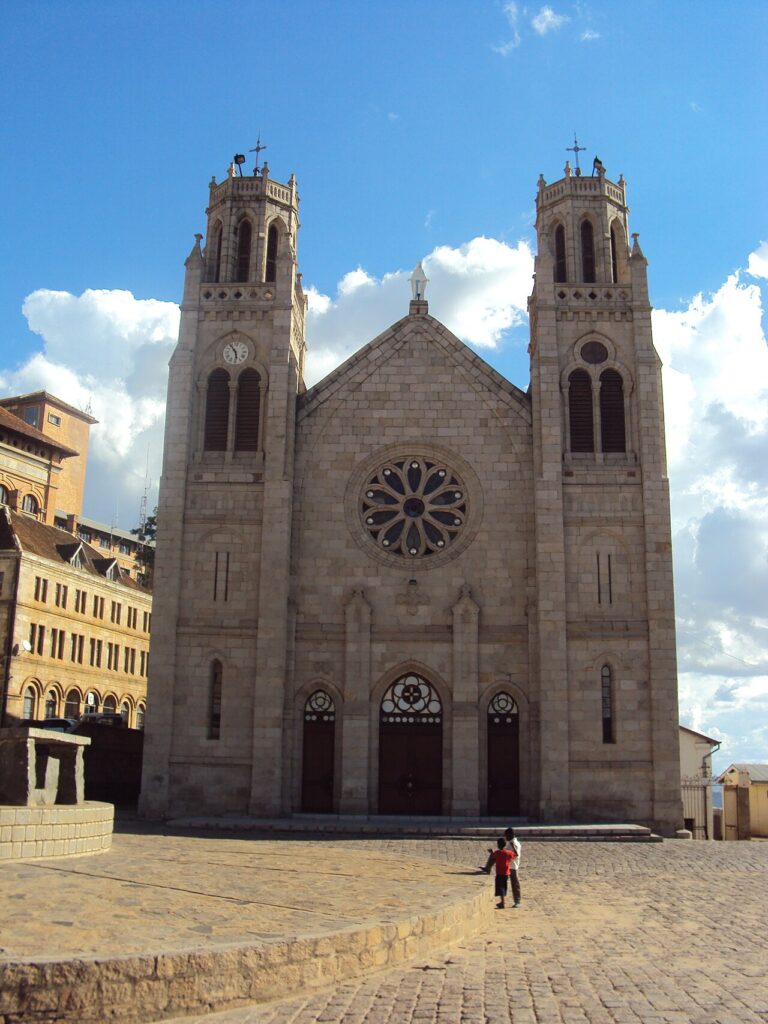
From the historical point of view, the cathedral of Andohalo was built between 1873 y 1890on the hill of Andohalo, in a neo-Gothic style, as the main church of the Catholic presence in the capital. It is the Marian temple of reference for the great Catholic community of Antananarivo and the country, and has become a point of convergence of devotion to the Virgin by the faithful of the Latin rite. The subsequent development of Catholicism in Madagascar led to the creation of the archdiocese of Antananarivo as the metropolitan seat of a local Church today structured in 22 ecclesiastical constituencies.
Along with the cathedral, the Marian devotion associated with grutas de Lourdes and other sanctuaries, following the European model: they are spaces of popular piety where the faithful honor the Virgin with prayer, candles and pilgrimages. This network of Marian temples and grotto on the island reinforces the perception, in popular religiosity, of Mary as Mother and spiritual patron of the Malagasy people, although there is no official national sanctuary entitled "Our Lady of Madagascar" in the documentation consulted.
As for tradition and legend, there is no specific Marian apparition nor a legendary history of its own under the name "Our Lady of Madagascar" endorsed by the local Church or by historical documents: devotion is rather part of the general framework of universal Marian (Immaculate Conception, Lourdes, etc.) inculturated in the Malagasy context.
The image and the sanctuary
La Cathedral of the Immaculate Conception (Katedral Andohalo) is the main church of the archdiocese of Antananarivo and the main Marian sanctuary of the city. The temple, of neoGothic style, has facade and stone towers on Andohalo hill and dominates the urban landscape of the capital. It was built between 1873 and 1890, and its solemn dedication is part of the process of consolidating the Catholic Church in Madagascar. It does not know that it has the title of a minor basilica or that it is officially erected as a national sanctuary; it is, however, the catedral metro and, in fact, the main Marian reference of the archdiocese.
The Virgin Mary is venerated inside under the title of Immaculate Conception, according to the official name of the temple. The available sources do not provide a detailed description of the main image (type of sculpture, material and iconographic features), so it is not accurately recorded if it is a size of wood, stone, plaster or other material, nor its exact dating. In general, Malagasy Marian temples use images inspired by the western iconography of the Immaculate or Lourdes, adapted to local sensitivity.
In various localities of Madagascar, parishes and pilgrimage centres have erected grutas de Lourdes, integrated in parish or holy complexes where the Virgin is venerated through Marian processions and celebrations. These grotto reproduce the classical iconography of Our Lady of Lourdes with the image of Mary on the rock and often an image of Saint Bernadette in a praying attitude. It does not contain a single Marian "national sanctuary" officially recognized for the entire island in the revised sources; devotion is articulated around the cathedral and multiple local shrines and grotto.
Sponsorship and coronation
On the canonical plane, the cathedral of the Immaculate Conception of Andohalo is the mother church of the archdiocese of Antananarivobut there is no formal decree declaring "Our Lady of Madagascar" as the principal patron of the country or of a diocese under that specific title. Popular devotion does consider the Virgin, in her various claims (especially the Immaculate one), as spiritual protector of the Malagasy people, but this patronage is expressed more in pastoral and liturgical practice than in a particular legal title.
About a possible canonical coronation of a specific Marian image under the name "Our Lady of Madagascar" (or the Immaculate in Andohalo), the available diocesan and general sources do not mention any act of coronation with the decree of the Holy See or with a clearly identifiable date and pontificate. Therefore, does not contain a documented canonical coronation for this advocation.
Party and devotion
The main Marian liturgical reference linked to the cathedral of Andohalo is the solemnity of the Immaculate Conception (8 December), which the universal Church celebrates and which is of particular importance in the cathedral that bears this title. It does not contain a date of its own holiday under the name "Our Lady of Madagascar" officially recognized in the diocesan or national calendar.
In Madagascar, Marian devotion is especially expressed by local pilgrimages to Lourdes and Marian shrines, processions, novenas and prayer vigil, with strong participation of young people and families. Popular piety uses Mary in contexts of social need, disease and the search for peace, in a country marked by economic and social challenges; the Virgin is invoked as a comforting and protective mother of the home.
During the great ecclesial celebrations, such as the papal visits (for example, that of John Paul II in 1989 and that of Francis in 2019), the Virgin occupies a prominent place in the prayer of the people and of the pastors, as a sign of the nation's unity in faith. However, there are no official influx figures available for a specific Marian national pilgrimage in Andohalo or another sanctuary under the title "Our Lady of Madagascar."
Link to the Rosary
The sources consulted do not document a specific and official link between the title "Our Lady of Madagascar" and a fellowship, crusade or sanctuary explicitly focused on the Rosary (as is the case, for example, in some Marian shrines in other countries); therefore, there is no unique and specific link of this advocation to the Rosary beyond the common practice of the Church.
However, in the daily life of Malagasy Catholics, the prayer of the Rosary It is an important place within Marian piety: it is prayed in parishes, in families, in pilgrimages to the Grotto of Lourdes and in the face of the images of the Virgin in the cathedral and in the local shrines. In this way, the Rosary becomes a privileged way to contemplate the life of Christ with Mary, to sustain faith in contexts of poverty and to ask the intercession of the Mother of God for the peace, justice and evangelization of Madagascar. In this sense, although there is no particular decree or tradition, devotion to the Virgin in Madagascar is deeply accompanied and strengthened by the prayer of the Rosary.
A flower for the Virgin
It offers a simple prayer to this advocation. Pray a Hail Mary for Madagascar and for world peace.
Pray Hail MaryIs the advocation of the Virgin Mary of your people missing?
Si no encuentras la advocación mariana de tu ciudad o pueblo, cuéntanosla: la investigaremos para ubicarla y darla a conocer en este mapa del amor de la Madre por el mundo.
Propose an apvocation →