
Marian devotion
Our Lady of Madhu
Marian vocation of Madhu (Sri Lanka)
According to the traditionthe small image of the Virgin would have arrived with Portuguese Catholic missionaries to the coastal area of Mantai (or Mantota) towards the end of the 16th or early 17th century, from where the faithful would have guarded her with great devotion. With the anti-Catholic persecution unleashed by the Calvinist Dutch in the 17th century, it is reported that a group of Catholic families fled inland, carrying with them the image and taking refuge in the Madhu forest, where they erected a first wooden chapel. This pious memory, deeply rooted among the devotees, is located in the real context of the replacement of Portuguese rule by Dutch on the island.
Main data
Origin and history
According to the traditionthe small image of the Virgin would have arrived with Portuguese Catholic missionaries to the coastal area of Mantai (or Mantota) towards the end of the 16th or early 17th century, from where the faithful would have guarded her with great devotion. With the anti-Catholic persecution unleashed by the Calvinist Dutch in the 17th century, it is reported that a group of Catholic families fled inland, carrying with them the image and taking refuge in the Madhu forest, where they erected a first wooden chapel. This pious memory, deeply rooted among the devotees, is located in the real context of the replacement of Portuguese rule by Dutch on the island.
As for the documented historythe existence of the Madhu shrine with more than 400 years of Marian veneration, being considered today the oldest and most sacred Catholic sanctuary in Sri Lanka. Local historical sources point out that Tamil Catholic families from Jaffna, expelled by the Dutch, joined Sinhalan Catholics in the Madhu forest, consolidating a community and a stable place of worship there. Over the centuries, the church of Madhu grew as a national pilgrimage centre, and in the 20th and 21st century it was reaffirmed as symbol of peace and reconciliation in the middle and after the civil war (1983-2009), to the point of being officially recognized by the State as "sacred place."
During the armed conflict, the sanctuary was affected by violence, and even was bombarded, but it remained a place sought by displaced and faithful from different communities, strengthening its reputation as a spiritual refuge and intercession for peace.
The image and the sanctuary
The image of Our Lady of Madhu es una small statue of the Virgin Mary with the Child Jesusabout 400-500 years old, venerated as miraculous by generations of faithful. This is a simple, old-style, round-package (image of size) statuette linked to the early times of Portuguese evangelization; various sources describe this image as the oldest Marian representation preserved in Sri Lanka. The specific material (type of wood or other) is not certain in the sources consulted. The basic iconography presents the Mother with the Child, without further documented technical details.
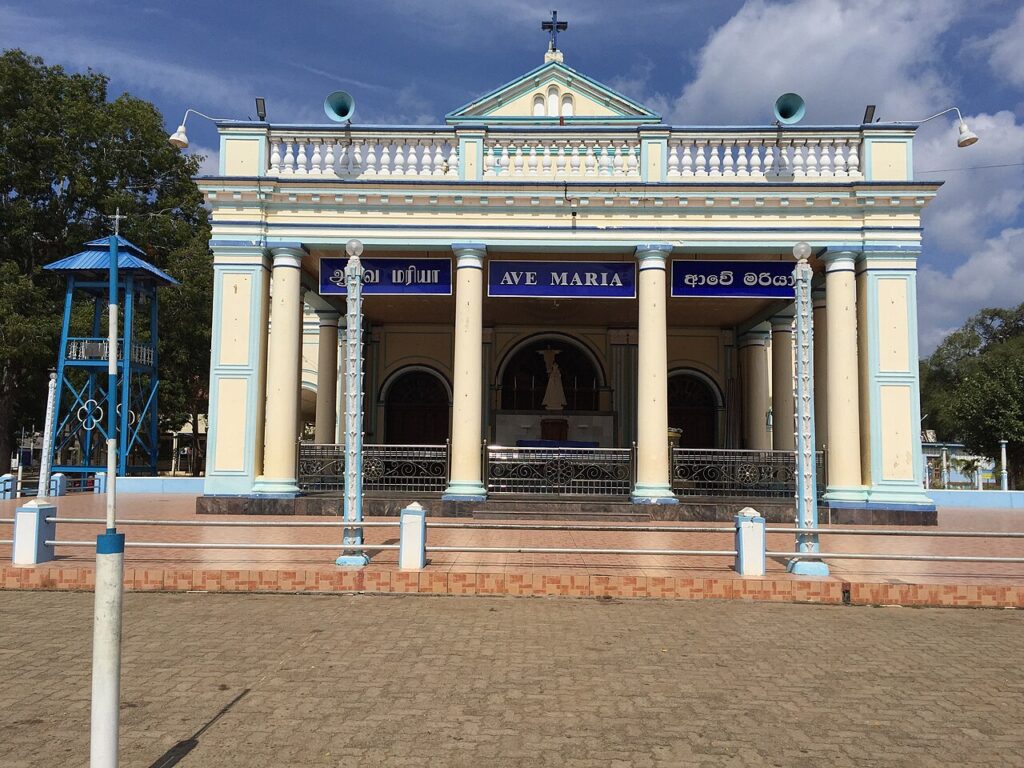
El Sanctuary of Our Lady of Madhu is a Marian shrine of Latin rite, located in the district of Mannar, in the middle of a forest area at a certain distance from the large roads, which gives it a character of retreat and recollection. The main temple is a simple colonial-style church, with a wide and wooded environment, prepared to host large crowds and open spaces where the liturgy and popular devotion are performed. The sanctuary is recognized as the most venerated Catholic place in the country and as a national sanctuary, and has been declared by the State of Sri Lanka itself as Obsolute Holy East given its spiritual and social relevance. It is not found in the consulted sources that the church has been elevated to the title of minor basilicaThe name of national Marian sanctuary is therefore maintained.
Sponsorship and coronation
Our Lady of Madhu is considered by the Church in Sri Lanka as a national pattern, since its sanctuary is the most important Marian pilgrimage center in the country and "the most sacred Catholic sanctuary on the island." Devotion overflows the diocesan boundaries: although it is found in the diocese of Mannar, faithful of all the dioceses come there, and the advocation has become a sign of Catholic identity for Tamils and Sinhalese.
On the canonical coronationthe sources consulted in Spanish and available chronicles do not mention a formal decree of pontifical coronation with date and clearly specified delegate. Special processions and honors are collected, especially on the occasion of Pope Francis's visit in 2015, but does not contain a documented canonical coronation in the usual legal terms.
Party and devotion
La main party of Our Lady of Madhu is celebrated the August 15the Solemnity of the Assumption of the Virgin Mary, the day on which the Church liturgical commemorates this advocation in the sanctuary. A great national pilgrimage is organized around this date: it is estimated that each year they will come to the sanctuary about 600,000 people of the whole country during the August celebrations. The influx includes not only Catholics, but also the faithful of other religions, attracted by the spiritual fame of the place.
The devotion to Our Lady of Madhu is characterized by the peregrinación a piethe ninth, the celebration of the Eucharist, the sacrament of reconciliation and long days of prayer in the open air. Many faithful spend the night around the sanctuary in a climate of retreat and penance. A very specific note of this advocation is his fame of protection and healing, also linked to the popular "Bendita arena" de Madhu: land of the sanctuary environment which the devotees gather as sacramental, especially associated with protection against dangers, including serpent bites, and intercession for health. Although science cannot support such properties, the popular tradition retains numerous testimonies of graces received.
On the social and spiritual level, the sanctuary is known as a symbol of unity and peaceHe has gathered and brought together Tamil and Sinhalese faithful, Catholics and also Buddhists, Hindus, Muslims and Protestants, even in the toughest years of the civil war. Several bishops and Pope Francis himself have emphasized this conciliating character, seeing in Madhu a reference for coexistence in Sri Lanka.
Link to the Rosary
Several testimonies and chronicles refer to the advocation as "Our Lady of the Rosary of Madhu", which points to a particular relationship with the prayer of the Holy Rosary in this sanctuary. The Rosary is a regular part of the great Marian pilgrimages and celebrations in Madhu: the faithful pray in procession, in night vigil and during waiting times, uniting the contemplation of the mysteries of Christ to the intercession of the Virgin venerated in the ancient image.
Beyond the concrete historical data, the link between Our Lady of Madhu and the Rosary is understood in key mariana y pastoralIn a place marked by war, suffering and the search for reconciliation, the Rosary becomes a "school of peace," where families recite the mysteries together, asking for protection, healing and the grace of unity. In this way, devotion to the Virgin of Madhu is harmonized with the universal Catholic tradition that she sees in the Rosary a privileged prayer to accompany Mary in the meditation of Christ's life and to sustain the hope of the faithful people.
A flower for the Virgin
It offers a simple prayer to this advocation. Pray a Hail Mary for Sri Lanka and for the peace of the world.
Pray Hail MaryIs the advocation of the Virgin Mary of your people missing?
Si no encuentras la advocación mariana de tu ciudad o pueblo, cuéntanosla: la investigaremos para ubicarla y darla a conocer en este mapa del amor de la Madre por el mundo.
Propose an apvocation →