
Marian devotion
Panagia of Mali, venerated in the monastery of Mali, in Arcadia
Marian Invocation of Mali (Arcadia) (Peloponese)
According to the Greek Orthodox tradition, la Panagia de Malevi is an icon of the Theotokos (Mother of God) attributed to St Luke evangelist and miraculously brought to the place where today the monastery of Malevi rises in the region of Arkadia, in the Peloponese (Greece). This tradition places the origin of the icon in the early centuries of Christianity and links it to the ancient custom of attributing to St Luke certain particularly venerated icons; however, this attribution is devotional in nature and cannot be confirmed historically by modern critical means, so it is maintained in the plane of the piety and local legendnot the documented story.
Main data
Origin and history
According to the Greek Orthodox tradition, la Panagia de Malevi is an icon of the Theotokos (Mother of God) attributed to St Luke evangelist and miraculously brought to the place where today the monastery of Malevi rises in the region of Arkadia, in the Peloponese (Greece). This tradition places the origin of the icon in the early centuries of Christianity and links it to the ancient custom of attributing to St Luke certain particularly venerated icons; however, this attribution is devotional in nature and cannot be confirmed historically by modern critical means, so it is maintained in the plane of the piety and local legendnot the documented story.
As regards historia verificablethe female monastery of the Sleeping of the Theotokos in Mali (Arkadia, Orthodox diocese of Mantinea and Kynuria) is documented as one of the important monasteries of the Peloponese region, with sources that mention it already in the post-Byzantine period and during the Ottoman domain, although the specific dates of foundation and development are imprecise in the accessible sources. It does not contain in reference Catholic sources or official documentation available a detailed chronology of the icon nor a precise historical moment when the fame of the myrrh-related wonders began.
A central feature of his recent devotional history is the testimony, widely spread in Orthodox media and religious reports, that the icon perfumed myrrh sister (an aromatic oil) on certain occasions, interpreted as a sign of God's grace and the intercession of the Virgin. The international spread of this devotion has intensified in recent decades, with pilgrims coming from different parts of Greece and abroad; however, no detailed critical studies have been found in Western academic sources that historically analyse these phenomena, so on this point can only be seen testimony of the faithful and of the monastic traditionwithout specific scientific assessment.
The image and the sanctuary
La Panagia de Malevi es un Orthodox icon of the Theotokos, of a traditional Byzantine type. The sources available online allow to state that it is an icon painted on rigid support (table), partly covered with oklad or ornamental revival (metal or other material) and richly adorned with exvotes, although the exact technical descriptions (dimensions, pictorial technique, secure stylistic dating) do not contain in detail in accessible verifiable sources. Iconographically, he eats it like the Panagia (The All Holy), without it being recorded with certainty in the sources consulted if the precise type is Hodigitria (the one that shows the Path) or other Byzantine Marian variant; therefore, any greater accuracy on the specific iconographic type does not exist.
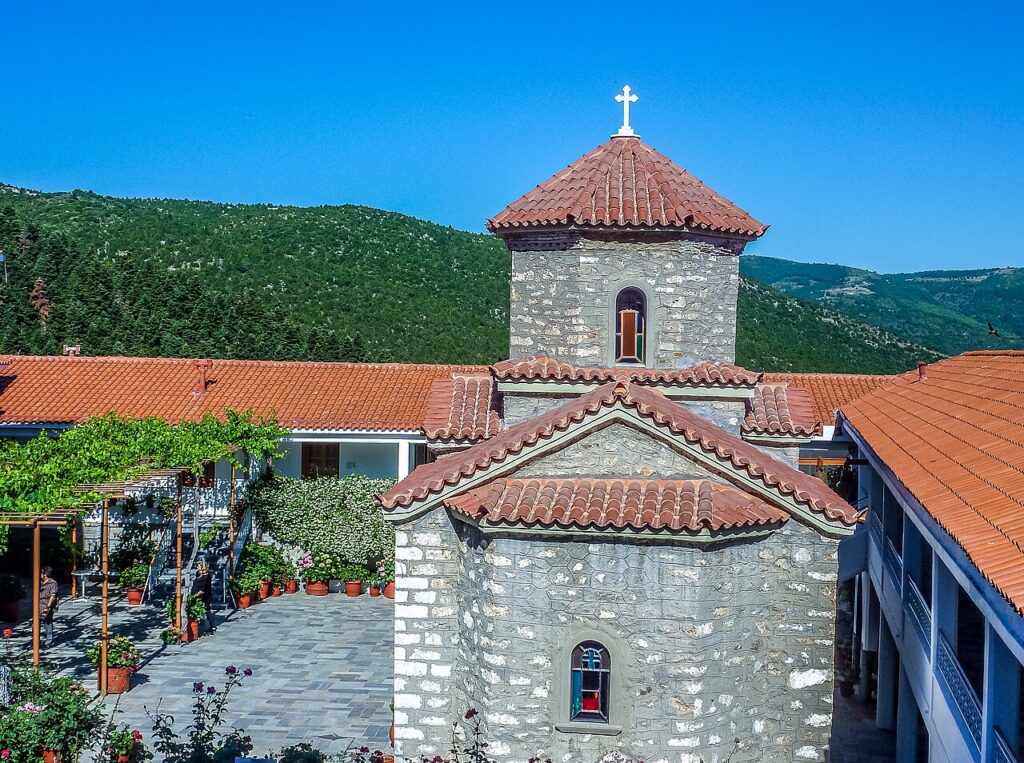
The icon is venerated in the Monastery of the Sleeping of the Theotokos of Malilocated in the mountains of Parnon, in the region of Arkadia (Peloponeso, Greece). It is a female monastery of the Orthodox Church of Greece, belonging to the local Orthodox metropolitan jurisdiction. The monastic set, according to the photographic and testimonial sources available, includes a main church (katholikon) of neo-Byzantine style, conventual buildings and spaces intended to host pilgrims. It is not known that the temple has the title of a minor basilica (distinction of Catholic discipline) or that it is officially declared a national sanctuary by the Catholic Church, since it is a sanctuary Strictly orthodox. Within the Orthodox Church of Greece, however, is recognized as one of the important Marian shrines of the Peloponese, with a strong tradition of pilgrimage.
Sponsorship and coronation
A formal statement of the icon of the Panagia de Malevi how patron of a city, municipality, diocese or all of Greece in a canonical legal sense comparable to that of the Catholic Church. In devotional practice, she is held as a protector of the Arkadia region and of the faithful who come to the monastery, but without a decree of patronage with canonical value according to the law of the Catholic Church; therefore, for the purposes of this document it should be indicated that does not contain a specific canonical patronage.
As for a canonical coronationno reference has been found in Catholic sources (Holy See, Diocese, Catholic press) or in translated Orthodox documentation that mentions a canonical coronation of the icon under the mandate of a Pope or an official representative of the Catholic Church. The Orthodox Church has its own rites of veneration and sometimes uses crowns on icons, but this does not amount to "canonical coronation" in the Catholic legal sense. For this purpose, the following must be stated: "does not contain a documented canonical coronation".
Party and devotion
In the Orthodox tradition, the fiesta principal of the monasteries is linked to the solemnity of the Sleeping of the Theotokosheld on 15 August (according to the revised Julian or Gregorian calendar, according to local practice). This feast, which in the Catholic Church corresponds to the Assumption of the Virgin Mary, is the center of the Marian liturgical year in Mali and calls for a significant number of pilgrims. In addition, in the general Orthodox calendar, the memory of the Panakia Malevi it is also recalled on other local dates, but it does not contain with precision, in accessible verifiable sources, a different date of specific celebration for the advocation beyond the great feast of August; therefore, any other particular feast cannot be said with rigour and should be indicated that only the celebration linked to sleep / Assumption is with certainty.
La devotion a la Panagia de Malevi se caracteriza por: – Peregrinaciones al monasterio, especialmente en verano y en torno al 15 de agosto, con participación de fieles griegos y de otras nacionalidades. – La práctica de la unción con el aceite perfumado que, según los testimonios, mana del icono o es recogido de la lámpara y se distribuye a los fieles como signo de bendición. – Numerosos exvotos y relatos de favores recibidos (curaciones, consuelos espirituales, ayuda en dificultades familiares), que se expresan en objetos devocionales, escritos de agradecimiento y velas encendidas ante el icono.
No reliable statistical data on the annual number of pilgrims have been found, so any specific figure is not recorded.
Link to the Rosary
It does not contain, in Orthodox sources or in Catholic documentation, a historical link the specific liturgical between the advocation of the Panagia de Malevi and the prayer of the Rosary in the way it is practiced in the Latin Catholic Church. Orthodox piety is rather marked by the use of komboskini o Prayer cord, litany and recitation of the Acathistos and other prayers to the Theotokos.
However, from a Catholic perspective and in ecumenical key, the Rosary can fully accompany devotion to the Panagia de Malevi. In the mysteries of the Rosary, the same Mother of God that the Orthodox Church venerates as Theotokos: the joyful mysteries tune with the Incarnation that the icon proclaims, the painful with Mary's participation in the Passion of her Son, the glorious with the glorification of the Mother in the Assumption / Sleeping, and the luminous with the manifestation of the Kingdom of Christ in which Mary occupies a unique place. So, though there is no tradition of the Rosary linked to Malithe prayer of the Rosary allows the Catholic faithful to spiritually join the veneration of the Panagia e
A flower for the Virgin
Offer a simple prayer to this Marian devotion. Pray a Hail Mary for Greece and for world peace.
Pray Hail MaryIs the advocation of the Virgin Mary of your people missing?
Si no encuentras la advocación mariana de tu ciudad o pueblo, cuéntanosla: la investigaremos para ubicarla y darla a conocer en este mapa del amor de la Madre por el mundo.
Propose an apvocation →