
Marian devotion
Our Lady of Mary Plain
Marian vocation of Bergheim (Salzburg)
La documented history de María Plain is located in the context of the Thirty-Year War (1618-1648). According to local tradition, the miraculous image of the Virgin with the Child arrived in Plainberg, near Salzburg, in 1652, after having escaped a fire during the war. This arrival of painting is the starting point of Marian devotion in this place and of subsequent pilgrimages.
Main data
Origin and history
La documented history de María Plain is located in the context of the Thirty-Year War (1618-1648). According to local tradition, the miraculous image of the Virgin with the Child arrived in Plainberg, near Salzburg, in 1652, after having escaped a fire during the war. This arrival of painting is the starting point of Marian devotion in this place and of subsequent pilgrimages.
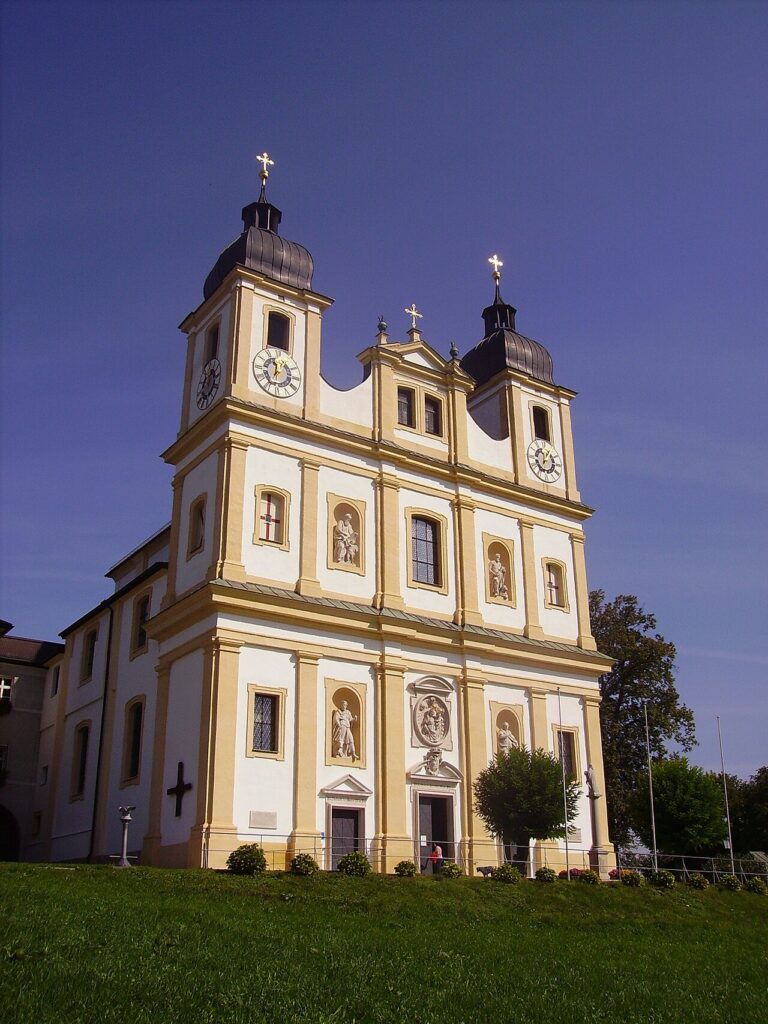
The first wood chapel in honor of the Virgin was built in the mid-17th century to house the venerated image. With the growing flow of pilgrims, the prince-archbishop of Salzburg, Max Gandolf from KhuenburgHe ordered a more worthy temple: the present church of pilgrimage was built between 1671 y 1674 by the architect of the court Giovanni Antonio Dario and consecrated the August 12, 1674. Since then, Maria Plain has been consolidated as one of the most important Marian shrines in the Salzburg region.
As for the tradition or legendlocal sources highlight the "miraculous" character of the image for having survived a fire in time of war and report that, as a result, it was recognized as a special protector of the city of Salzburg. The concrete link with prodigious interventions on the city belongs more to the devotional sphere than to a detailed historical chronicle; there is no precise official relationship of miracles with date and canonical certification in the sources consulted.
—
The image and the sanctuary
In the sanctuary of Mary Plain a Marian paint known as the miraculous image of "Mary with the Child Jesus"from the time of the Thirty-Year War. This is a Table (not a sculpture) that represents the Virgin with the Child, in Baroque style, guarded on the main altar of the pilgrimage church. The tradition highlights the miraculous character of the painting, especially for having survived a fire in the war context. The concrete material of the support (table or canvas) and more fine details of the iconography are not explicitly reflected in the general sources consulted; it is only stated that it is a baroque devotional painting of Mary with the Child.
The temple is the Maria Plain Pilgrimage Basilica (Wallfahrtsbasilika María Plain), located on the hill of Plainberg, in the municipality of Bergheim, dominating the city of Salzburg. The current building, in style baroqueIt was built between 1671 and 1674 and houses numerous works of art by sculptors and painters such as Franz de Neve, Thomas Schwanthaler and his son Franz, Martin Johann (Kremser) Schmidt and Christoph Lederwasch. In 1951, on the occasion of the 200th anniversary of the coronation of the image, the church was raised to the rank of minor basilica by the Holy See. The place remains one of the most important destinations of Marian pilgrimage in the region, with a spiritual retreat environment and wide views over Salzburg and the Alps.
—
Sponsorship and coronation
The Virgin venerated in Mary Plain is considered patron and protector of the city of Salzburg, according to local devotional tradition. The sanctuary, located at the end of Bergheim but closely linked to Salzburg, has become a reference centre for the Archdiocese of Salzburgwho since 1824 entrusted the place to the Abbey of St. Peter. The tourist and pilgrimage sources present Maria Plain as one of the main Marian shrines of the Salzburgese territory, with a strong roots in the religious life of the region.
As for the coronation, consta que en 1751, "in the performance of a vote," the Archdiocese of Salzburg offered two precious kronor for the miracle painting of the Virgin with the Child. This act is the origin of the veneration of Mary Plain as a crowned imageand is closely linked to the musical tradition of Mozart's so-called "Mass of Coronation," which was played in solemn celebrations in honor of the image. The sources consulted talk about the delivery of the crowns and the liturgical celebration, but do not explicitly mention a solemn canonical coronation made on behalf of a Pope or by a pontifical delegateand therefore, with the information available, it should be said: does not contain a documented canonical coronation in the strict terms of the modern canon title, beyond the votive coronation of 1751.
—
Party and devotion
La main party of the Virgin of Mary Plain is celebrated around the annual solemnity of the coronation of the image. The basilica of Mary Plain maintains the tradition of interpreting the "Mass of the Coronation"by Mozart in honor of the Marian image the fifth Sunday after Pentecost (Whitsuntide)as a musical and liturgical commemoration of coronation. Various sources indicate that the main memory is celebrated around the 24 June (in the context of the Nativity of Saint John the Baptist), but this date does not appear explicitly in the sources consulted; therefore, it is maintained as a traditional reference not fully documented.
The shrine of Mary Plain is a place of Marian pilgrimage for more than three centuries. Pilgrims from Salzburg, from other parts of Austria and even from abroad come to the Basilica to implore the intercession of the Virgin and give thanks. Since 1845 is introduced there the prayer of 40 hours, which highlights the Eucharistic and contemplative dimension of the place. In addition, Maria Plain has a rich musical life: Mozart played there sometimes during the Sunday Mass, and today important musical events continue to be held in the Salzburg cultural calendar, with the participation of the choir of María Plain, the Baroque orchestra and other ensembles. The pilgrims associate the visit to the Basilica with confession, participation in the Eucharist and silent prayer before the image of the Virgin.
—
Link to the Rosary
The historical and tourist sources consulted on María Plain do not explicitly mention a practice of the Rosary prayer which distinguishes this advocation (for example, a particular Rosary fellowship, specific promises linked to the Rosary or a Rosary feast proper to the sanctuary). Therefore, with the available data, it should be stated that there is no specific and documented link with the Rosary beyond the general practice of Marian piety.
However, as in every Marian sanctuary, the Rosary It occupies a natural place in the spiritual life of Mary Plain. The Rosary allows us to contemplate, together with Mary, the mysteries of Christ's life; in a sanctuary where an image of the Mother with the ChildThis prayer helps the faithful to meditate on the joyful mysteries and, in continuity, the other mysteries, integrating the joys, sufferings and hopes of the people of God. In this context, the Rosary becomes a privileged way of welcoming the protection of the Virgin of Mary Plain over the city of Salzburg and over those who pilgrim to its sanctuary, uniting the historical memory of protection in times of war with current confidence in its maternal intercession.
A flower for the Virgin
Offer a simple prayer to this Marian devotion. Pray a Hail Mary for Austria and for world peace.
Pray Hail MaryIs the advocation of the Virgin Mary of your people missing?
Si no encuentras la advocación mariana de tu ciudad o pueblo, cuéntanosla: la investigaremos para ubicarla y darla a conocer en este mapa del amor de la Madre por el mundo.
Propose an apvocation →