
Marian devotion
Our Lady of Mary Radna
Marian Advocation of Radna (Arad) (Banato)
According to the traditionthe origin of devotion is linked to a Marian icon printed on paper that would have been miraculously intact in a fire of the year 1695. The pious account states that, after the destruction of the temple by fire, the image of the Virgin was found among the ashes without damage, which was interpreted as a miraculous sign and motivated the growth of the pilgrimage.
Main data
Origin and history
According to the traditionthe origin of devotion is linked to a Marian icon printed on paper that would have been miraculously intact in a fire of the year 1695. The pious account states that, after the destruction of the temple by fire, the image of the Virgin was found among the ashes without damage, which was interpreted as a miraculous sign and motivated the growth of the pilgrimage.
As for the documented historyIn the place there was a Franciscan convent already in the 16th century, built initially on the initiative of the local nobility and developed after the region was incorporated into the Habsburg Empire. In the early 18th century, in the face of the increase in Marian devotion, a wider church was built in 1723, and on July 7, 1756 The first stone of the present Baroque church was placed, the building of which lasted until the last quarter of the 18th century. The diocese (then Cenad, today Timișoara) investigated the alleged miracles and declared the place as sanctuary and pilgrimage center for the image. In 1992The pope. Juan Pablo II raised the temple to the dignity of minor basilica under the title "Mother of Graces."
The image and the sanctuary
The image of Our Lady of Mary Radna es un engraving / image printed on paper of the Virgin Mary with the Child Jesus, devotional style of the Baroque era, associated with the iconography of a Mother of Thank You o Western type Virgin. The essential data, collected in the sources, is the character of printed image and the fact of its miraculous conservation in the fire of 1695; the measures and the authorship are not recorded in public and uniform technical detail, so these data no constan in a safe way.
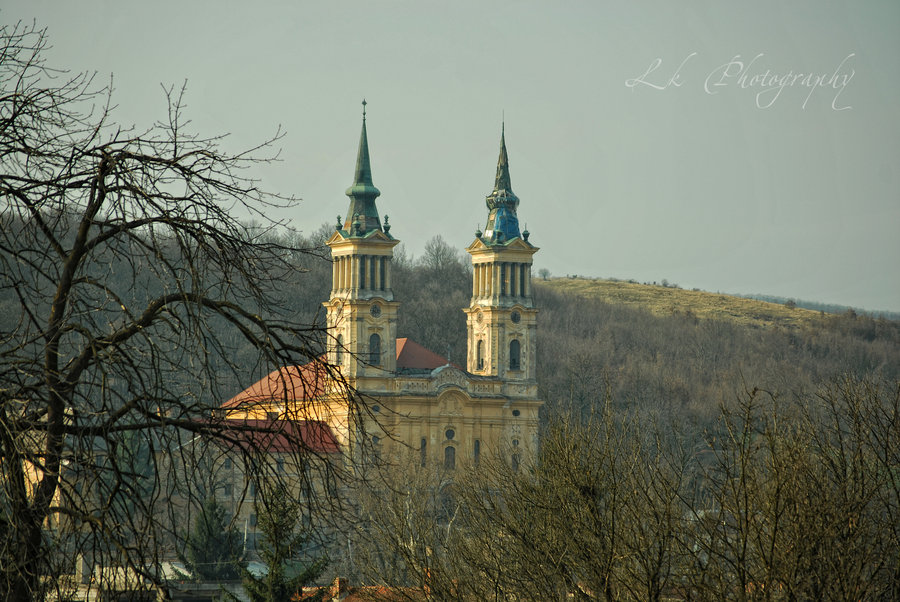
The sanctuary is the Basilica Maria Radna (officially, basilica of Our Lady of the Annunciation / Mother of Graces, according to the sources in Latin and English). It's a style church. baroque of the 18th century, with two facade towers and a voluminous central body, located on the right bank of the river Mureș, opposite Lipova, in the current county of Arad. It belongs to the diócesis de Timisoara y es de Roman rite (Latin Catholic). The complex includes an old Franciscan convent, facilities for pilgrims and exhibition spaces, and has been the subject of recent restoration in the twenty-first century for its consolidation and value as a place of pilgrimage and historical heritage.
Sponsorship and coronation
Maria Radna is considered the most important Catholic pilgrimage place in the diocese of Timișoara and one of the main Marian shrines of the Banato. While devotion attracts faithful from the whole region (Romania, but also German, Hungarian and Croatian communities of the Banato), there is no explicit decree from the public sources consulted. Official patronage on a specific city (like Lipova) or on the whole diocese; therefore, beyond its spiritual and practical importance as the main center of pilgrimage, no consta a formal legal-canonical patronage clearly defined in the available sources.
On the canonical coronation of the image, the sources consulted (including general documentation on the sanctuary and basilic lists) do not mention any solemn canonical coronation recognized by the Holy See. Accordingly, according to the available data, does not contain a documented canonical coronation.
Party and devotion
The main Marian parties held in María Radna, according to local sources, are the Solemnity of the Assumption of the Virgin Mary (15 August) and Nativity of the Virgin Mary (8 September), dates when thousands of pilgrims come to the sanctuary. In these days, and around other Marian solemnities, the temple is filled with faithful coming not only from the Romanian Banate, but also from communities of German, Hungarian and Croatian tradition, reflecting the multi-ethnic history of the region.
The basilica is configured as a permanent pilgrimage centreDuring the year, parish and diocesan pilgrimages are organized, with celebrations of the Eucharist, confessions and practices of Marian piety. Many testimonies of favors and alleged miraclesespecially healing, protection in danger and gifts granted to sterile families, associated with the intercession of the Virgin of Mary Radna. The exact influx of pilgrims varies according to the sources, but there is talk of miles de peregrinos in the great Marian solemnities.
Link to the Rosary
The specific sources on Maria Radna do not explicitly mention a of the Rosary nor an exclusive practice linked to this advocation that distinguishes it from other Marian shrines. The Rosary is, however, part of the usual Marian piety in the Catholic shrines of Latin rite, so it is reasonable to say that the prayer of the Rosary accompanies the pilgrimages and Marian vigil in Mary Radna, although specific details (schedules, specific co-fradies) no constan in the sources consulted.
From a mariological and pastoral perspective, the history of Maria Radna - focused on a simple, printed and preserved image in the midst of fire- invites to contemplate the Virgin as a protective Mother in the midst of the trials. The RosaryAs a meditation of the mysteries of Christ's life with Mary, it offers an appropriate framework for this devotion: it helps pilgrims to "read" their own sufferings and hopes in the light of the joyful, painful, luminous and glorious mysteries, and to join them in the intercession of the Virgin venerated in Mary Radna. Thus, even if there is no specific ritual link documented, the Rosary is naturally integrated into the spiritual experience of this Marian sanctuary.
A flower for the Virgin
It offers a simple prayer to this advocation. Pray a Hail Mary for Romania and for world peace.
Pray Hail MaryIs the advocation of the Virgin Mary of your people missing?
Si no encuentras la advocación mariana de tu ciudad o pueblo, cuéntanosla: la investigaremos para ubicarla y darla a conocer en este mapa del amor de la Madre por el mundo.
Propose an apvocation →