
Marian devotion
Our Lady of Marianka
Patrona de Eslovaquia es
According to the tradition, the origin of the sanctuary of Marianka dates back to the first half of the 11th century: some devotional sources place the size of the Virgin around the year 1030, presenting it already then as the object of Marian veneration in the place. Other local traditions speak of an ancient image found in the forest and of graces obtained by the intercession of the Virgin around a source, which over time would be venerated as miraculous source. This news is in the field of pious memory and are not based on contemporary documents, so they must be understood as Foundational legend.
Main data
Origin and history
According to the tradition, the origin of the sanctuary of Marianka dates back to the first half of the 11th century: some devotional sources place the size of the Virgin around the year 1030, presenting it already then as the object of Marian veneration in the place. Other local traditions speak of an ancient image found in the forest and of graces obtained by the intercession of the Virgin around a source, which over time would be venerated as miraculous source. This news is in the field of pious memory and are not based on contemporary documents, so they must be understood as Foundational legend.
As for the documented history, the shrine of Marianka is considered the place of Marian pilgrimage oldest in Slovakia, active for more than 600 years. Historical sources point out that the king of Hungary Luis I el Grande (Ludovico I, † 1382) stopped at the place, then in the middle of the forest, and 1377 had to build a church dedicated to the Nativity of the Virgin Mary. From the Middle Ages, the sanctuary was consolidated as one of the main Marian centers in the region and was integrated into pilgrimage routes, including its participation in a variant of Camino de Santiago from Budapest.
From 14th centurythe place was linked to the spirituality of the (Order of St. Paul, First Eremita)who regained and promoted the sanctuary for centuries, making it a Marian reference for Central Europe. The continuity of Marian devotion throughout history, despite wars, political changes and religious persecutions, has consolidated its fame as an ancient and venerated sanctuary.
The image and the sanctuary
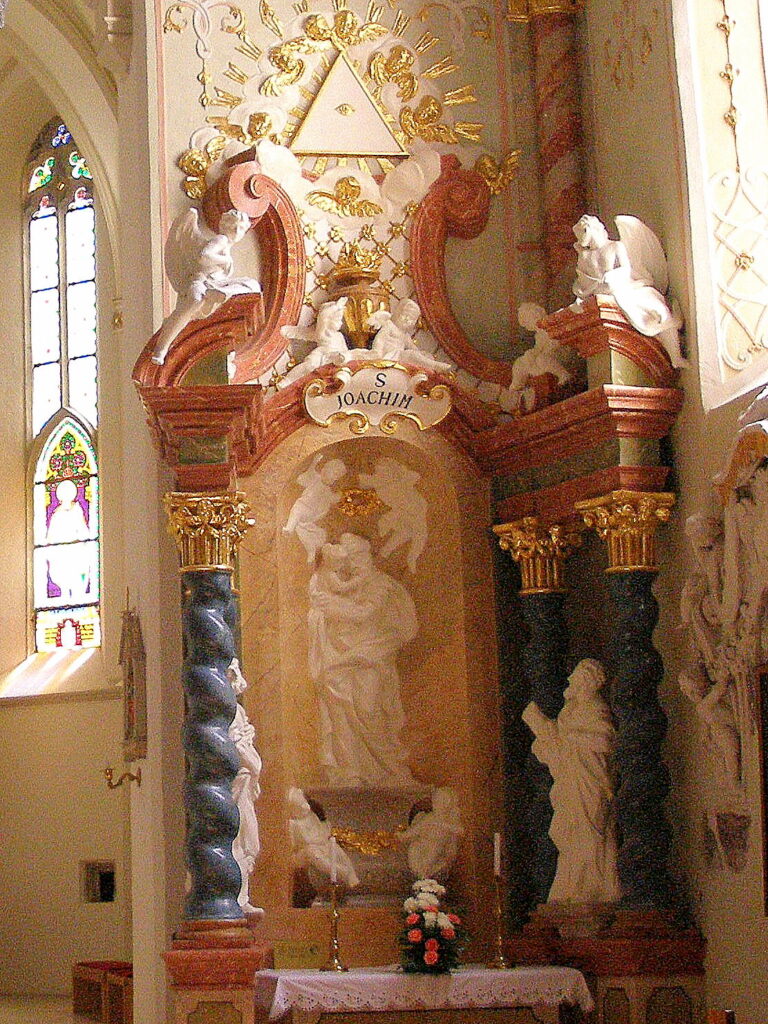
The image of Our Lady of Marianka es una small gothic wood size, traditionally identified as pear wood. Represents Holy Virgin Mary with the Child Jesus in armsOur Lady holds and shows the Son of God high, stressing her mission to present Christ to the world. With the passage of time they were added to the sculpture dos coronas y un manto As an ornament, according to the Central European custom of "wearing" images, thus enhancing the Regy dignity of the Mother and the Child. There is no more detailed official description of polychrome or specific iconographic elements in accessible sources.
The sanctuary is organized around the mandada church to be built in the 14th century, dedicated to the Nativity of the Virgin. It is currently known as the Marian shrine of Marianka, close to Bratislava (about 16 km north of the capital), and is recognized as the oldest Marian shrine in Slovakia. The set includes the main church, outdoor pilgrimage spaces and the area of the miraculous sourcewhere the faithful come in prayer and thanksgiving. The sources consulted do not mention that the church has the title of minor basilicaor that the place has been formally declared National sanctuaryIt is presented above all as a historic sanctuary of great importance to the country.
Sponsorship and coronation
The shrine of Marianka is a National pilgrimage focus and a reference place for the Slovak people, who have been there for more than six centuries; however, the available sources do not specify a Official canonical patronage (for example, as a patron of a particular diocese or of the nation). The main patron of Slovakia is, liturgically, the Virgin of the Seven Doloreswhose national party is held 15 September. The role of Our Lady of Marianka is therefore more in the context of a great historical and regional Marian sanctuaryclosely linked to Bratislava and to the west of the country.
As for a canonical coronation of the image (granting of crowns by pontifical authority and solemn ceremony recognized by the Holy See), in the documentation consulted does not contain a documented canonical coronation. The crowns currently visible on the image are understood as devotional additions, without reference being found to a specific decree of coronation by a pontiff or his delegate.
Party and devotion
The feast of the sanctuary is particularly linked to the Nativity of the Virgin Mary, el September 8, in line with the historical ownership of the church built in 1377. However, the general sources consulted do not provide a detailed calendar of local holidays, nor do they describe the annual liturgical programme precisely; therefore, the date is indicated by liturgical tradition and title, and not by explicit mention in an official document of the sanctuary.
Marianka is described as a sanctuary that "brings together the Slovak people for more than 600 years" and remains a important destination of pilgrimage, even integrated into long-range routes such as Santiago Road that starts in Budapest. The pilgrims come especially to the miraculous source, associated with spiritual and physical favors, and the veneration of the little Gothic image of the Virgin with the Child. Devotion is characterized by confident prayer, participation in the Eucharist and the search for conversion, in continuity with the Marian spirituality of the region. There are no precise figures of inflow in the sources consulted, but there is talk of a constant flow of pilgrims throughout the year, with special intensity in the great Marian parties.
Link to the Rosary
The available sources do not indicate a specific link to history of Our Lady of Marianka with some brotherhood of the Rosary, apparitions linked to the Rosary or titles directly related to this prayer (such as "Our Lady of the Rosary"). It does not include, for example, the documented erection of a Rosary Archicofradia of the sanctuary or the proclamation of a particular Rosary feast associated with this image.
However, as in most of the great Marian shrines of Central Europe, it is reasonable to think that the Rosary usual part of it ordinary devotional life of the pilgrims: families, groups and communities that come to Marianka pray the mysteries of Christ's life with Mary, meditating on the Incarnation, Passion and Glory of the Lord in the face of the image of the Mother who presents them to the Child. Although there is no specific historical data, the Rosary thus becomes a privileged way of living Marianka's spirituality: a simple and deep prayer that accompanies the pilgrimage, opens the heart to grace and helps to contemplate, with Mary, Christ that the image shows "high" as the Savior of the world.
A flower for the Virgin
Offer a simple prayer to this Marian devotion. Pray a Hail Mary for Slovakia and for world peace.
Pray Hail MaryDocumentary update
The information published by the municipality of Marianka and the parish-basilica makes it possible to specify some historical and artistic data. The first written mention of the place is in 1377, when King Louis I of Hungary entrusted the church and the settlement to the Pauline parents; the parish notes that the venerated image is about 42 centimeters and is carved in pear wood. The same parish source shows that art historians place their origin between the end of the 13th century and the first half of the 14th century. The traditional date of 1030 should therefore be maintained as a foundational tradition, not as a documented size dating.
The temple dedicated to the Nativity of the Virgin retains its Gothic structure, although it had Baroque reforms at the end of the 17th century and a neo-Gothic intervention of the presbytery in 1877. The municipal source documents the presence of the Paulines from 1377 to the suppression of the order in 1786; the parish also reports the continuity of the attention by the Congregation of the Consolador Brothers of Gethsemane, which resumed the administration of the place in 1990 after the interruption suffered during the communist regime.
The parish-basilica indicates that the temple was elevated to lower basilica on 29 July 2011during the pontificate of Benedict XVI. This data completes the above information in the tab: it is a basic title documented by the parish itself, but does not in itself constitute an approval of apparitions or miracles. The source and spring belong to the devotional history of the sanctuary; no decree has been located with these sources that declares a particular phenomenon supernatural.
Sources of this update: Marianka City Council; Parroquia-Basílica de Marianka.
Is the advocation of the Virgin Mary of your people missing?
Si no encuentras la advocación mariana de tu ciudad o pueblo, cuéntanosla: la investigaremos para ubicarla y darla a conocer en este mapa del amor de la Madre por el mundo.
Propose an apvocation →