
Marian devotion
Pangia Megasilis
Marian Advocation of Kalávrita (Peloponese)
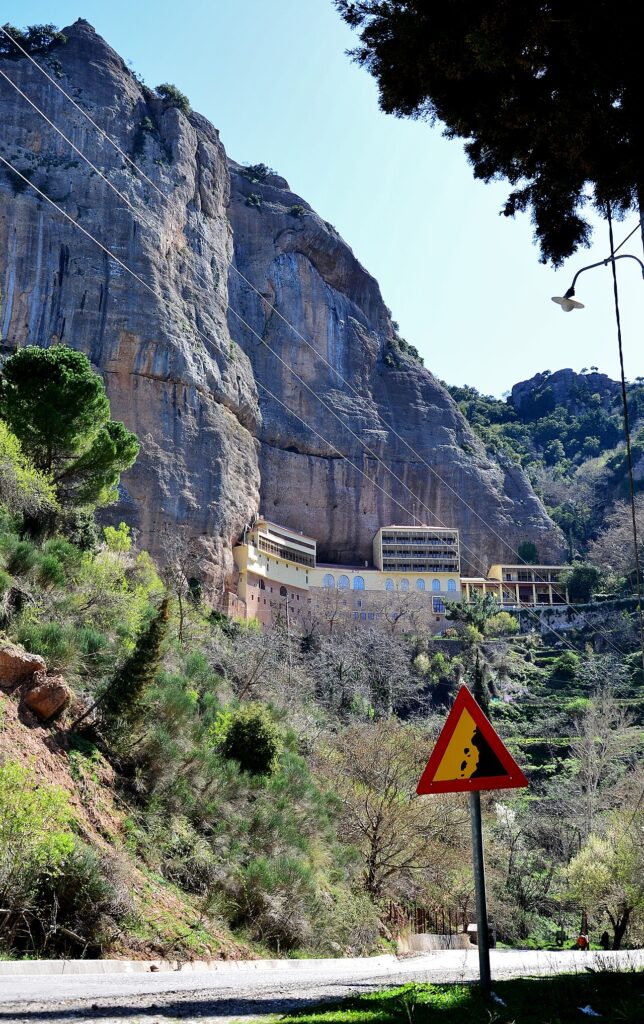
La veneración de Pangia Megasilis (Our Lady of the Great Espelius / of the Great Cave) is attached to the historical Mega Spileo Monastery (Μέγα Σπήλαιο, "Gran Cueva"), considered one of the oldest and most famous monasteries in Greece, located on an impressive cliff over the Vouraikós valley, near Kalávrita, in the Peloponese.
Main data
Origin and history
La veneración de Pangia Megasilis (Our Lady of the Great Espelius / of the Great Cave) is attached to the historical Mega Spileo Monastery (Μέγα Σπήλαιο, "Gran Cueva"), considered one of the oldest and most famous monasteries in Greece, located on an impressive cliff over the Vouraikós valley, near Kalávrita, in the Peloponese.
TRADITION / LEYENDA According to tradition, the icon of the Theotokos (Mother of God) venerated in Mega Spileo would have been painted by Luke the Evangelist on a mixture of wax and resins (mastic), and hidden for centuries until miraculously discovered in a large cave by two pastors or monks (the versions vary) guided by a light or by the Virgin herself. This tradition places the beginning of the monastery in the first centuries of Christianity and presents it as a place of miracles and protection in times of persecution and iconoclasia. However, these details belong to the field of popular piety and cannot be documented historically with precision (there is no verifiable date of the alleged Lucana authorship).
HISTORIA DOCUMENTADA Historically, the monastery of Mega Spileo is documented as one of the oldest monastic centers in the Greek territory, active already in the middle Byzantine era, and subsequently as an important focus of cultural and religious resistance in the Ottoman occupation, with its own school and scriptorium (it does not contain a unique, universally accepted, foundation date that can be cited rigorously). During World War II, the Kalávrita region suffered the well-known Kalavrita masacre (1943), in which Nazi troops killed hundreds of inhabitants and destroyed religious buildings. The monastery and its image were also affected in different wars and fires over the centuries, being restored on various occasions; the present complex is the result of successive reconstructions, which have preserved the veneration of the ancient icon of the Panagia Megaspiliottissa as the spiritual center of the place.
The image and the sanctuary
La image venerated under the advocation of Panagia Megaspiliottissa is a Orthodox icon de la Theotokos (Mother of God), traditionally venerated as the work of Luke, realized - according to tradition - in cera y almáciga (mixture of bee wax and resin). It's a strong-character icon. Byzantine aniconomatic, associated with the typology of the ancient images of the Virgin with the Child (Theotokos Vrefokratousa or similar), although the detailed descriptions of its specific iconography vary in the sources and are not always published with precision; therefore, a comprehensive iconographic analysis open to the academic public is not fully verifiable. It is preserved and venerated as a miraculous image and of great antiquity, the object of continuous veneration by the monks of the monastery and by the pilgrims.
El sanctuary es el Monastery of Mega Spileo (Gran Cueva), a male Orthodox monastery literally built on the wall of a cliff, embedded in an immense natural grotto over the Vouraikós valley, in the civil jurisdiction of Calabria (Acaya peripheral unit, Peloponese). The monastic complex, one of the most emblematic in Greece, has several levels of buildings, main church (katholikon), chapels, monastic dependencies and host for pilgrims. It is not known that the monastery has the Catholic title of minor basilica nor is canonically recognized as National sanctuary within the Catholic Church; it is, above all, a monastery and place of pilgrimage of the Greek Orthodox Church, within the Orthodox Metropolis of Kalávrita and Aigialeia (there is no specific official Catholic designation).
Sponsorship and coronation
El icono de Pangia Megasilis is venerated as the region of Kalávrita and the surroundings of the monastery of Mega Spileo; in the local tradition it is considered spiritual patron of the faithful of the area and of many pilgrims who come from different parts of Greece. However, there are no official sources of the Catholic Church canonical appointment of patronage (by specific Catholic diocese), since it is a sanctuary of the Greek Orthodox Church.
As regards a possible canonical coronation according to the Catholic rite (with the decree of the Holy See or the corresponding Latin ordinary), does not contain a documented canonical coronation. The veneration and honor attributed to the icon are expressed in accordance with the liturgical and ceremonial tradition of the Orthodox Church, with processions, offices and signs of honor of their own, but without the inclusion in the sources of a canonical coronation in the Roman way.
Party and devotion
In Greek Orthodox tradition, the great Marian asvocations linked to monasteries are usually held at the main festivals of the Virgin (Dormition / Koymēsis, Nativity of the Theotokos, etc.) or on a date of their own linked to some miracle or dedication. In case of Pangia Megasilisthe available sources of a public nature do not require a fecha litúrgica exclusiva for the advocation (beyond the participation of the monastery in the general Marian holidays of the Orthodox calendar); therefore, a specific holiday date is not safe of advocation beyond common Marian solemnities.
The devotion is manifested mainly through the pilgrimage to the monasterywho has been alive for centuries. The place is considered one of the most important Marian shrines in Greece, attracting both Orthodox faithful and visitors from other countries, including Catholics, who come moved by the ancient fame of the icon, by the miraculous character attributed to the Virgin and by the impressive location of the monastery on the rock. It does not contain an official and recent figure of annual inflow of pilgrims; it is known that the monastery and the area of Kalávrita are common destinations of pilgrimage and religious tourism, linked in historical memory also to the suffering of the population in the 1943 massacre. Popular devotion includes pleas for the protection of the family, health and help in difficulties, as well as thanksgiving for favors received, according to the own piety of the Orthodox world (candles, icons, vows, participation in the Divine Liturgy and processions with the icon).
Link to the Rosary
In the sources consulted on the Mega Spileo Monastery y al icono de Pangia Megasilis no consta una specific historical or liturgical relationship with the prayer of the Rosary in the Latin way (there is no document of a fellowship of the Rosary or an institutionalized association linked to this advocation in the Catholic field).
However, from a Marian Catholic perspective, the Rosary can perfectly accompany the devotion to Panagia Megaspiliottissa. Who looks at this ancient image of the Theotokos, venerated for centuries by the Orthodox Church, is invited to meditate on the mysteries of Christ's life with Mary, as proposed by the Rosary. The location of the icon in the "great cave" evokes the biblical symbolism of shelter y de la God's presence in the darkness illuminated by faith:: To pray the Rosary before this advocation can become a school of trust in the intercession of the Mother of God, of spiritual communion with the Christians of the East and of silent contemplation of the mysteries of the Incarnation, Passion and Resurrection, which are the centr
A flower for the Virgin
Offer a simple prayer to this Marian devotion. Pray a Hail Mary for Greece and for world peace.
Pray Hail MaryIs the advocation of the Virgin Mary of your people missing?
Si no encuentras la advocación mariana de tu ciudad o pueblo, cuéntanosla: la investigaremos para ubicarla y darla a conocer en este mapa del amor de la Madre por el mundo.
Propose an apvocation →