
Marian devotion
Our Lady of the Conception of Muxima
Marian Invocation of Muxima (Angola)
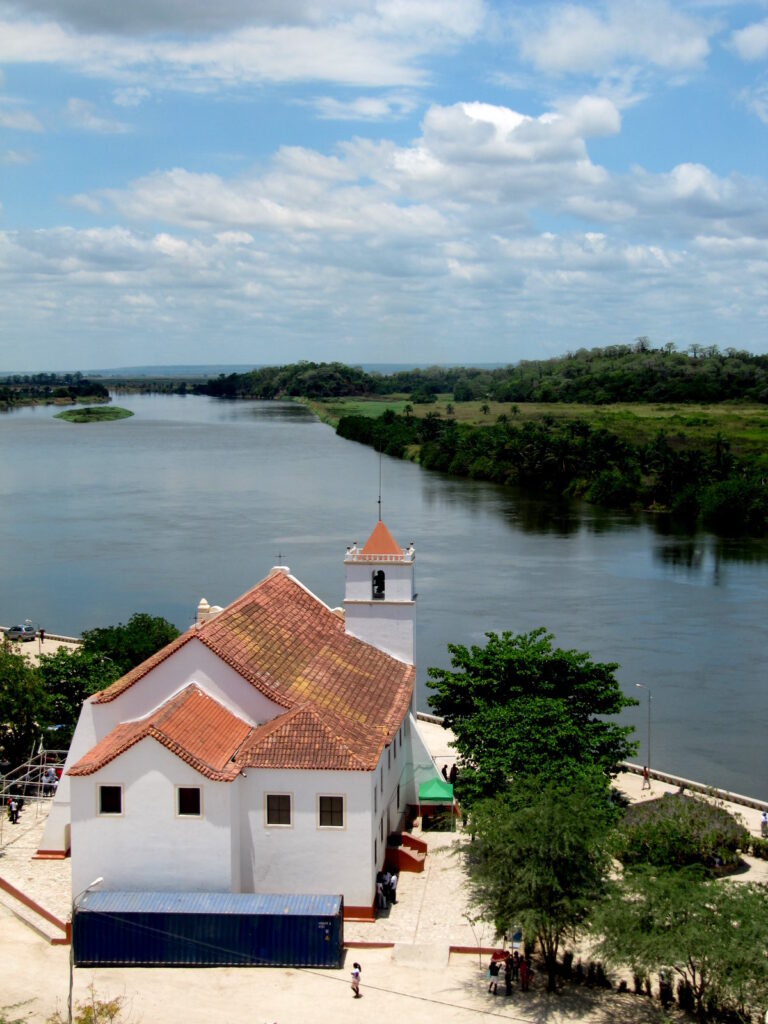
La advocación de Our Lady of the Conception of Muxima It belongs to the Marian tradition rooted in Angola and is linked to the ancient sanctuary on the banks of the Kwanza River in Muxima. The church preserved today is of Portuguese colonial style and is dated in the 16th century; a news and outreach source indicates that the sanctuary was built in 1599.
Main data
Origin and history
La advocación de Our Lady of the Conception of Muxima It belongs to the Marian tradition rooted in Angola and is linked to the ancient sanctuary on the banks of the Kwanza River in Muxima. The church preserved today is of Portuguese colonial style and is dated in the 16th century; a news and outreach source indicates that the sanctuary was built in 1599.
Tradition and devotional memory: the popular name “Mama Muxima” is explained by the term muxima del kimbundu, que significa "heart", and therefore the Virgin is called "Mother of the Heart." This explanation is part of local piety and Angolan devotional transmission.
Documented history: the sources consulted agree that it is one of the oldest Marian shrines in Angola and a central pilgrimage place for the religiosity of the country. The church was also an important enclave in Portuguese colonial times and appears to be linked to the religious and social history of the region.
The image and the sanctuary
The venerated image is presented in the local tradition as Our Lady of the Conception of Muxima; a description published by a Marian gallery presents it with a unique feature: does not carry the Child in his arms, but unites his hands in his lap, a gesture interpreted as a welcome of the prayers of the faithful. On the exact material of the size or image, no consta a secure data from the sources consulted.
The official sanctuary is the Church/Santuary of Our Lady of the Conception of Muximain Muxima, Angola, on the banks of the Kwanza River. The sources describe it as a church of Portuguese colonial style of the 16th century and as the country's main Marian pilgrimage. It does not include in the sources consulted that have the dignity of minor basilica; if its status as a sanctuary and its great national relevance is known.
Sponsorship and coronation
The invocation is strongly associated with patronazgo devocional de Angola in the broad sense, because of its status as the country's main Marian sanctuary and national pilgrimage centre. In the sources consulted no consta a civil or ecclesiastical patronage officially formulated for a specific city, municipality or diocese.
On the canonical coronation, does not contain a documented canonical coronation in the sources consulted.
Party and devotion
The great annual pilgrimage is concentrated between August and Septemberwhen many of the faithful come to the sanctuary for the celebrations of Mama Muxima. The sources present it as the most popular pilgrimage in Angola and highlight their ability to bring together faithful from various regions.
Popular devotion is characterized by its affective and penitential tone: the loving name “Mama Muxima” sum up the people's confidence in Mary as a close and welcoming mother. The sources consulted do not safely establish a fiesta litúrgica principal other than the popular celebration associated with the pilgrimage; therefore, no consta a specific liturgical date universally established in the revised materials.
Link to the Rosary
The sources consulted no explicitan a particular and exclusive historical link between this advocation and a fellowship, fellowship or rosarian tradition of its own. However, in a Marian devotion so deeply rooted, the Rosary It naturally accompanies the contemplation of the mysteries of Christ with Mary, and especially fits a sanctuary where the Virgin is invoked as Mother of the Heartthat is, like the one who receives and keeps the prayer of the faithful.
A flower for the Virgin
Offer a simple prayer to this Marian devotion. Pray a Hail Mary for Angola and for world peace.
Pray Hail MaryIs the advocation of the Virgin Mary of your people missing?
Si no encuentras la advocación mariana de tu ciudad o pueblo, cuéntanosla: la investigaremos para ubicarla y darla a conocer en este mapa del amor de la Madre por el mundo.
Propose an apvocation →