
Marian devotion
Our Lady of Naantali
Marian vocation of Naantali (Finland)
La advocación de Our Lady of Naantali is linked to the old Brigidino monastery founded in Naantali (Nådendal)in the south-west of Finland, near Turku, during the 15th century. The monastery belonged to the Order of the Most Holy Saviour, founded by Saint Brigida of Sweden, and was one of the country's main religious centers in the Middle Ages. The city itself grew around the monastery, which attracted population, trade and pilgrims; Naantali is mentioned as an important historical and religious enclave since that time.
Main data
Origin and history
La advocación de Our Lady of Naantali is linked to the old Brigidino monastery founded in Naantali (Nådendal)in the south-west of Finland, near Turku, during the 15th century. The monastery belonged to the Order of the Most Holy Saviour, founded by Saint Brigida of Sweden, and was one of the country's main religious centers in the Middle Ages. The city itself grew around the monastery, which attracted population, trade and pilgrims; Naantali is mentioned as an important historical and religious enclave since that time.
La documented history indicates that the convent (double, for nuns and friars, according to the tradition Brigidina) was the main Marian center of medieval Finland until the Protestant Reformation in the 16th century, when religious houses were suppressed or secularized in the territories under the Swedish Crown, of which Finland was a part. After the Reformation, the property of the monastery was confiscated and the church eventually passed to Lutheran veneration.
As regards tradition / legend, various secondary sources online refer to a special devotion to the Virgin in this place, called in Latin Vallis Gratiae ("Valley of Grace"), a name that highlights the Marian character of the monastery and its surroundings; however, it does not contain in the sources consulted clearly documented accounts of specific foundational apparitions or miracles in Naantali, beyond the general framework of Brigidine spirituality centered on Christ and the Virgin Mary. It does not contain, in the accessible documentation, a precise legendary narrative of this advocation that can be considered historically verifiable.
The image and the sanctuary
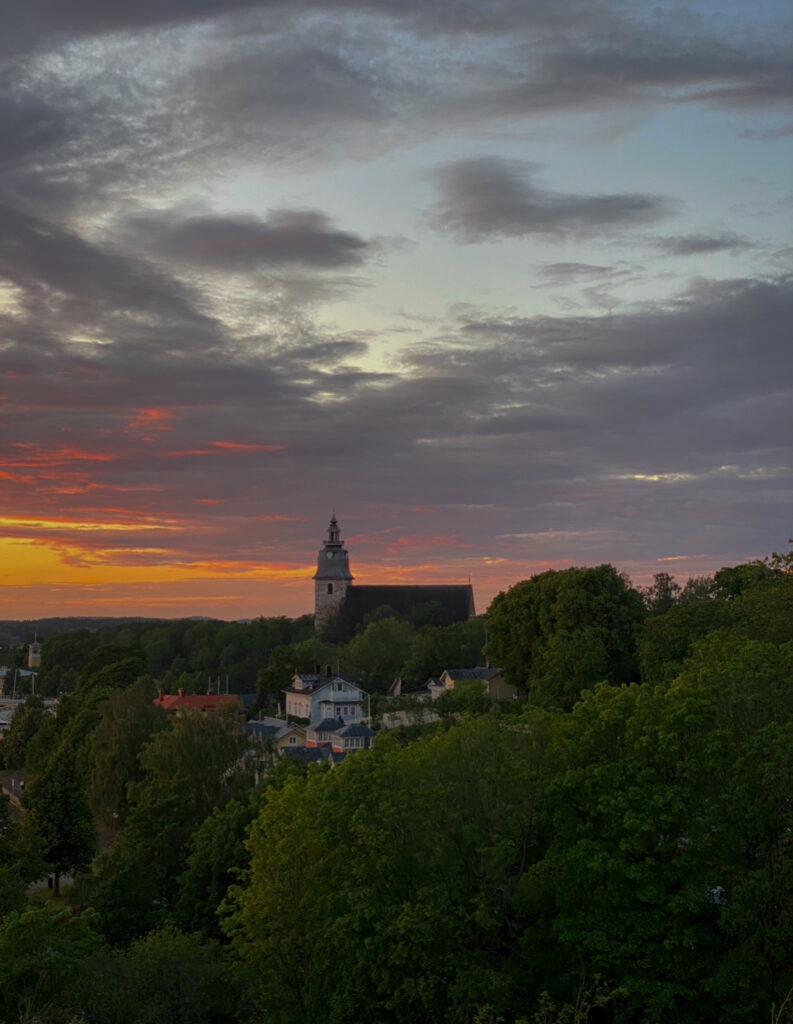
The church of the ancient Brigidino monastery is today known simply as the church of Naantali, one of the most significant historical buildings in the city and one of the oldest medieval stone churches preserved in Finland. Several tourist guides and city descriptions point to the presence of a large medieval stone church como hito principal del perfil urban de Naantali. Actually pertains to Iglesia evangélica luterana de Finland, so the cult that is celebrated there is Lutheran, although the origin and configuration of the temple are medieval and Catholic.
As for the imagen marian concrete that would embody the advocation of "Our Lady of Naantali (Vallis Gratiae)," the sources of public access consulted (historical general, tourist and basic online references) do not provide a precise and verifiable description of the type of image (sculpture or painting), material, style or specific iconographic details. It does not contain, with accessible documentary certainty, a current Marian image officially recognized with that title within the church, nor does it provide technical data (height, exact time, author, etc.) on a Marian size or altarpiece that officially bears that name. Given the lack of contrasting data, it can only be said that the ancient Brigidino monastery was strongly marked by the Marian devotion of the Order of Saint Brigida, but no constaa detailed description of a unique image today venerated under the title "Our Lady of Naantali."
It does not know that the Naantali church has the rank of minor basilicanor that the temple has been officially designated as a national Marian or diocesan sanctuary in the Catholic context; it is now a Lutheran parish that is outstanding for its historical and artistic value.
Sponsorship and coronation
The sources consulted on Naantali (historical, tourist and general reference) point to the importance of the old monastery for the history of the city and Finland, but no consta in them a current Catholic canonical recognition of "Our Lady of Naantali" as official patron of the city, diocese or nation. The city of Naantali is known today, among other things, for the summer presidential mansion and for being a coastal tourist destination, and not for a Marian patronage formally proclaimed in the Catholic field.
On a canonical coronation of the image under the title of Our Lady of Naantali, the available sources do not mention any act of canonical coronation granted by the Holy See or by pontifical delegation, or diocesan coronations of an official character. Therefore, according to the consulting data, does not contain a documented canonical coronation.
Party and devotion
The general documentation on Naantali and its medieval church does not include a specific Marian party under the title "Our Lady of Naantali" that has remained to this day as a self-celebration, no specific dates of Marian pilgrimages are included in the current calendar. The city does maintain various local traditions, such as the well-known summer festival "Sleepyhead," but these references are of a cultural and tourist nature, not specifically Marian.
In the medieval period, it is reasonable to assume (by analogy with other Brigidine monasteries of Scandinavia) an intense liturgical life around the great feasts of the Virgin (especially the Assumption and Nativity of Mary), as well as a daily practice of Marian prayer, although for Naantali in particular no constanin the sources consulted, detailed data on pilgrimages, inflow figures, and people's devotional traditions are strictly documented and continued to the present. Today the church of Naantali is presented, above all, as a historic monument and place of Lutheran veneration, visited by tourists and faithful.
Link to the Rosary
No documented references have been found that directly and specifically relate the advocation of Our Lady of Naantali (Vallis Gratiae) with the prayer of Rosary in contemporary Catholic tradition. The Lutheran Reformation interrupted the institutional continuity of the Catholic monastery, and the church passed to the Lutheran cult, where the practice of the Rosary, as understood in Catholicism, is not an ordinary part of piety.
However, from a general Marian perspective, the old character of “Valle de la Gracia” and the intense imprint of the spirituality of Saint Brigida of Sweden invite to contemplate this place as a space for meditation of the mysteries of the life of Christ and Mary, the purpose of the Rosary. Where the medieval Marian heritage has remained as a historical memory - as in Naantali - the prayer of the Rosary can become, for Catholics who visit or spiritually remember this historical sanctuary, a privileged medium for uniting the contemplation of the mysteries of Christ with the grateful memory of the ancient Marian devotion that gave rise to the city and its church. In this sense, although no conste a devotional bond of its own with the Rosary, the advocation of Our Lady of Naantali can be integrated in a harmonious manner into the prayer of the Rosary, especially by meditating on the joyful and glorious mysteries, which underline the grace of God shed in Mary and, through her, on the whole Church.
A flower for the Virgin
It offers a simple prayer to this advocation. Pray a Hail Mary for Finland and for world peace.
Pray Hail MaryIs the advocation of the Virgin Mary of your people missing?
Si no encuentras la advocación mariana de tu ciudad o pueblo, cuéntanosla: la investigaremos para ubicarla y darla a conocer en este mapa del amor de la Madre por el mundo.
Propose an apvocation →