
Marian devotion
Our Lady of Oostakker- Lourdes
Marian title of Oostakker (Eastern Flanders)
La devoción a Our Lady of Oostakker- Lourdes It was born directly from the influence of the apparitions of Lourdes (France, 1858), whose devotion spread very quickly throughout Europe. In a few decades, the "lourdist" grotto and sanctuaries, including that of Oostakker, in Eastern Flanders (Belgium), became the main Lourdes-type sanctuary of the country, associated with cures attributed to the intercession of the Virgin. In the sources consulted, there is not a tradition of own apparitions in Oostakker, but an extension of the message and iconography of Lourdes.
Main data
Origin and history
La devoción a Our Lady of Oostakker- Lourdes It was born directly from the influence of the apparitions of Lourdes (France, 1858), whose devotion spread very quickly throughout Europe. In a few decades, the "lourdist" grotto and sanctuaries, including that of Oostakker, in Eastern Flanders (Belgium), became the main Lourdes-type sanctuary of the country, associated with cures attributed to the intercession of the Virgin. In the sources consulted, there is not a tradition of own apparitions in Oostakker, but an extension of the message and iconography of Lourdes.
According to the documented story, the Oostakker Grotto was built in 1875 in the park of the castle of Maelcamp, in Oostakker, then a town near Ghent (now part of its periphery). It is explicitly inspired by the Grotto of Massalielle, in Lourdes, and very soon attracted pilgrims from both Flanders and other regions of Belgium, especially sick and people seeking spiritual comfort, like the French sanctuary. Various testimonies speak of healing and favors obtained, which consolidated the fame of the place as a Marian sanctuary of grace.
In the local tradition Oostakker- Lourdes is presented as a "Belgian Lourdes," where the Virgin continues to offer comfort to the sick and to those who suffer, in continuity with the advocation of Our Lady of Lourdes, patron of the sick in the universal Church. Beyond this spiritual and pastoral reference, there are no legends of particular apparitions or messages specifically linked to the Oostakker grotto.
The image and the sanctuary
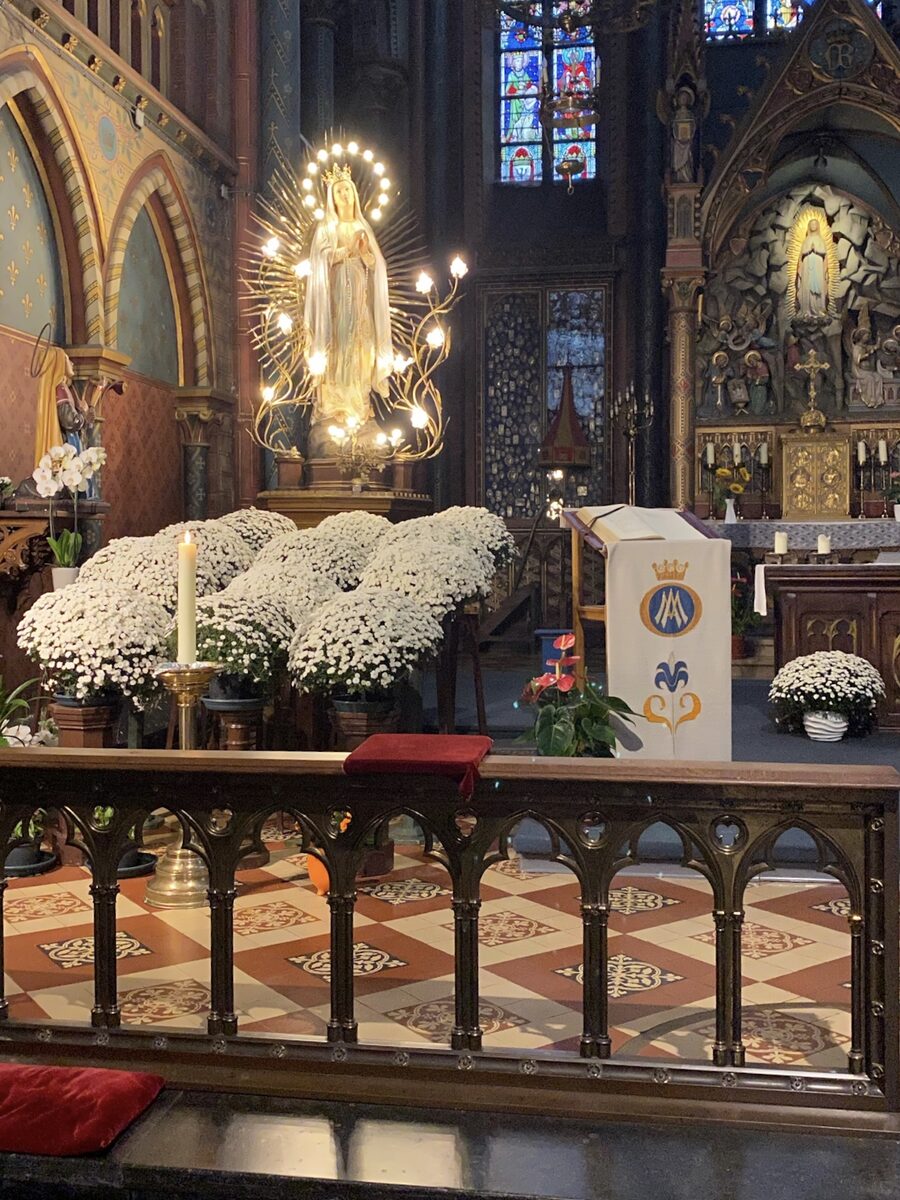
The venerated image in Oostakker-Lourdes is a image of Our Lady of Lourdes, following the model spread from the apparitions of 1858: the Virgin Mary de pie, dressed in white robe and blue mantle, with a rosary between your hands, as described by Saint Bernardita Soubirous. In the Lourdes iconography, in which the devotion of Oostakker is inspired, the Virgin presents herself as the Immaculate Conceptionwith his hands together in prayer attitude and a rosary hanging from his fingers, inviting prayer and penance.
The sanctuary is articulated around the gruta de Lourdes de Oostakkerbuilt in 1875 in the park of the castle of Maelcamp, as a devotional replica of the Grotto of Massabielle. Over time, the place was set up as a pilgrimage complex with church, prayer spaces and reception of faithful, taking the place of the main Lourdesian centre of Belgium, especially for the sick and organized pilgrimages. In the sources consulted it is not known that the main temple has been elevated to the range of minor basilicanor that it is officially declared a national sanctuary; it is, in any case, a Marian sanctuary of great importance at the regional level and for Lourdesian devotion in Belgium.
Sponsorship and coronation
Our Lady of Oostakker- Lourdes is venerated in a particular way as protection of the sick and those sufferingin full harmony with the general vocation of Our Lady of Lourdes, which the Church invokes as patron of the sick. However, the documentation consulted does not contain a specific formal proclamation of patronage over the municipality of Oostakker, the city of Ghent or some particular diocese, beyond its role as a reference Marian sanctuary for Eastern Flanders.
With regard to a possible canonical coronation of the image, in the accessible sources (including the general bibliography about Our Lady of Lourdes and the references to Lourdesian sanctuaries) does not contain a documented canonical coronation for the image of Oostakker-Lourdes. In the absence of verifiable data on date, pontiff or delegate, this statement should be kept with caution.
Party and devotion
La main party linked to Our Lady of Oostakker- Lourdes is celebrated around the 11 February, in line with the liturgical memory of Our Lady of Lourdes, which commemorates the first apparition in 1858. This date, which in the universal Church is also the World Sick Dayis of particular importance in a sanctuary of a marked Lourdesian and healing character.
The pilgrimages to Oostakker- Lourdes are inspired by the model of Lourdes (France): groups of faithful, parishes, movements and especially associations that accompany the sick come to the grotto seek comfort, spiritual strength and, in some cases, the grace of healing. The sources on Lourdes highlight the abundance of testimonies of spiritual cures and graces linked to prayer in the grotto and the use of water, elements that have been reproduced in other Lourdesian shrines. Oostakker, as the main sanctuary of this kind in Belgium, is involved in this same dynamism of faith, although there are no detailed figures of inflow in the sources consulted.
Devotion usually includes participation in the Eucharist, Marian processions (especially around February 11), prayer for the sick and acts of consecration to the Virgin. They do not contain, in the revised sources, popular traditions very unique or differentiated from other Lourdesian shrines; rather they are integrated into the common spirituality of Lourdes, focused on penance, conversion and trust in God's mercy through Mary's intercession.
Link to the Rosary
The advocation of Our Lady of Oostakker- Lourdes is deeply marked by the Rosary, being directly linked to the iconography and message of Lourdes. In the apparitions of Lourdes, the Virgin is shown with a rosary in the hands and accompanies the prayer of Bernardite, inviting the meditation of the mysteries of Christ's life. This image is the same as in the Lourdesian grotto and shrines, including Oostakker, where the Virgin is visibly presented as "Lady of the Rosary."
Although there are no rules of the Oostakker shrine on the Rosary prayer, by analogy with Lourdes and according to the iconography of the image, the Rosary prayer is an essential part of devotional life: it is prayed in groups, in processions and in an individual way, especially for the sick and for the conversion of the heart. Where Our Lady of Lourdes is venerated, the Rosary acts as a school of Marian and Christological prayer: by contemplating the mysteries, the faithful join Mary in the meditation of the Gospel, they ask for the grace of living the conversion to which Lourdes' message invites and find comfort in the moments of suffering, a particularly significant feature in a sanctuary that welcomes so many sick and needy.
A flower for the Virgin
Offer a simple prayer to this Marian devotion. Pray a Hail Mary for Belgium and for world peace.
Pray Hail MaryIs the advocation of the Virgin Mary of your people missing?
Si no encuentras la advocación mariana de tu ciudad o pueblo, cuéntanosla: la investigaremos para ubicarla y darla a conocer en este mapa del amor de la Madre por el mundo.
Propose an apvocation →