
Marian devotion
Our Lady of the Gate of the Aurora, Mother of Mercy
Marian title of Vilna (Polish Devotion (Vilna))
Documented history. The Aurora Gate (Aušros Vartai / Ostra Brama) was part of Vilna's defensive system, built between 1503‑1522 as one of the nine doors of the wall of the capital of the Grand Duchy of Lithuania. At the time it was customary to place sacred images on the doors, to ask for protection from war dangers and blessing for those who entered and left the city.
Main data
Origin and history
Documented history. The Aurora Gate (Aušros Vartai / Ostra Brama) was part of Vilna's defensive system, built between 1503‑1522 as one of the nine doors of the wall of the capital of the Grand Duchy of Lithuania. At the time it was customary to place sacred images on the doors, to ask for protection from war dangers and blessing for those who entered and left the city.
The icon of the Virgin, today known as Our Lady of the Gate of the Aurora, is dated around the primira mitad del siglo XVII (approx. 1630), of unknown author, and belongs to the tradition of the so-called "Black Madonas." During the Russian-Polish war of 1655, when Vilna was looted, both the door and the image were entrusted to the Barefoot Carmelites; from then on a public cult, especially alive between the years 1655-1661, began to be consolidated, when the population asked for its intercession into the city.
En 1720 The current brick chapel was consecrated on the Aurora Gate, where the icon was moved from its outer niche, receiving the look it has preserved until today. Since then, there has been a continuous flow of pilgrims from Lithuania, Poland, Belarus, Ukraine and other countries inherited from the former Polish-Lithuanian Commonwealth. The sanctuary was visited by John Paul II on his journey to Lithuania in 1993.
Tradition and devout memory. The pious tradition attributes to the image numerous wonders, cures and protections in times of war and oppression, which have made the Gate of the Aurora a symbol of unity and hope for the Lithuanian and Polish peoples. It is particularly invoked as Mother of Mercyand very loved by the Polish people, who recognize it as a sign of the struggle for freedom and faith. The rich collection of devotees around the icon testifies to that story of graces received.
The image and the sanctuary
The image. The icon of Our Lady of the Aurora Gate is a painting on board product, originally made to the temple, in the Nordic Renaissance style, dating back to the early 17th century. Represents the Virgin without the Childwith his hands crossed on his chest, in an attitude of humble reception and compassion, he inserted into the iconographic tradition of the Black Madones.
From the 18th century it was covered with a riza or metal coating - a typical oklad of the Slavic tradition - covering the body and the mantle, leaving the face and hands visible. It is adorned with rich ornaments and crowns, the fruit of the devotion of the faithful, and surrounded by numerous exvotes offered in gratitude for favors and miracles.
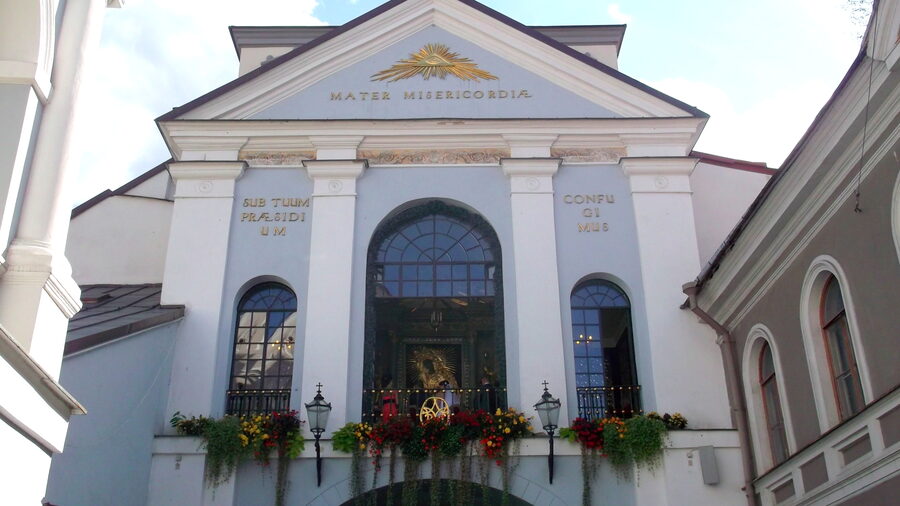
The sanctuary. The image is venerated in the Chapel of the Gate of the Aurora (Aušros Vartų koplyčia), built in brick and consecrated in 1720, located on the eastern gate of the city itself. The Aurora Gate is today the only original door preserved from the ancient fortifications of Vilna and is a unique set: a large white building that crosses the street, with the chapel on the upper level, open by large windows to the outside.
The chapel is one of the most important Marian shrines in Lithuania and a place of pilgrimage of great relevance to the faithful of Lithuanian and Polish tradition. It does not know that it has the title of a minor basilica; it is a Marian sanctuary well known, also historically linked to Carmelite spirituality and the spread of devotion to the Divine Mercy, whose first image was exposed there for a time.
Sponsorship and coronation
Patronage. Our Lady of the Gate of the Aurora is venerated as Patrona de Vilna and a symbol of union for the Lithuanian and Polish peoples. In devotional tradition it is invoked as Mother of Mercy, Queen of Poland and Grand Duchess of Lithuania, an expression that underlines its spiritual role in the history of both peoples. Its influence has led to numerous churches and chapels dedicated to this advocation in Lithuania, Poland and the diaspora (for example in Montreal and Buenos Aires, among others).
Canon coronation. The image was canonically crowned the 2 July 1927with crowns blessed by the Pope Pío XI, officially receiving the title of Mother of Mercy. This act, recognized by the Holy See, confirmed the long tradition of veneration and the numerous testimonies of favors attributed to the intercession of the Virgin at the Gate of the Aurora.
Party and devotion
La main party of Our Lady of the Gate of the Aurora in the calendar of the Catholic Church is celebrated the 16 November. For many faithful, especially Poles from the ancient eastern regions, this date evokes affectionate memories of Vilna and the Virgin venerated there in her miraculous image.
The sanctuary is described as the best known in Lithuania for miraculous healing and other graces received, and is a place of continuous pilgrimage. Pilgrims come, above all, from four main peoples - Lithuanian, Polish, Belarusian and Russian - and from two Christian, Catholic and Orthodox denominations, who together venerate the Mother of Mercy. The chapel is almost always attended, especially on Sundays and holidays, with celebration of the Eucharist and prayers before the icon.
Popular devotion is expressed in silent prayer, the offer of vows, processions and novies around the November feast, as well as in the dissemination of copies of the icon in numerous shrines and parishes of Polish and Lithuanian tradition. In the Polish context, the advocation occupies a prominent place within national Marian piety, along with other great shrines such as Jasna Góra.
Link to the Rosary
The sources consulted do not mention a specific or historical relationship documented between the advocation of Our Lady of the Gate of the Aurora and a practice proper to the prayer of the Rosary (for example, rosarian copradies originating from the sanctuary or a feast of the Rosary expressly linked to this icon). Therefore, there is no particular institutionalized link with the Rosary.
However, as in most Marian shrines of Central and Eastern Europe, the Rosary is a regular part of the daily Marian piety of the pilgrims: he prays before the icon as a simple way to contemplate, together with Mary, the mysteries of Christ's life, imploring his mercy on people and peoples. In the specific case of the Mother of Mercy of the Gate of the Aurora, this prayer is naturally harmonized with the emphasis of the sanctuary in the divine mercy a la not
A flower for the Virgin
Offer a simple prayer to this Marian devotion. Pray a Hail Mary for Poland and for world peace.
Pray Hail MaryIs the advocation of the Virgin Mary of your people missing?
Si no encuentras la advocación mariana de tu ciudad o pueblo, cuéntanosla: la investigaremos para ubicarla y darla a conocer en este mapa del amor de la Madre por el mundo.
Propose an apvocation →