
Marian devotion
Panagia Ekatontapliani
Marian Invocation of Pariká (Paros) (Cyclades)
La Panagia Ekatontapliani (in Greek, "Most Holy of the One hundred Doors") is an ancient Paleocristic Basilical complex located in Pariká, on the island of Paros, considered one of the oldest Christian temples still in use in Greece. According to archaeological and architectural studies, the main structure dates back to the 4th century, linked to the period of Constantine and its successors, with important reforms in the 6th century (Justinian period) and subsequent restorations following earthquakes and medieval modifications.
Main data
Origin and history
La Panagia Ekatontapliani (in Greek, "Most Holy of the One hundred Doors") is an ancient Paleocristic Basilical complex located in Pariká, on the island of Paros, considered one of the oldest Christian temples still in use in Greece. According to archaeological and architectural studies, the main structure dates back to the 4th century, linked to the period of Constantine and its successors, with important reforms in the 6th century (Justinian period) and subsequent restorations following earthquakes and medieval modifications.
La TRANSITION local states that the basilica was founded by Saint Helena, mother of the Emperor Constantine, who would have made a vow to erect a temple to the Virgin during a journey to the Holy Land, passing through Paros; this promise would have been fulfilled later by his son Constantine (or by a successor) by building the sanctuary. This tradition, deeply rooted in popular piety and in guides of the sanctuary itself, however, lacks contemporary documentation to confirm it.
From the perspective of the HISTORIA DOCUMENTADAthe researchers agree that the building is an imperial or high-ranking foundation of the 4th century, remodeled in the 6th century, but there is no direct written evidence that links St. Helena in a verifiable way. The whole was a monastery and Marian cult center throughout the Byzantine era, suffered damage and restoration due to earthquakes, and continued in use during Venetian and Ottoman domination, always maintaining a continuity of veneration in Greek Orthodox tradition.
The image and the sanctuary
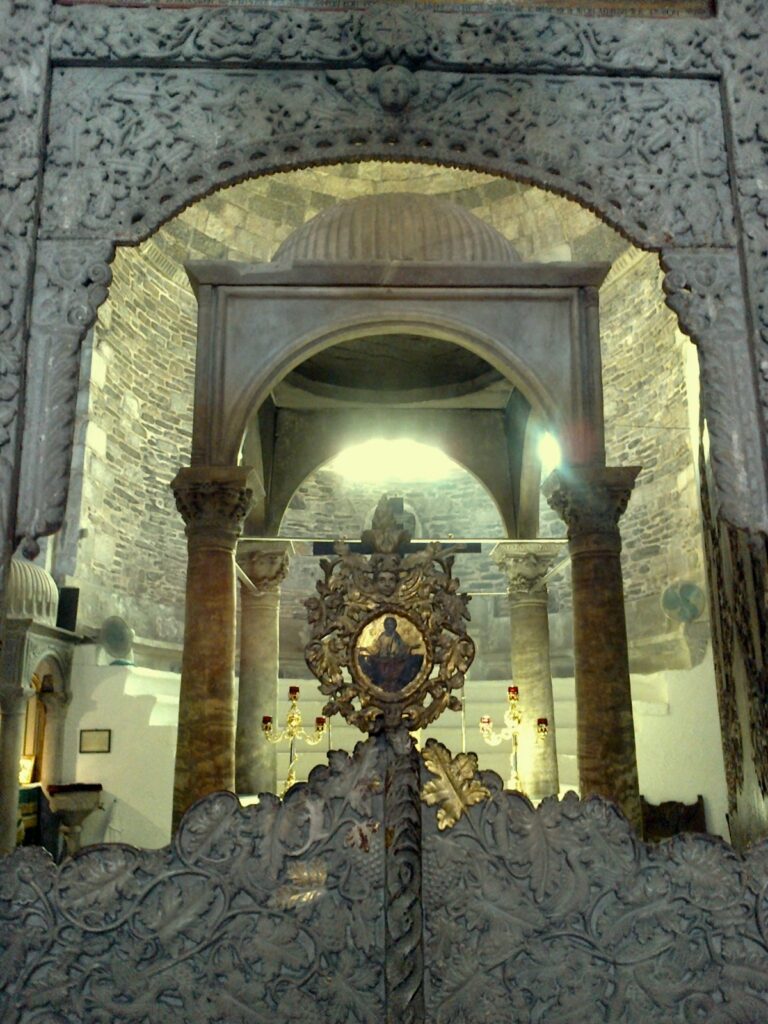
The invocation is mainly associated with the basilica and to the architectural set of the Panagia Ekatontapliani, rather than a single concrete image. The temple is a great three-ship basilica with dome, paleocristian-Byzantine style, with independent central-plant baptistery, annexed chapels and an important set of ancient architectural and decorative elements, including columns and reused capitals (spolia) of classical times. The main church is dedicated to the Sleeping of the Theotokos (Assumption of the Virgin, in Latin language), core of the Marian cult of the place.
In the interior are venerated various Marian icons of Byzantine and post-Byzantine style, typical of the Orthodox tradition; among them, a main icon of the Panagia in the iconostase, partially covered by metal coatings (riza) and decorated with exvotes. The sources consulted do not require the author, exact dating or detailed technique of an "original" icon specific to this advocation; it is, in general, icons on table, following the traditional iconography of the Theotokos, without a certain record of a single official taumaturgo icon in front of others.
The Ekatontapyliani set is recognized as one of the oldest and most significant Christian monuments in Greeceprotected as a national historical and religious heritage. It is not known that the church has been formally declared minor basilica by the Holy See; the title "basilica" in the literature responds to its character as a paleocristic basilica in the historical-architectural sense and to the Orthodox tradition, not to a Latin canon concession.
Sponsorship and coronation
The Panagia Ekatontapyliani is an important place of Marian pilgrimage for the faithful Greek Orthodox and, in general, for the Christians of the Cyclades, but the sources consulted do not contain a formal proclamation of canonical pattern (in the Catholic legal sense) about a particular diocese or municipality. It is especially venerated as a protector of the island of Days y de su capital, Parikiain the context of the Greek national Orthodox tradition.
As for a canonical coronation According to the use of the Latin Catholic Church (pontifical decree, official coronation act), there are no verifiable data in the usual sources (sanctuary documentation, historical literature, Catholic press). Therefore, according to the above criteria:
does not contain a documented canonical coronation.
Party and devotion
La main party vinculada to the Panagia Ekatontapyliani if celebrates el August 15, solemnidad de la Sleep / Assumption of the Virgin Mary, which is one of the great Marian parties of the Greek Orthodox calendar. On that date, Paros hosts important liturgical celebrations, processions and religious and popular acts, which make Pariká a focus of pilgrimage within the Cyclades archipelago.
Devotion is expressed by the participation in the Divine Liturgy, las processions with the icon of the Panagia, the veneration by kisses (proskynesis), the burning of cirios and votive lamps and the offering of exvotes hanging next to the main icon. The August 15 party in Paros combines religious and cultural elements: the arrival of pilgrims from other islands, festive events, the atmosphere of romance and a strong sense of local identity around the Mother of God. There are no constant official figures of influx, but various tourist and ecclesial chronicles describe the celebration as one of the most popular on the island.
In addition to August 15, the Orthodox liturgy celebrates frequent paráclis (pleas) to the Panagia, especially in the period of the fasting of August prior to the Sleep, which reinforces the character of the sanctuary as a place of continuous Marian intercession.
Link to the Rosary
La Panagia Ekatontapyliani pertenece a la Greek Orthodox traditionin which it is not part of the usual spirituality Holy Rosary as we pray in the Latin Catholic Church. There is no specific link of this advocation to the prayer of the Rosary in the documentation consulted, or rosarian copradies officially linked to the sanctuary.
However, from a Marian and ecumenical perspective, the Rosary may accompany devotion to the Panagia Ekatontapyliani in the Catholic faithful who visit the sanctuary or spiritually join it. The Rosary, which travels the mysteries of Christ's life with Marywith the Orthodox brothers, the centrality of the Theotokos in the mystery of the Incarnation, of the Cross and of the glory of Christ. In praying the Rosary, the Catholic faith recognizes in Mary the same Mother of God venerated in Paros, so that this prayer becomes an inner bridge of communion and respect for the rich Marian tradition of the East.
A flower for the Virgin
Offer a simple prayer to this Marian devotion. Pray a Hail Mary for Greece and for world peace.
Pray Hail MaryIs the advocation of the Virgin Mary of your people missing?
Si no encuentras la advocación mariana de tu ciudad o pueblo, cuéntanosla: la investigaremos para ubicarla y darla a conocer en este mapa del amor de la Madre por el mundo.
Propose an apvocation →