
Marian devotion
Our Lady of Peñafrancia
Marian Invocation of Naga (Luzon)
La advocación de Our Lady of Naga's Peñafrancia is historically linked to the devotion to the Virgin of the Peña of France, in Salamanca (Spain), from where the name and model of the image was taken. The name "Peñafrancia" comes from Peña de France"rock of France."
Main data
Origin and history
La advocación de Our Lady of Naga's Peñafrancia is historically linked to the devotion to the Virgin of the Peña of France, in Salamanca (Spain), from where the name and model of the image was taken. The name "Peñafrancia" comes from Peña de France"rock of France."
According to the tradition collected in devotional sources, the remote origin of the advocation is located in the 15th century, when the French noble Simon Vela, moved by interior revelations, found an image of the Virgin in the Peña de France, in Spain, in 1434. This story explains how the cult of Our Lady of the Peña of France, who would later inspire Filipino devotion, was consolidated in Europe, but does not even tell the concrete origin of the Naga shrine.
La documented history in the Philippines places the beginning of devotion in Naga at the beginning of the 18th century. around 1710, the Spanish priest Miguel Robles de Covarrubias He took Naga's personal devotion to Our Lady of Peñafrancia and promoted the construction of a chapel and the realization of an image inspired by the Spanish advocation. From then on, devotion spread throughout the region of Bicol, until it was popularly recognized as EASSE (Mother) and Biolandia Patron.
The image and the sanctuary
The venerated image of Our Lady of Naga's Peñafrancia is a lump size, of approximately 91 cm high, venerated as "Ina" or "Mother of the bicolans." Various sources describe it as a traditional-style Marian image, inspired by the primitive Virgin of the Peña of France, with Child Jesus in arms and regious attributes, but without detail of its iconography in the sources consulted; therefore, not accurately recorded a more detailed iconographic description. The current image is considered very old (around 275 years, according to local tradition), but this dating is presented in devotional sources and not always with full critical support.
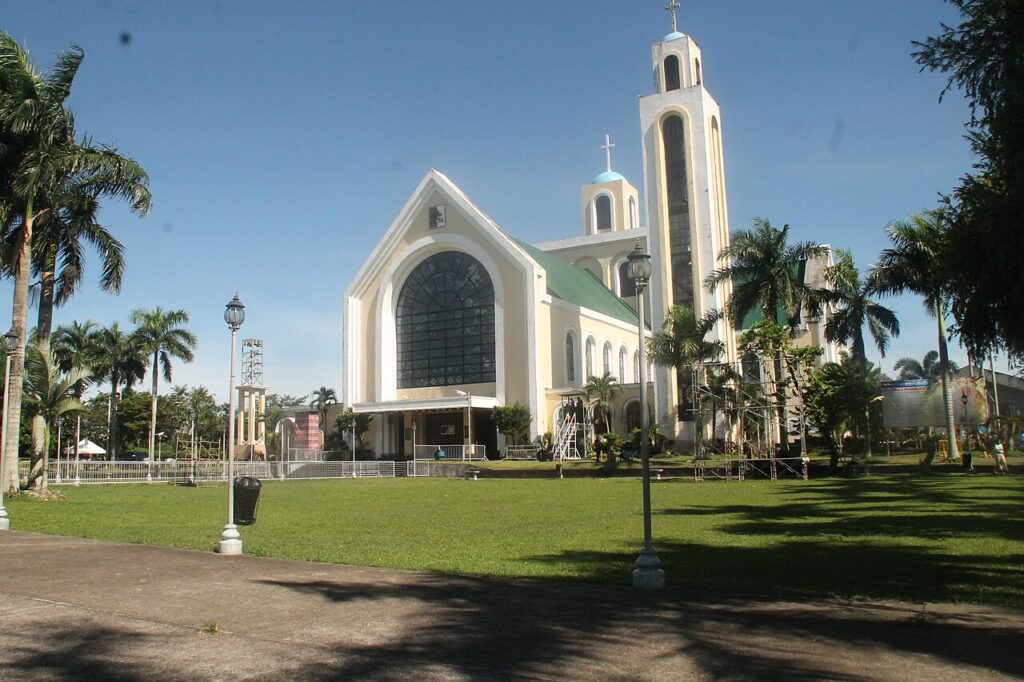
The main place of worship is the Minor Basilica of Our Lady of Peñafrancialocated on the outskirts of the city of Naga, in the region of Bicol, Luzon Island. The temple is officially recognized as minor basilica and also National sanctuary in the Filipino field, and usually houses the venerated image, except during certain procedural acts. The Basilica is a great pilgrimage complex that welcomes every September to millions of pilgrims and devotees, being considered one of the largest Marian pilgrimage centres in Asia and the world, with figures that exceed the five million faithful a year according to disclosure estimates.
Sponsorship and coronation
Our Lady of Peñafrancia is recognized and venerated as Main Patron and Queen of the Bicol Region, being called familiar EASSE for the faithful and for many devotees from other regions. On the devotional and pastoral level, it is therefore the great Marian patronage of the city of Naga and of the whole of Bicolandia.
The image received canonical coronation en 1924, under the pontificate of Pío XI. The ceremony was held at 20 September 1924and was chaired on behalf of the Holy See by Mons. Guillermo Piani, Apostolic Delegate in the Philippines. The sources also highlight that it was the second Marian image in the Philippines and Asia in receiving a canonical coronation, a sign of the arraigo and prestige of this devotion in the Asian sphere.
Party and devotion
La main party of Our Lady of Peñafrancia is celebrated in the Philippines the third Saturday of September. The famous Festival of Peñafranciawith an extensive ninth (ninth) and multiple liturgical and popular celebrations that make September the "month of Ina" in Naga.
The sources describe a great annual pilgrimage, con una ninth of nine days, processions and mass acts. Among them is the call Transfera solemn procession in which the image is moved from the basilica to the Cathedral of Naga at the beginning of the celebrations. It culminates with the famous river procession by the Bicol River (or Naga River), in which the image is taken back to the basilica in a gilded and illuminated barge, accompanied by numerous boats, prayers, songs and manifestations of popular piety. Each September, it is estimated that millions of pilgrims from all over the Philippines and abroad participate in these celebrations, strengthening their fame as one of the greatest Marian devotions in Asia.
Link to the Rosary
In devotional titles the full name appears "Our Lady of the Most Holy Rosary of Peñafrancia of Naga", which explicitly shows the relationship of this advocation with the Most Holy Rosary. This nominal link suggests that devotion to Our Lady of Peñafrancia has traditionally been understood as a rosarian key, as a Marian way of contemplating the mysteries of Christ in the company of the Virgin.
The sources consulted do not describe in detail specific practices of the Rosary or exclusive of this advocation (as differentiated co-fradies of the Rosary or particular formulas); therefore, beyond the title, no consta a unique documented tradition of the Rosary different from the general practice of the Church in the region. However, in the context of the great festival of September, the prayer of the Rosary, the novenas and the processions form a fabric of Marian piety in which the Rosary acts as substantive sentence, accompanying the pilgrimage, the Transformation and the river procession. In this sense, devotion to Our Lady of the Most Holy Rosary of Peñafrancia fully integrated into the Marian spirituality of the Church: the Rosary helps the faithful to contemplate the mysteries of Christ's life by the hand of EASSE, renewing the faith of the region of Bicol and of those who come to its sanctuary.
A flower for the Virgin
Offer a simple prayer to this Marian devotion. Pray a Hail Mary for the Philippines and for world peace.
Pray Hail MaryIs the advocation of the Virgin Mary of your people missing?
Si no encuentras la advocación mariana de tu ciudad o pueblo, cuéntanosla: la investigaremos para ubicarla y darla a conocer en este mapa del amor de la Madre por el mundo.
Propose an apvocation →