
Marian devotion
Our Lady of Penrhys
Marian vocation of Penrhys (Rhondda) (Wales)
La devoción a Our Lady of Penrhys is located on the Penrhys hill, on the Rhondda valley, in southern Wales (United Kingdom). The medieval tradition presents it as one of the main Marian shrines in Wales, visited by many pilgrims until the time of the Protestant Reform. According to historical studies, Penrhys belonged to the possessions of the Cistercian abbey of Margam, who would have guarded a Marian image there and promoted the pilgrimage to the place, well known in the 15th and early 16th century.
Main data
Origin and history
La devoción a Our Lady of Penrhys is located on the Penrhys hill, on the Rhondda valley, in southern Wales (United Kingdom). The medieval tradition presents it as one of the main Marian shrines in Wales, visited by many pilgrims until the time of the Protestant Reform. According to historical studies, Penrhys belonged to the possessions of the Cistercian abbey of Margam, who would have guarded a Marian image there and promoted the pilgrimage to the place, well known in the 15th and early 16th century.
Tradition and legend. The popular tradition maintains that an image of the Virgin was miraculously found on a tree on the hill, and that, despite attempts to move it, the statue "returned" to the place where it had been found, interpreting this as a sign that the Virgin wanted to be venerated there. The hill is also associated with an old well or fountain, considered of special graces, where pilgrims drank or washed as a gesture of faith. These elements fall within the scope of popular piety and do not record as verifiable facts in medieval documentation.
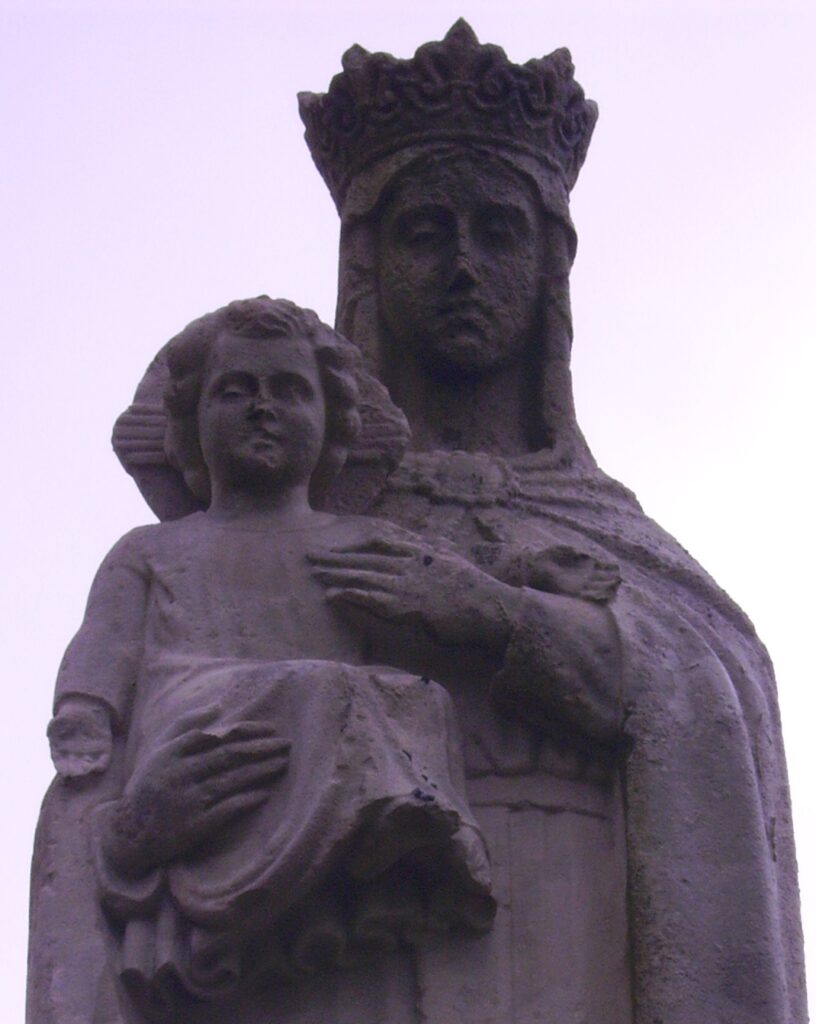
Documented history. Historical records indicate that Penrhys was already a well-known place of Marian pilgrimage in the 15th century; Welsh poets mention the pilgrimages and the sanctuary, and there are testimonies of offerings and exvotes. During English Reform, in the time of Henry VIII, the sanctuary was suppressed and the image destroyed or removed, following the same pattern as other Marian shrines from England and Wales. The place was abandoned as a Catholic sanctuary for several centuries. In the 20th century, with the rebirth of Catholicism in Wales and the pastoral in the Rhondda Valley, the memory of the ancient sanctuary was recovered; in 1953 a new and great statue of the Virgin and the Child was erected on the Penrhys hill, reviving Marian devotion in the place.
The image and the sanctuary
La current image of Our Lady of Penrhys is a great outer statue of the Virgin Mary with the Child Jesus in her arms, placed on the top of the Penrhys hill, visible from much of the Rhondda valley. It is a modern sculpture (mid-20th century); the sources describe that it represents Mary standing, supporting the Child, in a clearly Christological and maternal iconography. The material is not safely recorded in all open sources, but is often described as a large, monumental statue designed to dominate the landscape of the valley. The imagen medieval original it is not preserved and no detailed description of its iconography is available; it is known only that it was a Marian image venerated as a focus of pilgrimage.
As regards sanctuary / temple, la devoción se articula hoy en torno a: – La Penrhys hill, con la gran estatua mariana y el lugar tradicional del pozo o fuente. – La parroquia y las comunidades católicas cercanas que organizan peregrinaciones y actos de culto en relación con la Virgen de Penrhys.
It is not clear that there is a temple with an official title of "minor Basilica" or that Penrhys was formally declared "national sanctuary" by the Episcopal Conference of England and Wales. There is no reference to a specific canon title (minor basilica, national sanctuary, etc.); therefore, from the legal-ecclesial point of view, no consta a special recognition beyond its historical and local importance as a Marian place of pilgrimage.
Sponsorship and coronation
The advocation of Our Lady of Penrhys has a mainly local and regional sponsorship. It is traditionally considered an important focus of Marian devotion in southern Wales, in particular for the faithful of the Rhondda valley and the Catholic communities of the Penrhys area. It is not known that she has been formally proclaimed the principal patron of Wales (this role is more associated, in the Marian field, with Our Lady of Cardigan / Our Lady of the Taper).
As for a canonical coronationthere is no reliable documentation indicating the celebration of a pontifical canonical coronation rite (with the decree of the Holy See) for the image of Penrhys. Therefore, following the above criteria:
> does not contain a documented canonical coronation.
Party and devotion
The devotion to Our Lady of Penrhys focuses above all on the pilgrimage to the place, more than at a liturgical feast widely recognized in the universal calendar. The current consulting documentation does not contain a specific Marian holiday date of compulsory liturgical use for the entire diocese or for the whole of Wales; therefore, an official main holiday date is not clear associated with this advocation in the general calendar. It is possible that, at the local level, some parishes may celebrate a Marian votive mass or a special pilgrimage day, often in spring or summer, but open sources do not set a date with certainty.
Desde el punto de vista devocional, Penrhys se caracteriza por: – La rise on pilgrimage a la colina, a menudo en grupo, con oración del Rosario y cantos marianos. – El recuerdo del old well or source ligado a gracias especiales, donde tradicionalmente los peregrinos se lavaban o bebían, gesto hoy interpretado como signo de purificación y confianza. – La contemplación de la gran estatua de la Virgen y el Niño que domina el valle, como signo visible de la presencia de María sobre la vida cotidiana de las familias, especialmente en un área históricamente obrera y marcada por dificultades sociales y económicas.
There are no precise and current data of influx (annual number of pilgrims), but sources agree that Penrhys has experienced a rebirth of the pilgrimage in the 20th and 21st century as part of the recovery of Catholic memory in Wales.
Link to the Rosary
The historical sources on the medieval shrine of Penrhys do not explicitly describe a of the Rosary nor a particular link of this advocation to the prayer of the Rosary, as in other Marian shrines. In contemporary documentation, no specific official association between Penrhys and rosarist movements is noted. It can therefore be said that does not contain a unique documented historical link with the Rosary.
No obstante, en la praxis actual de la Iglesia, el Rosario se ha convertido en una forma habitual de oración mariana en todo santuario dedicado a la Virgen. En el caso de Penrhys, la subida en peregrinación a la colina y la permanencia junto a la estatua de la Virgen y el Niño se prestan de modo natural al rezo de los misterios, contemplando: – En los joyful mysteries, la maternidad de María y la encarnación del Hijo, tan claramente expresadas en la imagen de la Virgen con el Niño. – En los light and painful mysteries, la presencia de María en la vida pública y en la pasión de Cristo, que ilumina también la historia sufriente del valle del Rhondda. – En los glorious mysteriesthe hope of resurrection and glory that Mary, raised to Heaven, offers to the communities that contemplate her image on the hill.
Thus, even if there is no specific historical link documented, the Rosary is presented today as the simpler and more universal mode to unite devotion to Our Lady of Penrhys with the contemplation of the mystery of Christ with Mary.
A flower for the Virgin
It offers a simple prayer to this advocation. Pray a Hail Mary for the United Kingdom and for the peace of the world.
Pray Hail MaryDocumentary update: modern image and pilgrimage
The two research entries - the medieval image of Penrhys and its modern restoration - describe the same place and remain gathered in this tab. A publication by the Catholic province of Cardiff and Menevia indicates that the current statue was erected and blessed in the place by Archbishop Michael McGrath on July 2, 1953. The same publication figures the first pilgrimage of the new stage to approximately twenty to twenty-five thousand people; the figure should be read as an estimate of assistance, not as an exact census data.
The publication also explains that Portland's stone sculpture was designed on the basis of the description of the ancient image preserved in medieval Welsh poetry. This documents the intention of symbolic continuity, but does not show that the modern statue is the medieval image, nor does it confirm as a historical fact the legend of its discovery and return to the place.
The sources of pilgrimage describe the recovery of the sanctuary in 1953 and the preservation of the roads to Penrhys. The diocesan publication also mentions an annual mass around the solemnity of the Assumption. These data demonstrate a practice of permitted Catholic pilgrimage and veneration; they do not constitute a supernatural approval of medieval legend or an individual recognition of miracles.
Sources of this update
Publication of the Catholic province of Cardiff and Menevia (PDF, HTTP 200); Our Lady of the Valleys, historia de Penrhys (HTTP 200); Pilgrim Ways, ruta de Cardiff a Penrhys (HTTP 200); Tonyrefail and District Community Council (HTTP 200).
Is the advocation of the Virgin Mary of your people missing?
Si no encuentras la advocación mariana de tu ciudad o pueblo, cuéntanosla: la investigaremos para ubicarla y darla a conocer en este mapa del amor de la Madre por el mundo.
Propose an apvocation →