
Marian devotion
Our Lady of Pew
Marian Advocation of London (Westminster) (England)
La advocación de Nuestra Señora de Pew (Our Lady of Pew) is linked to an ancient Marian chapel located in the Westminster Abbeyin London, very close to the royal throne, and was part of the Marian devotion of the English medieval royal house before the Protestant Reformation. This presence of a Marian chapel within the most sacred space of the English monarchy underlines the strong link between royalty and devotion to the Virgin Mary in medieval Catholic England. In English historiography this chapel is remembered as one of the Marian historical santuaries of the country, along with other large centres such as Walsingham, though more courtesan than popular.
Main data
Origin and history
La advocación de Nuestra Señora de Pew (Our Lady of Pew) is linked to an ancient Marian chapel located in the Westminster Abbeyin London, very close to the royal throne, and was part of the Marian devotion of the English medieval royal house before the Protestant Reformation. This presence of a Marian chapel within the most sacred space of the English monarchy underlines the strong link between royalty and devotion to the Virgin Mary in medieval Catholic England. In English historiography this chapel is remembered as one of the Marian historical santuaries of the country, along with other large centres such as Walsingham, though more courtesan than popular.
As regards documented historythe existence of a chapel of Our Lady of Pew in the abbey of Westminster, linked to the realm of the throne and used as a place of private prayer of the monarchs, especially in the Middle Ages. It was part of the dense network of altars and chapels dedicated to the Virgin Mary in England before the break of Henry VIII with Rome and the suppression of traditional Marian sanctuaries and devotions. After the Reformation, devotion was almost suppressed in the official arena, and the memory of Our Lady of Pew remained above all as a historical reference to an ancient Marian sanctuary of the English monarchy.
As regards tradition and possible legendsome modern narrations highlight the character of "chapel by the throne" where kings came to entrust themselves to the Virgin before important decisions, or present it as one of the signs of how England was considered "dowry of Mary" (Mary’s dowry), an expression very associated with the country's Marian identity in the Middle Ages. These interpretations have a strong symbolic and spiritual value, but cannot always be documented in detail on a case-by-case basis for each monarch; therefore, they must be considered as devotional reading of a real historical fact (the Marian chapel regia), rather than as precise chronicles of specific episodes.
The image and the sanctuary
The invocation is linked to a internal Marian capillary de la Westminster Abbey (Westminster Abbey), London. This is the historic Benedictine abbey, today a temple of Anglican worship, which was the center of the religious and ceremonial life of the English Crown: place of coronations, real graves and celebration of solemn acts of the kingdom. The chapel of Our Lady of Pew was one of the devotional Marian spaces in the heart of the abbey, close to the throne or area reserved for the royal family. The Westminster Abbey is an important Gothic monument, but it does not currently have, from a Catholic point of view, the status of a minor basilica or is a canonically recognized Marian sanctuary; it is, above all, a historical sanctuary of great significance for the Christian and monarchical history of England.
On the concrete image of Our Lady of Pew, is not certain a detailed description, material, size or authority clearly documented for the medieval period. No secure data are available on whether it was wood, stone or painting, or on specific iconographic features (Madonna enronized, Virgin with the Child, type of clothing, attributes, etc.). Nor does it know that the original image has come to this day in an identifiable and venerated way under that title on a continuous basis. Therefore, any specific iconographic description would be conjectural and cannot be presented as a true historical data.
Today, the memory of Our Lady of Pew is preserved above all as historical reference to an ancient Marian chapel in Westminster Abbey and as part of the Marian spiritual heritage of England prior to the Reformation. It is not known that today there is a Marian Catholic sanctuary active under this title in the abbey itself, which belongs to the Anglican Communion, nor that the advocation has an official sanctuary structure in the Catholic Church (national or diocesan).
Sponsorship and coronation
The tradition places Our Lady of Pew within the scope of the Medieval English monarchy, so his patronage is mostly understood as spiritual protection of the royal house and, in a broad sense, of the kingdom. However, no consta a formal decree or ecclesiastical proclamation that explicitly establishes it as a canonical patron of a city, diocese or all of England in the present legal terms. Other Marian shrines, such as Walsingham, have in recent times received specific recognition as a national sanctuary and Marian sign of England, while in the case of Our Lady of Pew the patronage remains rather at the level of historical tradition and devotional memory.
As regards a possible canonical coronation of the image, does not contain a documented canonical coronation by the Holy See or a Pontifical Delegate. There is also no record of an equivalent liturgical coronation in the Anglican field in available sources that can be equated to Catholic canonical coronation. It is therefore prudent to say that this advocation has not received, to be known, canonical coronation officially recognized by the Church.
Party and devotion
The general Roman calendar and the recent particular calendars of England do not include a fiesta litúrgica específica universally recognized for Our Lady of Pew, with a fixed date and official celebration similar to that of other Marian shrines in the country. The memory of this advocation is more associated with the historia medieval and to studies on the ancient Marian shrines of England that to a wide popular devotion in our days.
After the Reformation, the heavy suppression of traditional Marian shrines and devotions in England reduced or extinguished public practice linked to many local titles of the Virgin. In the twentieth and twenty-first century, a Marian renaissance in England has been given, with a special focus on advocacy such as Our Lady of Walsinghamwho have recovered pilgrimages and their own parties. In this context, Our Lady of Pew is more like historical memory from a time when the English monarchy cultivated an intense Marian piety, but without a movement of contemporary mass pilgrimage or significant inflow data. It does not contain the present existence of pilgrimages organized to the Westminster Abbey specifically under the title of Our Lady of Pew, nor live popular traditions associated with this advocation in a differentiated way.
Link to the Rosary
The documentation available does not contain a specific and direct historical relationship between the advocation of Our Lady of Pew and the prayer of Rosary (for example, co-fradies of the Rosary specifically linked to that chapel, particular indulgences or officially recognized rosarian pilgrimages). Since the invocation is mainly part of the Marian medieval English courtesan piety, its link with the Rosary - in the sense in which the Dominican rosarian devotion was later developed - is not clearly documented.
However, from a general Marian perspective, the Rosary today offers a privileged way of uniting the current devotion to Our Lady with the memory of the ancient Marian shrines of England, like Our Lady of Pew. The Rosary allows us to meditate on the mysteries of Christ's life together with Mary and, at the same time, to remember that the history of salvation has been embodied in specific places and cultures, such as the medieval England that honored the Virgin in the abbey of Westminster. To pray the Rosary in communion with all Marian aspirations - also the almost forgotten historical ones - helps to rediscover the Marian dimension of the Christian identity of peoples and to entrust nations and their rulers again to the intercession of the Mother of God, following the spirit of those antig
A flower for the Virgin
It offers a simple prayer to this advocation. Pray a Hail Mary for the United Kingdom and for the peace of the world.
Pray Hail MaryDocumented expansion: the chapel and the current image
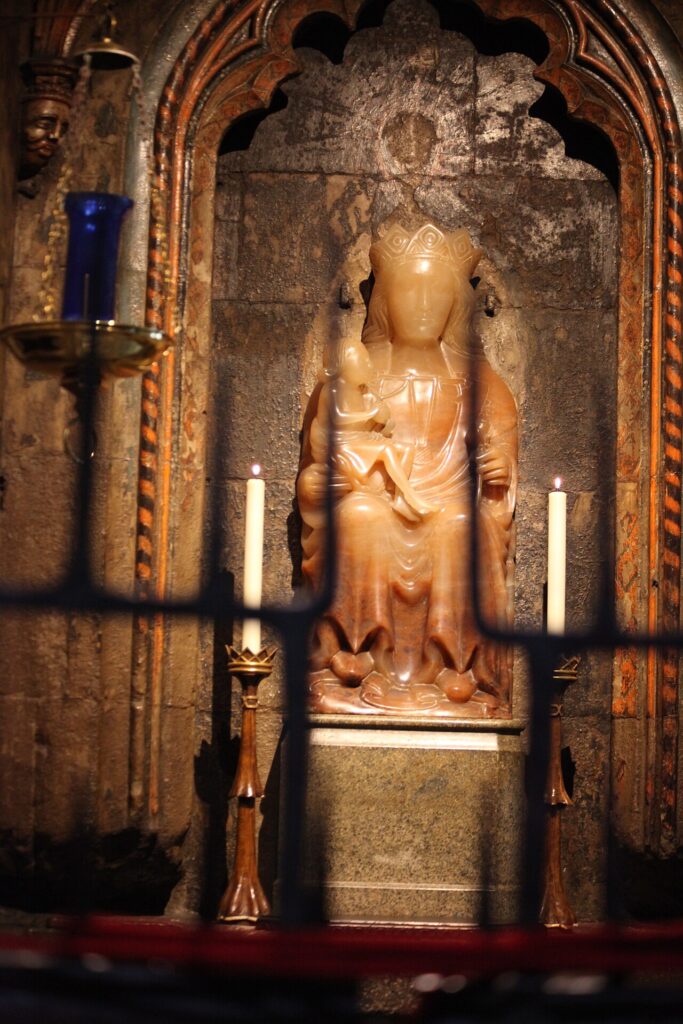
Westminster Abbey explains that the current statue of the Virgin with the Child was carved in alabaster by the Benedictine sister Concordia Scott of Minster Abbey. The work took 14 months and was placed in the chapel on May 10, 1971. The original image had disappeared centuries ago; the design of the modern statue was inspired by a 15th century English alabaster Madonna preserved in Westminster Cathedral.
The Westminster Abbey service order describes the Pew original as a rectangular enclosure of the 14th century, with baking and support for an image, and documents the activity of the Society of Our Lady of Pew, which celebrates mass and retreats in the abbey. The sanctuary belongs to the Church of England and does not appear here as an approved apparition.
Additional sources: Westminster Abbey, Sister Concordia Scott y Our Lady of Pew's service order.
Is the advocation of the Virgin Mary of your people missing?
Si no encuentras la advocación mariana de tu ciudad o pueblo, cuéntanosla: la investigaremos para ubicarla y darla a conocer en este mapa del amor de la Madre por el mundo.
Propose an apvocation →