
Marian devotion
Our Lady of Poondi
Marian Advocation of Poondi (Thanjavur) (Tamil Nadu)
According to local tradition, devotion to Our Lady of Poondi (Poondi Madha, Our Lady of Lourdes, Poondi) It was consolidated around a church raised by the Jesuits in the 18th century in the small town of Poondi, in the region of the Kaveri delta, now the diocese of Thanjavur (Tamil Nadu, India). The first church would have served as a missionary center for the peasants and poor in the area, in a context of expansion of the Catholic presence in southern India.
Main data
Origin and history
According to local tradition, devotion to Our Lady of Poondi (Poondi Madha, Our Lady of Lourdes, Poondi) It was consolidated around a church raised by the Jesuits in the 18th century in the small town of Poondi, in the region of the Kaveri delta, now the diocese of Thanjavur (Tamil Nadu, India). The first church would have served as a missionary center for the peasants and poor in the area, in a context of expansion of the Catholic presence in southern India.
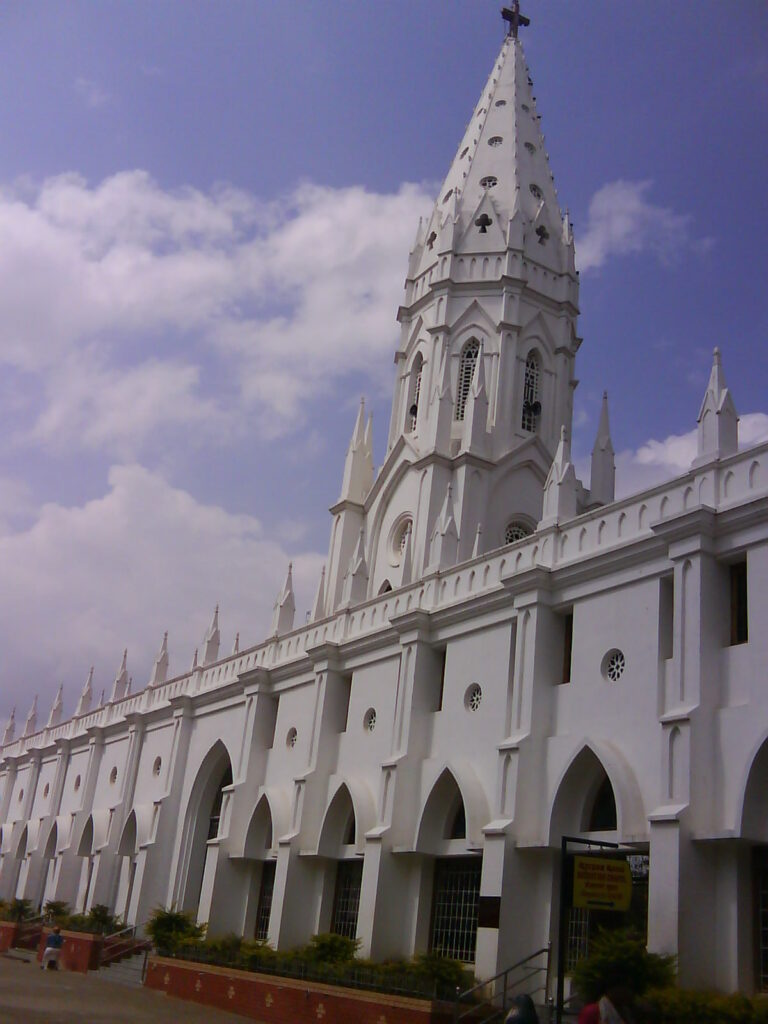
It is historically documented that the church of Poondi was built in the 18th century by Italian Jesuits, who used an unusual Gothic and French architectural style in India of the time. Over time, the place became an important Marian pilgrimage center of Latin rite for the faithful of the Thanjavur region and nearby rural areas. In contemporary times, the church has been recognized by the Church as Marian sanctuary and later elevated to the dignity of minor basilicathus consolidating its importance in the pastoral life of the diocese.
Detailed accounts of fundational apparitions or miracles comparable to other Marian shrines in India (such as Vailankanni) have not been found in accessible sources; what is seen is a intense and prolonged devotion to the Virgin in this place, which has grown especially among the poor, peasants and inhabitants of the rural environment of the Kaveri delta. When in the tourist and devotional sources it is called "Our Lady of Lourdes of Poondi," it seems to be a spiritual assimilation to the message of Lourdes rather than a self-account of apparitions; there are no data from an apparition explicitly recognized by the Church in Poondi.
The image and the sanctuary
The available sources mention the advocation as “Our Lady of Lourdes, Poondi” o ‘Poondi Madha’ and place the main image on the altar of the present basilica, but do not provide a detailed description of the material (wood, stone, etc.) or the date of execution of the size; therefore, is not certain the type of material or the author of the image. Given the name "Our Lady of Lourdes," it is reasonable to assume an iconography near the Virgin of Lourdes (Virgin standing, hands together, mantle and white dress), although this identification is only inferred by the title and is not explicitly described in the sources consulted, it should be considered as an unfully documented data.
The temple is officially known as Basilica of Our Lady of Lourdes, Poondi (Basilica of Our Lady of Lourdes, Poondi). It's built on Gothic and French style, something noted as unusual in the Indian context, and dates back to the 18th century. The original Jesuit church was extended and embellished over time, until it acquired its current physionomy. Today is recognized as minor basilica and Marian sanctuary, and is among the main places of Christian pilgrimage in southern India, articulating the liturgical and devotional life of the rural area of Thanjavur.
Sponsorship and coronation
Our Lady of Poondi is, above all, the spiritual patron of the Catholic community of Poondi and the surrounding regionespecially of the peasants and families of the Kaveri delta; it is a sanctuary diocesan very linked to the Marian pastoral of the diocese of Thanjavur. It is not officially known that this advocation has been proclaimed patron of all India (title associated rather with other Marian advocations of the country), nor that there is a specific national patronage under the title of Poondi Madha in public documents of the Church.
There is no mention of a canonical coronation of the image (i.e. an official coronation act approved by the Holy See with date and decree). In the absence of clear data on the year, pontiff or pontifical delegate, it should be stated: does not contain a documented canonical coronation for Our Lady of Poondi.
Party and devotion
Not found in the sources consulted exact date of the main liturgical or patron feast of Our Lady of Poondi; some Marian shrines of the region celebrate with special solemnity on 8 September (Nativity of the Virgin), but in the specific case of Poondi this fact no consta explicitly.
What is indicated is that the basilica is a great pilgrimage centerand many faithful from various areas of Tamil Nadu. The poor and peasantswho come to entrust their family life, crops, health and daily needs to the intercession of the Virgin. The influx increases in the strong times of the liturgical year (Christmas, Easter, Marian parties); however, the sources consulted do not offer official figures of pilgrims, so any specific number would be conjectural and should therefore be avoided.
The popular traditions include long walking to the sanctuary, symbolic offerings (candles, flowers, exvotes) and participation in the Mass, Eucharistic worship and Marian processions typical of Indian popular piety, where not only Catholics, but also some Hindus come to ask for the intercession of the Mother of God, a very characteristic phenomenon of the Marian shrines of southern India.
Link to the Rosary
The available sources do not detail a specific relationship between Our Lady of Poondi and a practice from the prayer of the Rosary (for example, co-fradies of the Rosary, rosarian jubilee or apparitions where the Rosary is expressly requested); therefore, no consta a particular documented link beyond ordinary Marian devotion.
However, in a Marian sanctuary of Latin rite like Poondi, the Rosary It is naturally integrated into the spiritual life of the place: it is one of the simplest and most profound ways of contemplating the life of Christ with the eyes of Mary, accessible to peasants and poor, even to those who have little formal education. In rural contexts in southern India, the Rosary prayed in family, in small communities or in Marian processions helps Unite the faith of the people with the intercession of the Virginsupporting pilgrims in their daily difficulties and linking their devotion to Poondi Madha with the very heart of the Gospel. Thus, even if there is no "own" and uniquely described link, the Rosary is a privileged road to live devotion to Our Lady of Poondi and to be guided by her towards Christ.
A flower for the Virgin
It offers a simple prayer to this advocation. Pray a Hail Mary for India and for world peace.
Pray Hail MaryDocumented expansion: Poondi Madha and the history of the temple
The official page of the basilica presents Poondi as a Catholic pilgrimage center located between the Causes and Colleroon rivers, near Thirukattupalli, in the Thanjavur district. According to this institutional source, the Italian Jesuit Constantine Joseph Beschi - known in Tamil as Veeramunivar - raised between 1714 and 1718 a church dedicated to Mary Queen of the Immaculate Conception. The image venerated under the dome is described as one of the statues made in France after Lourdes and taken to the mission by a French priest.
The same official history recalls the catechetical work carried out in Poondi in the early 20th century and the intervention of the parish priest Lourdes Xavier since 1955 to repair the building. The account that the central roof fell in the day and the hour he had announced is part of the local memory as the basilica retains it; it is offered as a account of devotion, not as a canonically proven miracle in this chart.
On 3 August 1999, according to the website of the sanctuary itself, Poondi was declared a minor basilica by John Paul II. This data refers to the range of the temple and its public veneration. It should not be confused with an approval of a local apparition: the image comes from devotion to Lourdes and does not contain in the sources consulted an apparition that occurred in Poondi.
Source added: Poondi Madha Basilica, “Our Basilica” (HTTP 200 query, archived in the batch report).
Is the advocation of the Virgin Mary of your people missing?
Si no encuentras la advocación mariana de tu ciudad o pueblo, cuéntanosla: la investigaremos para ubicarla y darla a conocer en este mapa del amor de la Madre por el mundo.
Propose an apvocation →