
Marian devotion
Our Lady of the Liberation of Popenguin
Marian title of Popenguin (Senegal)
Popenguine (also written Poponguine) is a small coastal town of about 2,500 inhabitants, located about 60 km south of Dakar, in the Petite Côte Senegalese. The origin of the Marian sanctuary goes back to 1887when the French apostolic vicar of Senegal had one of the oldest churches in the country built there, which soon became a place for Marian pilgrimage.
Main data
Origin and history
Popenguine (also written Poponguine) is a small coastal town of about 2,500 inhabitants, located about 60 km south of Dakar, in the Petite Côte Senegalese. The origin of the Marian sanctuary goes back to 1887when the French apostolic vicar of Senegal had one of the oldest churches in the country built there, which soon became a place for Marian pilgrimage.
As for the documented historythe sources point out that the church of Popenguin was built in 1887 and that since the late 19th century the place was gaining fame as a Marian sanctuary for the Catholics of Senegal. Throughout the 20th century, the sanctuary went through stages of boom and crisis: temporary closures, buildings collapse and difficulties linked to epidemics were mentioned, but the memory of the place was always maintained as a Marian protection site for the country. In 1991 the present basilica was consecrated, consolidating Popenguine as Marian national sanctuary and the heart of Senegalese Catholicism.
With regard to spiritual traditions and readingsvarious testimonies present the sanctuary as "a gift that the Senegalese wanted to offer to Mary to thank her for her protection," especially in the midst of a majority Muslim coexistence and a Catholic minority very united around the Virgin. The role of Popenguin as a sign of spiritual and social liberation, where the faithful entrust their sufferings and hopes for the peace and religious harmony of the country to the Virgin, is also highlighted in the recent pastoral reflection. There are no specific apparitions or supernatural facts linked to this advocation in the documents consulted.
The image and the sanctuary
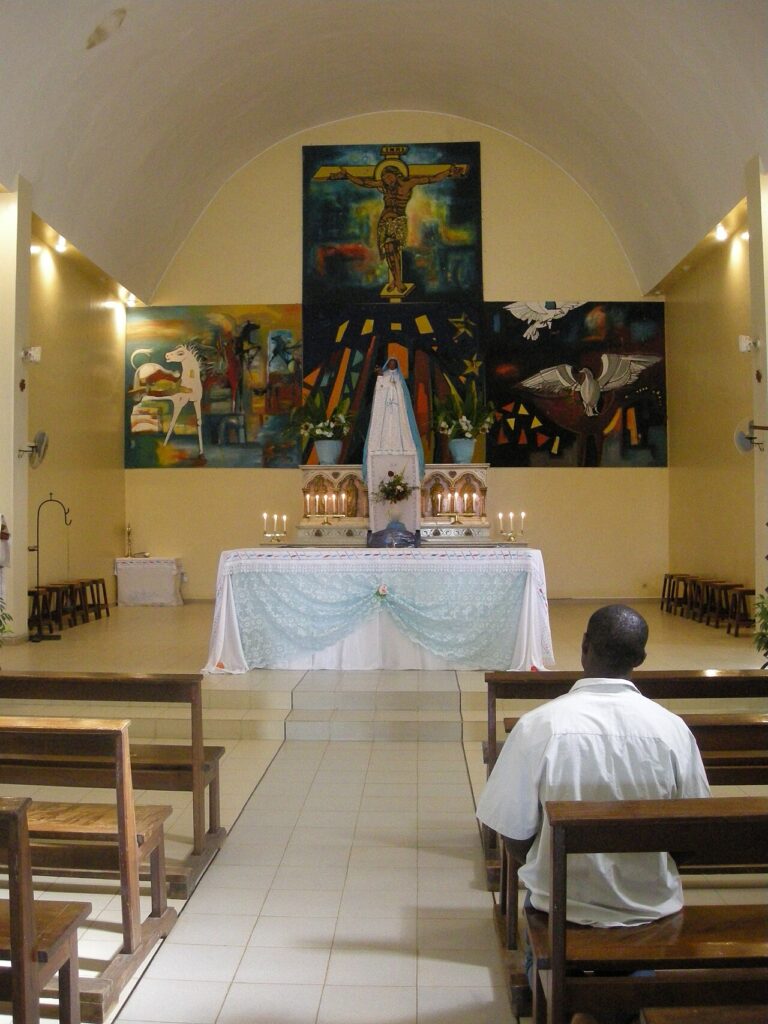
Devotion focuses on an image of the Virgin Mary known as "Our Lady of Liberation", revered as "Black Virgin." A recent chronicle speaks of the "black virgin of whom the pilgrims who go to Popenguin every year are devotees. The information sources do not safely require the material (wood, plaster or other) or the author of the image, nor do they describe in detail their iconography (position of the hands, presence of the Child, etc.), so no consta This information is documented in the sources consulted.
The present temple is the Basilica of Our Lady of the Liberation of Popenguin (in French, Notre-Dame de la Délivrance), identified as a Roman Catholic pilgrimage church. It was dedicated to 23 November 1991, and is presented as a great basilica by the sea, visible in the region and characterized by its function as a national sanctuary. It is recognized as one of the main points of interest of Popenguin, and is the destination of thousands of pilgrims who come on foot from different parts of the country.
The basic sanctuary is entered in the Latin catholic rite and depends on the Catholic Church in Senegal, which assigns Popenguin a central role in her Marian and youth pastoral. The technical detail of its architectural style is not recorded in the sources consulted, but its importance is emphasized as "the heart of Senegalese Catholicism."
Sponsorship and coronation
La advocación de Our Lady of the Liberation of Popenguin is presented repeatedly as great Marian devotion of Senegal and, in pastoral practice, as country pattern. Testimonies from African Catholic associations and the Catholic press explicitly describe the Virgin of Popenguine as "patron of Senegal," to which both Catholics and many other inhabitants of the country are entrusted.
As regards a possible canonical coronationin the sources consulted (sanctuary, historical reviews and Catholic press) does not contain a documented canonical coronation of the image of Our Lady of the Liberation of Popenguin. There are no safe references to date, to pontifical bull, or to papal delegate responsible for such a coronation.
Party and devotion
La big party of Our Lady of the Liberation of Popenguin is linked to the national pilgrimage of Pentecostwhich is celebrated each year during the weekend of this solemnity and brings together tens of thousands of faithful. A recent chronicle speaks of 70,000 pilgrims who come to the Basilica, many of them coming on foot from various dioceses of Senegal.
This pilgrimage of Pentecost has become a genuine national event: the Catholic press stresses that, 129 years after the origins of the sanctuary, Popenguin is the "heart of Senegalese Catholicism" and a manifestation of the country's devotion to Our Lady of Liberation. The cooperation of Muslims of the area, which help logistically the welcome of the pilgrims and participate in the climate of respect and religious coexistence.
Devotional features include:
– La peregrinación a pie, especialmente de jóvenes y movimientos apostólicos. – La confesión y la participación en la Eucaristía como momentos centrales de la celebración. – La presentación de intenciones por la paz, la liberación de las esclavitudes modernas y la armonía entre comunidades religiosas.
This devotion is lived as a sign of the Catholic faith in a country of Muslim majoritywhere the Virgin is recognized as the mother and protector of the whole nation, beyond the confessional borders.
Link to the Rosary
The specific sources on the Popenguin shrine and its history do not mention a unique practice of the Rosary which distinguishes this advocation from other Marian devotions; therefore, no consta a particular historical or statutory link between the advocation of Our Lady of the Liberation of Popenguin and a form of prayer of the Rosary.
However, several testimonies of Marian spirituality and prayer initiatives for Senegal present Our Lady of Liberation as natural destiny of the Rosary of the faithful, inviting you to offer it for the country and for peace. In a context such as Senegal, where the Virgin is a bridge of dialogue and coexistence, the Rosary It becomes a school of contemplation of the mysteries of Christ with Mary, and a persevering supplication for the inner "liberation": of violence, of divisions, of poverty and of all forms of spiritual and social slavery.
Thus, even if there is no documented tradition of its own, the prayer of the Rosary before Our Lady of the Liberation of Popenguin is fully understood in the great Marian tradition of the Church: to join Mary in the meditation of the life of Christ, imploring her intercession so that the Senegalese people and all Africa will live in the freedom of the children of God.
A flower for the Virgin
It offers a simple prayer to this advocation. Pray a Hail Mary for Senegal and for world peace.
Pray Hail MaryIs the advocation of the Virgin Mary of your people missing?
Si no encuentras la advocación mariana de tu ciudad o pueblo, cuéntanosla: la investigaremos para ubicarla y darla a conocer en este mapa del amor de la Madre por el mundo.
Propose an apvocation →