
Marian devotion
Panagia Proussiótissa
Marian Advocation of Proussós (Evritania)
According to the tradition the icon of the Panagia Prousiottissa was painted "by the hand of St Luke Evangelist" and was originally in Prusa (Bursa, in the present Turkey). It is said that, during the iconoclastic persecution of the 9th century, the icon miraculously disappeared from Prusa and reappeared in a cave near Proussós, in Evritania, around 829. Local traditions also speak of two monks, Dionisios and Timoteos, who would have followed the icon trail from Asia Minor to Greece and founded the monastery around the place where it appeared.
Main data
Origin and history
According to the tradition the icon of the Panagia Prousiottissa was painted "by the hand of St Luke Evangelist" and was originally in Prusa (Bursa, in the present Turkey). It is said that, during the iconoclastic persecution of the 9th century, the icon miraculously disappeared from Prusa and reappeared in a cave near Proussós, in Evritania, around 829. Local traditions also speak of two monks, Dionisios and Timoteos, who would have followed the icon trail from Asia Minor to Greece and founded the monastery around the place where it appeared.
As for the documented history, the sources written on the monastery are after the iconoclastic period and do not allow to verify with certainty neither the authorship of Luke nor the exact date of foundation. The monastery of Panagia Prousiotissa is witnessed throughout history as an important spiritual center of Evritania and central Greece, and has traditionally been seen as a refuge in times of danger, especially during occupations and conflicts. The recent devotional memory particularly recalls the protection given to the Virgin of Poussós over the cities of Agrinio and Mesolongui during the Spanish flu pandemic in 1918.
The image and the sanctuary
El icono de la Panagia Proussiótissa is an Orthodox Marian icon, of a Byzantine type, venerated as "miraculous." It is an ancient image, dark over time, richly covered by a Revêtement or metal cover (reed) decorated with silver and gold, so that only some parts of the original painting are visible. The exact iconography (precise type of Marian representation) is not clearly recorded in the sources consulted; it is above all indicated its character as an icon of the Virgin with strong miraculous and protective imprint.
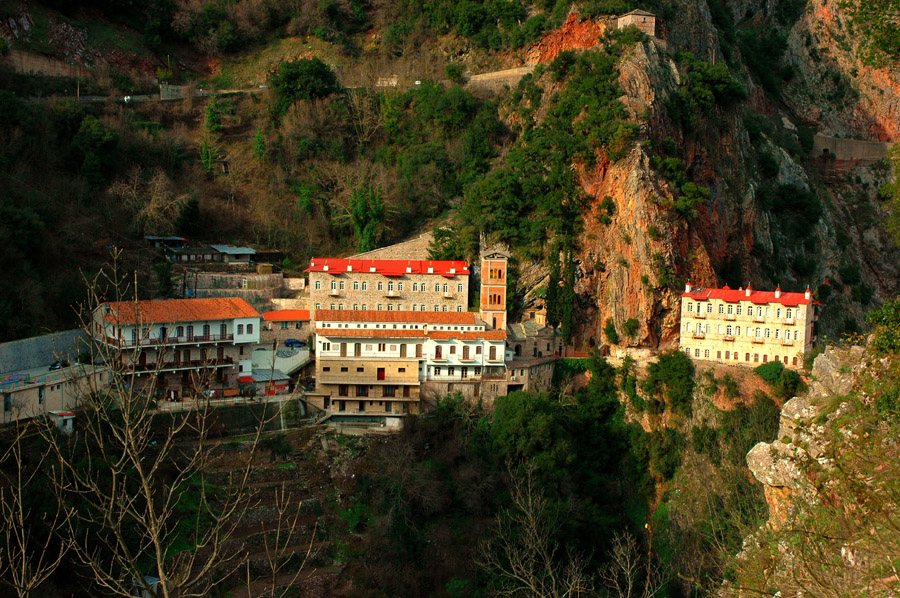
The sanctuary is the Saint Monasterio de la Virgen Prousiotissa (Panagia Prousiotissa)located in an abrupt mountain landscape, embodied in the rocks near the town of Proussós, in the region of Evritania, Greece. The monastery is built on a cliff, partially attached to the rock, with a complex that includes the main church where the icon, chapels, monastic dependencies and reception spaces for pilgrims are kept. The tourist and religious descriptions present it as one of the most important monasteries of Evritania and a prominent centre of religious tourism in Greece. It is not known that the temple has the title of a minor basilica or that it has been declared a national sanctuary in the Catholic canon sense; it is an Orthodox monastery of great regional and national spiritual relevance in the Hellenic context.
Sponsorship and coronation
La Panagia Proussiótissa es venerada como of the region of Evritania and, in particular, as an intercessor of several cities in central Greece, including Agrinio and Mesolongui, which give him protection in times of danger, such as the 1918 flu pandemic. Various devotional texts present it in very broad terms as "bastion" and "protagonist of Greece," that is, as one of the great protective Marian asvocations of the Greek people.
On a canonical coronationin the technical sense of the Catholic Church, does not contain a documented canonical coronation. In the Orthodox sphere, the icon is venerated with great solemnity and rich ornaments, but no act of canonical coronation is documented according to Catholic praxis and regulations.
Party and devotion
La fiesta principal de la Panagia Proussiótissa se celebra el August 15, Solemnity of the Sleep / Assumption of the Virgin Mary in the Eastern and Western tradition respectively. Around that date the monastery became one of the most popular pilgrimage centres in Central Greece, with the participation of many faithful from both the region and other parts of the country and from abroad.
The devotion to the Virgin of Proussos is characterized by strong confidence in her Miraculous intercession in situations of danger, disease and public calamities. The pilgrims come to the icon to light candles, offer exvotes of thanks and participate in the liturgy and processions that are held especially in August, as well as other Marian parties of the Orthodox calendar. The natural environment itself - a monastery hung on the rock, in a mountainous region of difficult access - reinforces the penitential and protective character of these pilgrimages.
Link to the Rosary
As for a specific link with the Rosary prayerin the sources consulted there is no particular historical or devotional relationship between the Panagia Proussiotissa and the Rosary in the Latin Catholic sense. The tradition of the monastery is rooted in Greek Orthodox spirituality, where other modes of Marian prayer and the practice of "Jesus' prayer" are more appropriate with the komboskini (knot cord).
However, from a Marian Catholic perspective, the Rosary It can perfectly accompany devotion to this advocation. The mysteries of the Rosary contemplate the same events of the life of Christ and of the Virgin that the Orthodox Church celebrates in its great feasts, especially the Incarnation, Passion and Sleeping / Assumption. In this way, a faithful Catholic who prays the Rosary before the image of the Proussiotissa Panagia is spiritually united with the veneration that the Eastern Church places on the Mother of God, sharing with the Orthodox Christians the praise of Mary as a protector, intercessor and sign of hope for the People of God.
A flower for the Virgin
Offer a simple prayer to this Marian devotion. Pray a Hail Mary for Greece and for world peace.
Pray Hail MaryIs the advocation of the Virgin Mary of your people missing?
Si no encuentras la advocación mariana de tu ciudad o pueblo, cuéntanosla: la investigaremos para ubicarla y darla a conocer en este mapa del amor de la Madre por el mundo.
Propose an apvocation →