
Marian devotion
Madre de Dios de Pühtitsa
Marian vocation of Kuremäe (Estonia)
According to the local tradition, the place of Pühtitsa was already from ancient times a sacred hill for the Estonians, linked to a spring at the foot of the hill considered a place of offerings and of a sacred character. This same Orthodox Christian tradition speaks of finding an icon of the Mother of God (Sleeping) and the memory of an intervention of the Virgin linked to that spring, to which the faithful attribute healing properties, making it a "holy spring." Several divulgative materials on the monastery explicitly mention the "apparition of the Mother of God" and the "finding of the miraculous icon," without providing precise historical documentation on dates or protagonists.
Main data
Origin and history
According to the local tradition, the place of Pühtitsa was already from ancient times a sacred hill for the Estonians, linked to a spring at the foot of the hill considered a place of offerings and of a sacred character. This same Orthodox Christian tradition speaks of finding an icon of the Mother of God (Sleeping) and the memory of an intervention of the Virgin linked to that spring, to which the faithful attribute healing properties, making it a "holy spring." Several divulgative materials on the monastery explicitly mention the "apparition of the Mother of God" and the "finding of the miraculous icon," without providing precise historical documentation on dates or protagonists.
As for the documented historythe existence of a small Orthodox church in Pühtitsa already in the 16th century. El Convent of the sleeping of Pühtitsa (Convent of the Dormition of the Mother of God) fue fundado oficialmente en 1891with ecclesiastical authorization, eventually becoming the main commonity orthodox female of the Baltic States and the only Orthodox convent in operation in Estonia. The monastery, of Russian obedience, has remained active even during the most difficult political times of the 20th century.
The image and the sanctuary
The invocation is linked to a icon of the Mother of God in her sleepin line with the dedication of the convent and the main church to the Sleep of the Mother of God (Uspie). The sources consulted describe the icon as microroso and linked to the place of the spring and the memory of the apparition, but no consta a detailed and verifiable description of the size, material, specific iconographic style or precise dating. It is, however, part of the Eastern iconographic tradition of the Sleeping of the Theotokos, widely spread in the Byzantine rite and the Russian Orthodox Church.
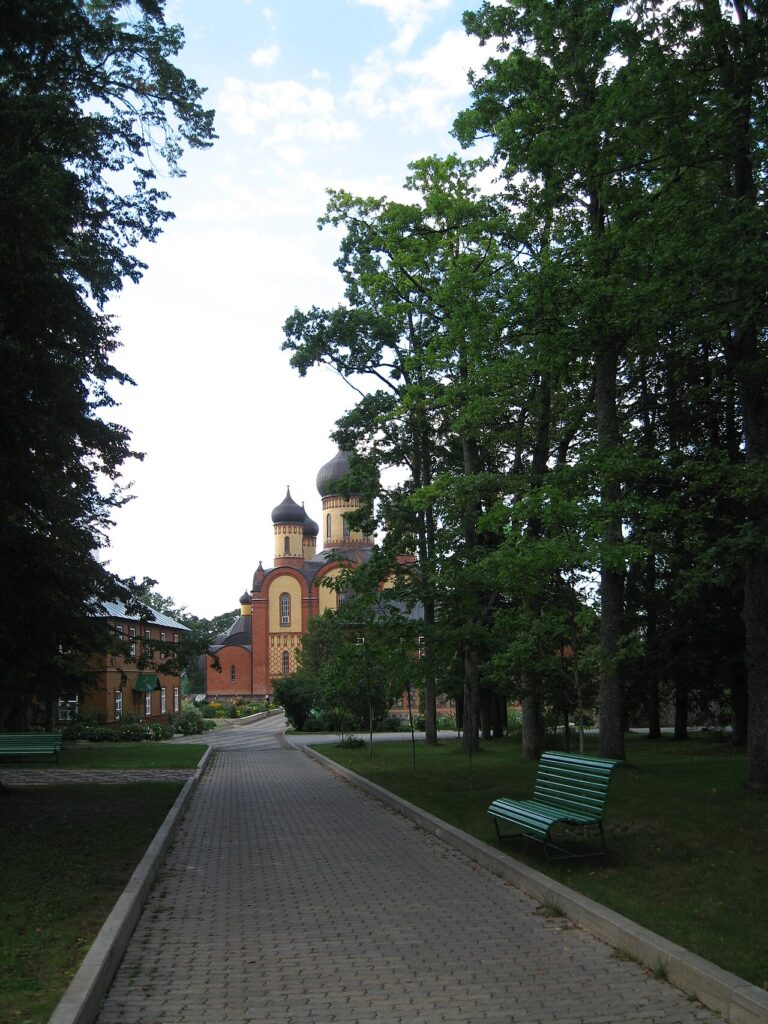
El Convent of the sleeping of Pühtitsa is a Russian Orthodox female monastery of character stavropegial (directly dependent on the patriarch, not the local diocese). The monastic complex, located in the village of Kuremäe (Alutaguse municipality, Ida-Viru county), is characterized by a great church of sleep with Russian-style domes (notably five towers / domes visible in the profile of the whole), surrounded by other smaller churches, conventual buildings and landscaped areas. It is described by the guides as an important Orthodox pilgrimage centre in Estonia, with an atmosphere closely linked to Russian tradition. It is not known that the main church has the title of minor basilica or that the whole has been declared National sanctuary in the Catholic sense; it is a Ruso Orthodox monastery recognized as such.
Sponsorship and coronation
La advocación de la Mother of God of Pühtitsa (Sleep) is closely linked to its own Convento de Pühtitsa and the environment Stork Mountainwhich has become a reference place for the Orthodox faithful of Estonia and the neighbouring countries. The sources present it as a Marian Orthodox shrine of national importance within Estoniabut no consta a formal decree of canon patronage in Catholic terms (for example, official patron of the country or of the diocese, in the legal-canon sense).
In Catholic tradition, canonical coronation requires a documented pontifical act. For the Madre de Dios de Pühtitsain the sources consulted does not contain a documented canonical coronation (not by a Pontiff, not by papal delegation). It is a devotion of the Russian Orthodox Churchwhere liturgical and honorary practices of icons (including ornamentation with curling, crowns or metal coverings) are not identified with the legal institute of "canonical coronation" as understood in the Catholic Church.
Party and devotion
The convent, its churches and the advocation that gives it name are dedicated to the Sleep of the Mother of God, whose main liturgical date in Byzantine tradition is the August 15, according to the Julian or Gregorian calendar according to local use. The sources on the monastery explicitly describe it as Convent of the sleeping of Pühtitsa and as a place of pilgrimage linked to this feast. However, in the documentation consulted the calendar of the convent's celebrations is not explicitly and in detail specified (concrete processions, novenas, etc.), beyond the centrality of the Feast of Sleep.
Devotion is expressed in several features:
– El Holy spring at the foot of the hill, to which they are attributed healing properties, es un centro de peregrinación en sí mismo; los fieles acuden a beber o a bañarse en sus aguas como gesto de confianza en la intercesión de la Madre de Dios. – El convento recibe pilgrims from all over Estonia and abroad, siendo comparado en alguna guía con un “Lourdes estonio” por la combinación de santuario mariano y manantial venerado. – El conjunto monástico permanece abierto a los visitantes, y las monjas ofrecen visitas guiadas para explicar la historia y mostrar las distintas iglesias interiores, lo que refleja una stable liturgical and devotional life.
Accurate quantitative inflow data (annual number of pilgrims) no constan in the sources consulted, although they all agree that it is one of the the main places of Orthodox pilgrimage in Estonia.
Link to the Rosary
En la Russian Orthodox traditionthe most widespread form of Marian prayer is not the Latin Rosary, but other practices, such as the repetition of the "Hail Mary" in different combinations, the akathistos y paraclesis to the Mother of God, as well as the veneration of icons with their own hymns and liturgy. None of the sources consulted on the Convento de Pühtitsa and his Marian advocation mentions a specific link with the prayer of the Rosary as practised in the Catholic Church; therefore, does not contain a particular historical or liturgical relationship with the Rosary in this sanctuary.
From a general Marian perspective, devotion to the Mother of God of Pühtitsa (Sleep) is in full harmony with the mysteries that the Rosary contemplates: Assumption / Sleeping of Mary y su coronation in glory. The contemplation of sleep - very present in the spiritual orientation - invites us to meditate, also in the prayer of the Rosary, the Christian hope for deathMary's participation in Christ's Passover and her maternal closeness to the pilgrim Church. A faithful Catholic, by praying the Rosary before this advocation, can unite the glorious mysteries (en particular la Assumption of Mary and her Coronation) with the tradition venerated in Pühtitsa, recognizing, in spiritual communion with Christians of rite orien
A flower for the Virgin
It offers a simple prayer to this advocation. Pray a Hail Mary for Estonia and for world peace.
Pray Hail MaryIs the advocation of the Virgin Mary of your people missing?
Si no encuentras la advocación mariana de tu ciudad o pueblo, cuéntanosla: la investigaremos para ubicarla y darla a conocer en este mapa del amor de la Madre por el mundo.
Propose an apvocation →