
Marian devotion
Our Lady of Regla, patron saint of Baní
Patron Saint of Baní
La advocación de Our Lady of Rule in Bani is inserted in the broad Hispanic tradition of the Virgin of Rule, especially related to the Franciscan sanctuary of Chipiona (Cadiz, Spain) and its patronage over the men of the sea and the sailors. The general tradition of Rule refers to an ancient agustinian and then Franciscan devotion, widely spread in the territories of Spanish influence, where the Virgin is invoked as a protector in dangers and storms.
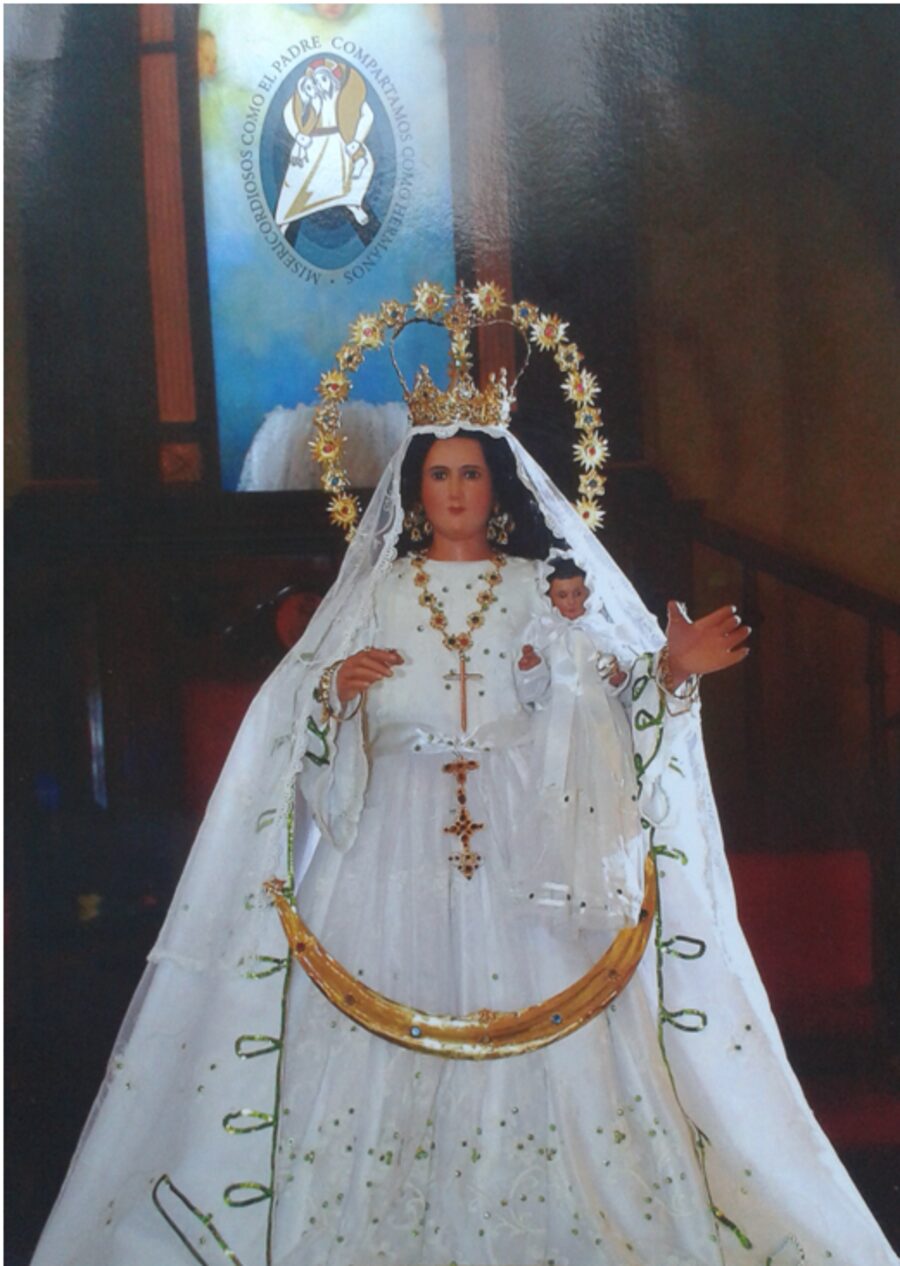
Main data
Origin and history
La advocación de Our Lady of Rule in Bani is inserted in the broad Hispanic tradition of the Virgin of Rule, especially related to the Franciscan sanctuary of Chipiona (Cadiz, Spain) and its patronage over the men of the sea and the sailors. The general tradition of Rule refers to an ancient agustinian and then Franciscan devotion, widely spread in the territories of Spanish influence, where the Virgin is invoked as a protector in dangers and storms.
In Baní (province of Peravia, Dominican Republic), the presence of the Virgin of Rule has been documented since early in the colonial period, although the exact origins of the first image are not clearly fixed in accessible sources. A conference about the Virgin of Rule in Baní indicates that for the year 1610 It already recorded the existence of this advocation in the place, and that devotion would be prior even to the formal foundation of the people, although it is presented as an oral historical data worked by local historians. There is, however, no original founding document of devotion that can be accurately dated, so many references to previous dates should be considered a tradition based on later chronicles.
La documented history of the main temple shows that the present parish church and then cathedral dedicated to Our Lady of Rule began to be built in 1876, with various later enlargements. Enter 1929 y 1931 The façade was changed, the side chapels and the temple tower were raised. The reopening of the church, already with a physionomy closer to the current one, took place the 21 November 1933, a date that would be linked both to the life of the temple and to the patron celebration of the city. The temple was later raised to cathedral of the diocese of Bani, built in the ecclesiastical organization of the Dominican Republic (institutional data, no date detailed in the sources consulted).
(The mention of "Baní, department of Peravia, Colombia" does not correspond to the geographical reality: Baní and the province of Peravia belong to the Dominican Republic, not Colombia.)
The image and the sanctuary
La image of Our Lady of Rule venerated in Bani follows the iconographic tradition of the Spanish Rule, although the technical details (author, exact material, school, date of size) do not accurately record in the sources consulted. The official page of the cathedral refers genetically to the "image of the Virgin" linked to the history of the people and to the old forms of representation (in its origins, paintings on table or canvas), without offering detailed art sheet of the current size. Therefore, no consta with documented certainty the concrete type of size (wood, polychrome, etc.) and the exact measurements of the image that today chairs the temple.
The temple where it is venerated is the Cathedral Our Lady of Rule, located on Duarte Corner Sánchez, in the city of Baní, province of Peravia, Dominican Republic. It is the main temple of the diocese and at the same time exercises the function of an urban parish, with intense sacramental and pastoral life. It is not known that the temple has been declared minor basilica ni National sanctuary; the available documentation presents it explicitly as diocesan catedral. It is a large-nave temple, with a tower and chapels added in the first third of the 20th century, which has been the subject of various restorations over time to attend to the growth of the felicacy and the preservation of its heritage.
Sponsorship and coronation
Our Lady of Rule is recognized and celebrated as patron of the city of Baní, and his patron party marks one of the most significant religious moments of local life. The devotion has also spread to institutions in the province, to the point of giving name, for example, to the Our Lady of Rule Hospital, opened in 1969 as a provincial hospital in Baní. The sources consulted do not mention a title of patron at the national level, but essentially its status as patron of Baní and spiritual reference of the province of Perevia.
As for the canonical coronationthe official sources (cathedral, diocese, press and outreach materials) do not record an act of canonical coronation formally decreed by the Holy See or by pontifical delegation for the image of Our Lady of the Rule in Bani. Therefore, according to the information available, does not contain a documented canonical coronation.
Party and devotion
La main party of Our Lady of Rule in Baní is celebrated the November 21. The cathedral indicates that that day is also commemorated the opening / reopening of the temple (1933), which reinforces the link between Marian devotion and the history of the sacred building. A number of devotional testimonies point out that "every 21 November the banilejos celebrate the day of the protective mother of this people, the Virgin of Rule."
Patronal celebration is often understood as a village partywith intense community participation, although the sources consulted do not provide exact flow figures. It is emphasized that the patron parties are among the main religious and cultural events of the city. As in other Marian devotions of the Caribbean and the tradition of the rule, the Virgin is associated with special protection over families, the city and its workers, as well as intercession in times of need and disease, something that can be reflected in the choice of her name for service institutions, such as the provincial hospital.
No detailed and systematic descriptions of national pilgrimages organized in the style of great international sanctuaries, but the status of a cathedral and local patron makes the temple a permanent point of reference for prayer and devotional visit for the faithful of Baní and other areas of the province of Peravia. It is reasonable to assume, on the basis of the common pastoral experience in the region, that during the ninth and the patron's feast the masses, processions and religious acts increase significantly, although the sources do not detail a complete liturgical program.
Link to the Rosary
The specific sources on devotion to Our Lady of Rule in Bani do not explicitly mention a particular or exclusive link with the Rosary prayer (e.g. specific rosarian copradies, own indulgences or other documented forms). Therefore, no consta a unique historical link with the Rosary beyond the ordinary practice of Marian piety.
However, in Catholic spirituality, every Marian advocation is naturally harmonized with the Rosarywhich is a contemplation of the mysteries of Christ along with the Virgin. In the case of Our Lady of the Rule, Patron of Bani and linked to the tradition of the Protective Rule of navigators, the Rosary can be seen as a "spiritual navigation" for the life of Jesus, where Mary accompanies and guides in the midst of the storms of existence. In this way, the prayer of the Rosary before the image of the Virgin of Rule becomes a simple and profound form of:
– To entrust the city's own life and life to its maternal protection, especialmente en tiempos de prueba. – Unirse a la Iglesia universal que contempla, junto a María, los misterios de la salvación. – Strengthening the Christian identity of Baní, making the cathedral and the image of its patron a center of daily prayer, not only at the patron's feast, but throughout the year.
A flower for the Virgin
Offer a simple prayer to this Marian devotion. Pray a Hail Mary for the Dominican Republic and for all of America.
Pray Hail MaryIs the advocation of the Virgin Mary of your people missing?
Si no encuentras la advocación mariana de tu ciudad o pueblo, cuéntanosla: la investigaremos para ubicarla y darla a conocer en este mapa del amor de la Madre por el mundo.
Propose an apvocation →