
Marian devotion
Our Lady of Salambao de Obando
Marian devotion of Obando (Bulacan) (Luzon)
According to the tradition local, the image of the Virgin was found by fishermen in the 18th century within a fishing network called salt, mounted on a bamboo raft, in the waters near Obando. The pious narrative refers that, in trying to take the image to other places, the boat was only moving forward as it went towards Obando, interpreting this fact as a sign of the will of the Virgin to be venerated there. It mentions a secular named Diego as who would have initially received the image in his house before being transferred to the temple.
Main data
Origin and history
According to the tradition local, the image of the Virgin was found by fishermen in the 18th century within a fishing network called salt, mounted on a bamboo raft, in the waters near Obando. The pious narrative refers that, in trying to take the image to other places, the boat was only moving forward as it went towards Obando, interpreting this fact as a sign of the will of the Virgin to be venerated there. It mentions a secular named Diego as who would have initially received the image in his house before being transferred to the temple.
As for the documented historythe existence of the cult of Our Lady of Salambáo in the parish of San Pascual Baylon of Obando, at least since the late Hispanic period, although the written sources do not require with certainty the exact year of the finding or the full name of the fisherman Diego. The church and its images suffered serious damage during the liberation of the Philippines at the end of World War II: the temple was burned in 1945 and later rebuilt in 1947, the original stems being lost. From then on, devotion continued unabated around new images, keeping the memory of traditional origin linked to salt and the connection with the life of the fishermen and peasants of the area.
The image and the sanctuary
The venerated image of Our Lady of Salambáo is a size of the Virgin Mary under the advocation of the Immaculate Conception, which bears as a distinctive feature a réplica del salt, the fishing network that recalls its miraculous finding according to tradition. The current image is a replica, since the original was destroyed, along with the temple, during the war in 1945. The size is kept in a wooden altarpiece on the main altar, flanked by the images of Santa Clara de Asís y San Pascual Baylónwith whom it forms a devotional triad of Obando.
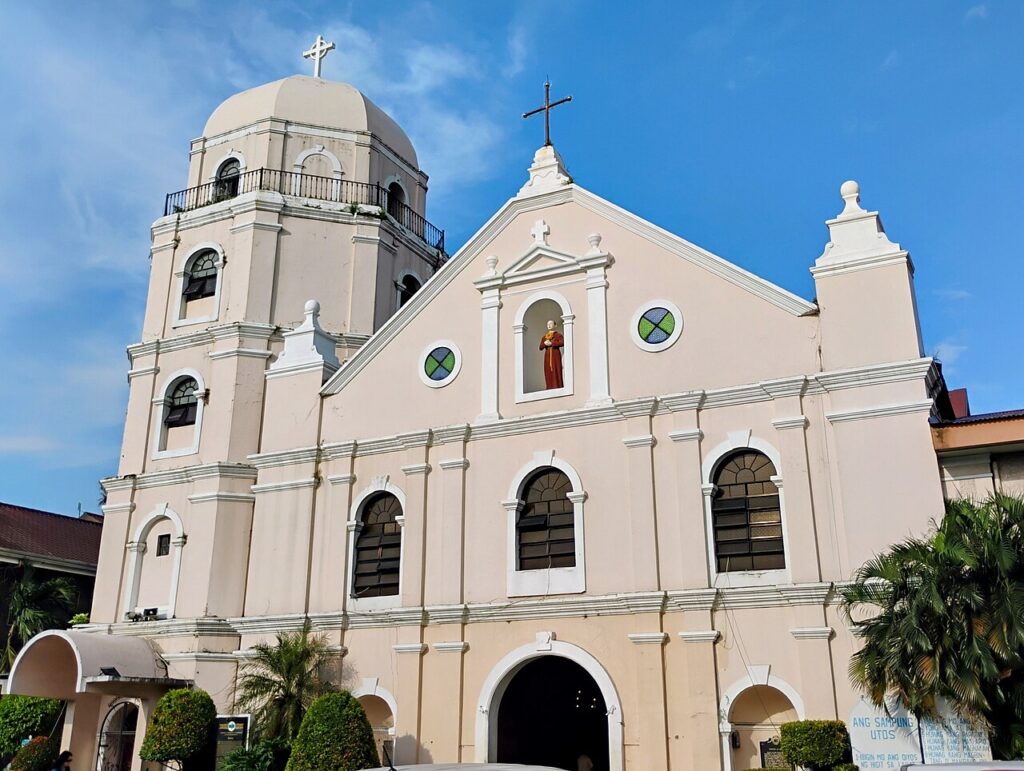
The sanctuary where it is venerated is the Church of San Pascual Baylon, parish of Obando in the diocese of Malolos. This temple, rebuilt after 1947, is one of the oldest places of Marian devotion in the area and is also known as Diocesan Sanctuary of Our Lady of the Immaculate Conception of Salambáo. It does not include in the consulted sources the title of the minor basilica or national sanctuary; it is a diocesan sanctuary, a regional pilgrimage centre very linked to the May festivities and the procedural dances of the faithful.
Sponsorship and coronation
Under the title of Our Lady of Salambáothe Virgin Mary is recognized as patron of Bulacan fishermen, linking the invocation in a special way with those living from fishing and with the coastal communities of the region. In the local context, the advocation forms part, together with San Pascual Baylón and Santa Clara, of the devotions that accompany the religious and festive life of the municipality of Obando.
As for the coronation, consta una Episcopal coronation of the image the 12 December 2004. The source mentions the fact as coronation by episcopal authority, but does not specify the name of the pontiff who had granted a possible canonical coronation or details the corresponding pontifical decree; therefore, according to the available data, it is indicated that it is a coronation Bishopsand beyond it does not contain a documented canonical coronation in the sources consulted.
Party and devotion
The main feast of Our Lady of Salambáo is celebrated 19 May, last day of the triduum May 17-19 in honor of the three saints of Obando: St. Pascual Baylon (May 17), St. Clare of Assisi (May 18) and Our Lady of Salambáo (May 19). During these days the famous take place Obando fertility rites (Obando Fertility Rites), which combine masses, processions and ritual dances, especially the Fandango, executed by the devotees as a plea for the gift of children, as well as for success in fishing and crops.
The celebrations take place around the parish church of San Pascual Baylon, Diocesan Sanctuary of Our Lady of the Immaculate Conception of Salambáo, which becomes a popular pilgrimage center during these days. The faithful participate in processions in which a industrial replica of the Virgin, adorned with her own salt, is carried on the streets on the third day of the holiday, accompanied by traditional dances and songs. The sources mention the popularity of these rites, known in the Philippines and beyond, although there are no exact figures of influx; however, there is a remarkable influence of pilgrims and devotees, including marriages that come to ask for the gift of fertility or to thank it.
Link to the Rosary
The specific sources about Our Lady of Salambáo do not mention a particular or exclusive link with the Rosary prayer (for example, own rosarian copradies or parties explicitly associated with the Rosary). There is, therefore, no differentiated relationship between this advocation and the Rosary beyond the general Marian practice of the Church.
However, in the context of the Philippine Catholic piety, the Rosary It occupies a central place in devotional life and usually accompanies Marian parties, novena and processions. In the spirituality of Our Lady of Salambáo, focused on the demand for fertility, sustenance and protection over the fishermen, the prayer of the Rosary is naturally harmonized with this devotion: the contemplation of the mysteries of Christ's life with Mary strengthens trust in Providence and supports the persevering prayer of families who come to Obando to ask or thank the children's gift, the maintenance of work and peace at home. Although no specific rosarian link is documented, the Rosary is presented as well as a privileged way to accompany the intercession of Our Lady of Salambáo and to insert local piety into the great Marian tradition of the Church.
A flower for the Virgin
Offer a simple prayer to this Marian devotion. Pray a Hail Mary for the Philippines and for world peace.
Pray Hail MaryIs the advocation of the Virgin Mary of your people missing?
Si no encuentras la advocación mariana de tu ciudad o pueblo, cuéntanosla: la investigaremos para ubicarla y darla a conocer en este mapa del amor de la Madre por el mundo.
Propose an apvocation →