
Marian devotion
Our Lady of Graces of Sardhana
Marian Advocation of Sardhana (Meerut) (Uttar Pradesh)
La devoción a Our Lady of Graces of Sardhana is linked to the history of Christianity in northern India and, in particular, to the figure of the famous Begum Samru (also known as Joanna Nobilis Snoma), Catholic princess and ruler of Sardhana in the 19th century. According to historical documentation, Begum Samru became a Catholic in 1781 and, as a Christian, he promoted the construction of a great Marian temple in its capital, which became one of the main Catholic centers in northern India.
Main data
Origin and history
La devoción a Our Lady of Graces of Sardhana is linked to the history of Christianity in northern India and, in particular, to the figure of the famous Begum Samru (also known as Joanna Nobilis Snoma), Catholic princess and ruler of Sardhana in the 19th century. According to historical documentation, Begum Samru became a Catholic in 1781 and, as a Christian, he promoted the construction of a great Marian temple in its capital, which became one of the main Catholic centers in northern India.
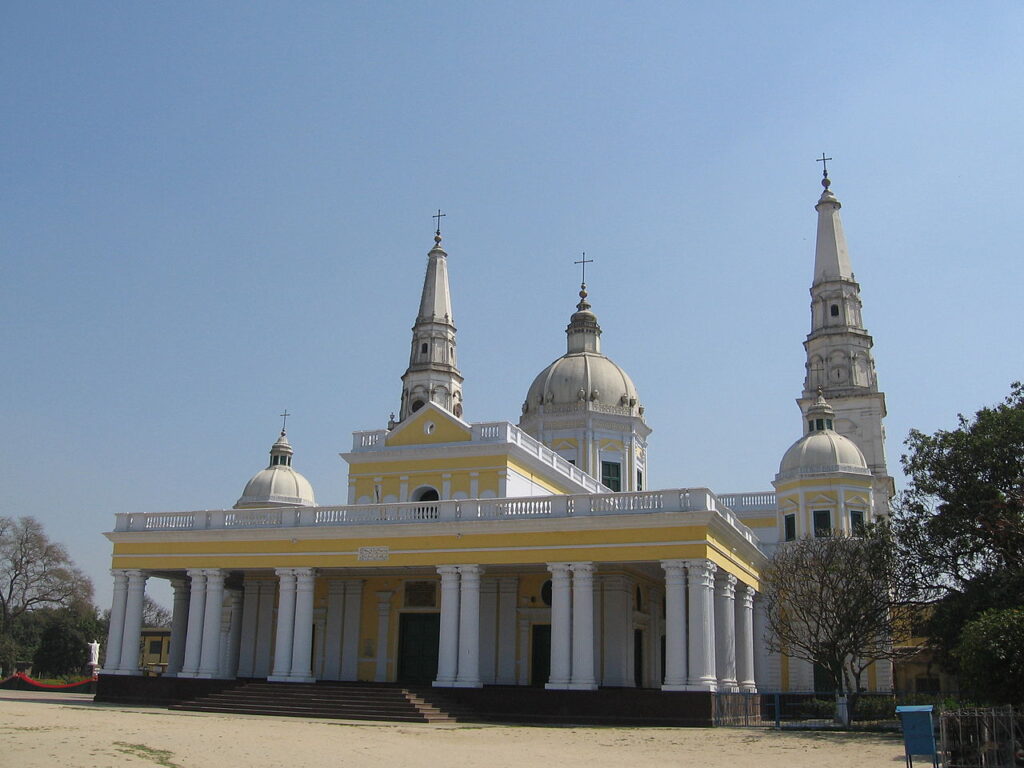
Historical studies indicate that the church of Sardhana was built between 1809 y 1822under the direction of the Italian architect Antonio Reghelliniat the expense of the Begum, as a thanksgiving and a visible sign of the Catholic faith in its principality. It is not a sanctuary originating in a concrete apparition or miracle, but a great parish and pilgrimage temple, where the Virgin is venerated under the title of Our Lady of Graces / Our Lady of Graces, within the Latin rite.
No firmly documented traditions on foundational legends (apparitions, initial wonders) comparable to other Marian advocacy are preserved; the available sources describe rather a devotion historical, linked to the sponsorship of the Begum and the growth of the Church in the region of Meerut. In this case, the documented history about the legendary tradition.
The image and the sanctuary
The temple holder is venerated under the advocation Our Lady of Graces; sources describe a Marian image of European stylein the context of a church designed with clear influence Neoclassical and late baroquebut they do not provide a detailed technical description (material, author, exact date of the image or specific iconographic features). Consequently, no consta with precision, in accessible sources, the type of size (wood, marble or other material) nor a unique iconography that distinguishes it from other classical representations of the Virgin with Western features.
The sanctuary is the Basilica of Our Lady of Graces en Sardhana, near Seaweedin the state of The Pradesh (India), belonging to the Iglesia católica latina. The temple is famous for its style architecture European, with monumental plant, central dome and classical elements (front, columns, large ship), which has been considered one of the largest and most notable Catholic temples in northern India. The church was elevated to the dignity of minor basilica, recognition that underlines its historical and devotional importance within the Church in India.
The funeral monument and the tomb of Begum Samru, which increases the historical interest of the place and makes it a meeting point between local history, colonial art and Marian devotion.
Sponsorship and coronation
The Basilica of Our Lady of Graces of Sardhana is an important Marian center for the region of Seaweed and for Catholics in northern India, but the sources consulted do not point to a Specific canonical patronage (e.g., formal patron of the diocese or of a city, proclaimed by decree). In practice, devotion to the Virgin of Graces in Sardhana exercises a spiritual patronage over the local community and over many faithful who come from various areas of Uttar Pradesh and neighbouring states.
In relation to a canonical coronation of the image (by the Pontifical Decree or by the Congregation for the Divine Worship and Discipline of the Sacraments), the available sources do not record an officially recognized coronation ceremony. Therefore, according to the accessible information: does not contain a documented canonical coronation.
Party and devotion
The devotion to Our Lady of Graces in Sardhana is particularly expressed in a great annual celebration that brings together many pilgrims in the basilica. However, easily accessible sources do not provide an unequivocal and commonly accepted data on a litúrgical fecha propia for the feast of Our Lady of Graces of Sardhana other than the general Marian memories of the Roman calendar. That is why, as regards a specific party with exact date, is not certain in the documents consulted.
The Basilica is described as a place of very busy Marian pilgrimageespecially in the great Marian festivities and in diocesan celebrations, receiving faithful from Sardhana, Meerut and large areas of northern India. Devotion is characterized by participation in the Holy Mass, Marian processions, prayers of supplication and thanksgiving to the Virgin under the title of Graces, and for a strong sense of Catholic identity linked to the memory of Begum Samru and the historical character of the temple. Specific annual inflow data (precise figures) no constan in the sources consulted.
Link to the Rosary
The specific sources about Our Lady of Graces of Sardhana do not mention a or exclusive relationship of this advocation with the prayer of Rosary (e.g., apparitions linked to the Rosary or explicit impositions of this prayer). Consequently, no consta a unique historical link between this advocation and the Rosary similar to that of other Marian shrines.
However, as in most Marian shrines of the Latin rite, the Rosary It is an ordinary part of the piety of the faithful who come to the basilica: it is one of the privileged ways of meditating on the mysteries of Christ from the hand of Mary, of asking for spiritual and temporal "graces," and of supporting Christian life in contexts where Catholics are a minority. In a sanctuary dedicated to Our Lady of GracesThe Rosary takes on a tone particularly in line with the title of the advocation: in reciting it, the faithful contemplate the mysteries of salvation as they beg, through Mary's intercession, for the necessary graces for the faith, family and mission of the Church in India.
A flower for the Virgin
It offers a simple prayer to this advocation. Pray a Hail Mary for India and for world peace.
Pray Hail MaryIs the advocation of the Virgin Mary of your people missing?
Si no encuentras la advocación mariana de tu ciudad o pueblo, cuéntanosla: la investigaremos para ubicarla y darla a conocer en este mapa del amor de la Madre por el mundo.
Propose an apvocation →