
Marian devotion
Our Lady of Šiluva
Marian Advocation of Šiluva (Samogitia)
According to the traditionthe Marian devotion in Šiluva dates back to the 15th century, when 1457 the Lithuanian noble Petras (Peter) Gedgaudas, diplomat at the service of Vytautas the Great, donated land to raise a church in honor of the Virgin Mary and brought from Rome a painting of the Virgin with the Child to place it in the new temple. For generations, the faithful went there to honor God and his Mother, until wars and the expansion of Calvinism in the region led to the decline of Catholic worship and the disappearance of the original painting.
Main data
Origin and history
According to the traditionthe Marian devotion in Šiluva dates back to the 15th century, when 1457 the Lithuanian noble Petras (Peter) Gedgaudas, diplomat at the service of Vytautas the Great, donated land to raise a church in honor of the Virgin Mary and brought from Rome a painting of the Virgin with the Child to place it in the new temple. For generations, the faithful went there to honor God and his Mother, until wars and the expansion of Calvinism in the region led to the decline of Catholic worship and the disappearance of the original painting.
La aparición de 1608 It belongs to the field of the pious tradition collected in writing decades later. The oldest witness that is preserved is of 1651: He says that in the summer of 1608, some shepherds, near a large rock in the vicinity of Šiluva, saw a young woman sitting on the stone with a Child in her arms, crying sadly. When he asked why he was crying, he would have responded - according to the traditional story - that he was crying "because in this place my Son was once venerated, but now he is not." This experience, repeated and confirmed by other neighbours, led to research, the recovery of the titles of property of the former church and the restoration of the Catholic cult in the place.
In the plan of the documented historythe existence of a Marian sanctuary in Šiluva since the 15th century, the spread of its fame as a place of pilgrimage, the passage from the area to the Calvinist predominance by 1532, and the subsequent Catholic recovery in the early 17th century. It is documented that a chapel was built on the stone of the apparition and, about 200 metres away, a new church was erected on the site of the ancient 15th century sanctuary. Devotion was officially recognized when the Pope Pío VI approved the worship of Our Lady of Šiluva and the miraculous character of her image by a decree of 17 August 1775after an ecclesiastical investigation into the graces attributed to this sanctuary.
The image and the sanctuary
The image currently venerated is a Mary's icon with the Child Jesus who presides over the main altar of the basilica. For centuries it was considered a relic from the 15th century church, hidden in a chest together with documents and rediscovered at the place of apparition; however, recent studies indicate that it was probably painted by a local artist in the first half of the 17th century, therefore after of the apparition. It is made of oil on canvas and is a Copy from Salus Populi Romani, the famous Marian icon of the Basilica of Santa Maria la Mayor in Rome. She represents the Mother of God with the Child in her arms: Mary, with a serious and majestic bearing, looks to the faithful to lead her to her Son, while the Child looks at her Mother and blesses with her right hand.
The table is covered by a metal dress of silver and gold that leaves visible only the faces and hands of Mary and Jesus. This coating was made in 1674 from exvotes that the pilgrims left in the sanctuary as thanksgiving for the graces received. Over time, the image was consolidated as "miraculous image" of Šiluva.
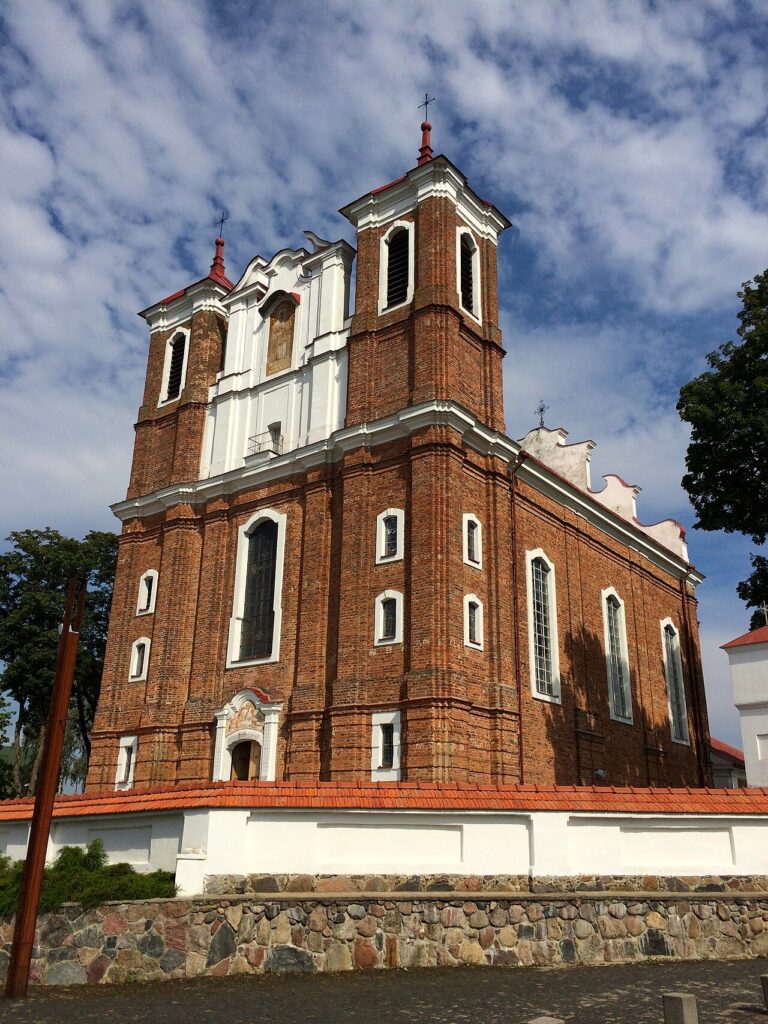
The main sanctuary is the Basilica of the Nativity of the Blessed Virgin Mary in Šiluva, Lithuania, where the icon is kept. The present temple was built in the middle of the 18th centuryin style late baroquewith the outer walls of red brick and a rich interior iconography that intertwines the themes of the Mother of God, Christ and the Church. The Pope Pablo VI raised this church to the dignity of minor basilica, thus recognizing the importance of the sanctuary within the Marian life of Lithuania. In addition to the basilica, there is a chapel on the rock of the apparitionwho keeps the memory of the place where, according to tradition, the Virgin manifested herself.
Sponsorship and coronation
Our Lady of Šiluva is considered a great Marian national sanctuary of Lithuaniaand is especially venerated as a patron of the Siluva. Several Catholic sources present it as an advocation of great importance to the Lithuanian people, in line with the title "Terra Mariana" (Land of Mary) with which Pope Pius XI appointed Lithuania for its particular Marian devotion.
As for the canonical coronation, it is clear that the Pope Pío VIby decree de 17 August 1775, officially recognized the authenticity of devotion to the Virgin of Šiluva and granted permission to coronar solemnly the image of Mary and the Child Jesus. After various preparations, the coronation was held 8 September 1786the feast of the sanctuary, at the disposal of the bishop of the place. It is therefore a documented canonical coronation, confirmed by a pontifical decree.
Party and devotion
La main party of Our Lady of Šiluva is celebrated the September 8the day of the Nativity of the Virgin Mary, which is also the titular feast of the Basilica. The traditional ones are developed around this date parties of Šilinėsone of Lithuania's most important pilgrimages, which bring together many faithful from various regions of the country and from the Lithuanian diaspora.
Devotion clearly presents features Penitential and Eucharistic: The Virgin appears weeping for the abandonment of the worship of Christ, which has been interpreted as a call to fidelity to the Church, to the Eucharist and to the unity of Christians, especially in a context of conflict with Protestantism. Many exvotes, which already in the 17th century served to make the silver dress of the image, express the gratitude of the pilgrims for spiritual and physical favors received, in particular related to the health of the sick. Today the sanctuary remains the destination of diocesan and national pilgrimages, with the prominent participation of bishops, priests and religious communities, who come to celebrate novies, confessions and Marian processions.
Link to the Rosary
The sources consulted on Our Lady of Šiluva do not mention a specific link to history between this advocation and a particular revelation or practice of the prayer of the Rosary (as is the case, for example, in Fatima). It is not clear that the Virgin, in the tradition of Šiluva, has explicitly requested the prayer of the Rosary, nor that devotion to the Rosary is a unique distinguishing feature of the sanctuary.
However, as in most Marian shrines recognized by the Church, the Rosary It is an essential part of the spiritual life of pilgrims: it accompanies processions, vigil and prayer before the miraculous icon, helping to contemplate the mysteries of Christ's life precisely in the place where Mary wept for the abandonment of the worship of her Son. In this way, the Rosary is presented as a path of conversion, return to the Eucharist and intercession for the sick and for the unity of Christians, in full harmony with the spiritual message associated with Our Lady of Šiluva.
A flower for the Virgin
It offers a simple prayer to this advocation. Pray a Hail Mary for Lithuania and for the peace of the world.
Pray Hail MaryIs the advocation of the Virgin Mary of your people missing?
Si no encuentras la advocación mariana de tu ciudad o pueblo, cuéntanosla: la investigaremos para ubicarla y darla a conocer en este mapa del amor de la Madre por el mundo.
Propose an apvocation →